
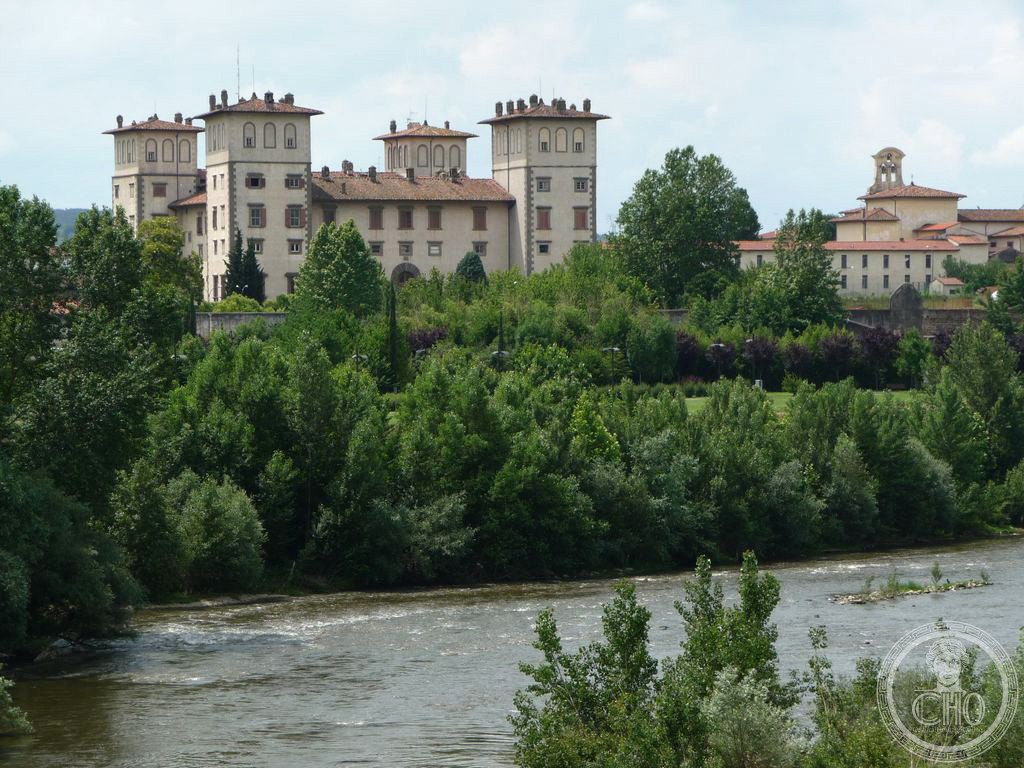
Where the Arno and the Pesa meet, Buontalenti designed for Ferdinando I a plan with four corner towers that turns a hunting residence into a symbolic fortress — today the seat of a judicial psychiatric hospital.
At a glance
Villa Medicea dell’Ambrogiana stands at the confluence of the Arno and the Pesa rivers near Montelupo Fiorentino, 25 km south-west of Florence. Built between 1587 and 1594 by Bernardo Buontalenti for Grand Duke Ferdinando I de’ Medici, it is the most fortress-like of the Medici villas: a square block with four massive circular corner towers, whose silhouette reads — from across the river — as a bastioned fortification rather than a country house. The villa served as a base for the Medici’s hunting expeditions in the Valdarno marshes and river bottoms, with quick access to the river for both hunting and movement by boat. After the Medici dynasty ended in 1737, the building was converted by the Lorraine grand dukes into a judicial psychiatric hospital — a use it retains, making it the only major Medici villa still actively occupied as an institution. In 2013, UNESCO inscribed it as one of the twelve Medici Villas and Gardens in Tuscany (ref. 175bis).
Key facts
- UNESCO inscription: 2013, “Medici Villas and Gardens in Tuscany,” ref. 175bis
- Built: 1587–1594 by Bernardo Buontalenti for Grand Duke Ferdinando I de’ Medici
- Plan: square block with four massive circular corner towers — unique among the Medici villas in its fortress-like appearance
- Location: confluence of the Arno and Pesa rivers, Montelupo Fiorentino; strategic position for river navigation and hunting in the Valdarno marshes
- Current use: Ospedale Psichiatrico Giudiziario (OPG) — a forensic psychiatric hospital; restricted public access
- View: most impressive from across the Arno; the four towers reflect in the river at dawn and dusk
History
Ferdinando I de’ Medici came to power in 1587 after his brother Francesco I’s death — possibly poisoned, though historians debate this. Ferdinando was an energetic and pragmatic ruler who in the same year commissioned the Uffizi’s new eastern wing from Buontalenti and began the fortification of Livorno as the Medici’s new Atlantic-facing port. The Ambrogiana commission fit this pattern: a secure, strategically positioned residence that combined hunting access with the ability to monitor the river traffic on the lower Arno.
Buontalenti designed the four-tower plan in 1587 and construction was complete by about 1594. The towers are not fortifications in a strict military sense — they lack the defensive angling of a proper bastion — but they read as fortress towers, creating an image of dynastic power visible from the river. Ferdinando used the villa primarily for hunting waterfowl and river birds in the marshes that then extended along the Arno’s lower course.
After the end of the Medici dynasty in 1737, Pietro Leopoldo I of the House of Lorraine converted the villa into a poorhouse and later a hospital for the mentally ill. In the 19th century it became one of Italy’s first forensic psychiatric institutions (OPG), a use it retains today. The UNESCO inscription created some tension with the ongoing institutional use of the building, and conservation discussions have been ongoing since 2013.
What you see
The most revealing view of the Ambrogiana is from across the Arno or from the river bank opposite: a long low facade punctuated by four circular towers of considerable bulk, the whole reflected in the river water. The towers have the rounded projecting silhouette of 16th-century military architecture (compare the towers of the Fortezza da Basso in Florence), and Buontalenti’s use of them here — for a hunting villa rather than an actual fortress — is an assertion of Medici power through architectural metaphor.
Access to the interior is restricted by its current use as a forensic psychiatric facility. The exterior can be seen from the riverbank and from the bridge at Montelupo, and the facades are visible in their full extent. A small portion of the historic grounds on the river side remains accessible, and the Montelupo Fiorentino municipal museum (famous for ceramics) provides context for the villa’s place in the regional landscape.
Practical information
- Access: exterior only (no public interior access); best seen from the Arno riverbank or the Montelupo bridge
- Nearby museum: Museo della Ceramica di Montelupo Fiorentino — 10 minutes on foot; excellent collection of local Renaissance maiolica
- Best time: morning light illuminates the south facade and towers
- Time needed: 20–30 minutes for exterior viewing; 1 hour including the ceramics museum
Getting there
By train: Montelupo-Capraia station (Florence–Empoli–Pisa line), 15 minutes from Florence SMN; the villa is a 10-minute walk along the Arno. By car: Fi-Pi-Li expressway, exit Montelupo Fiorentino; the villa is on the Arno bank. GPS: 43.7347° N, 11.0678° E.
Nearby
- Museo della Ceramica di Montelupo Fiorentino — one of Italy’s best Renaissance ceramics museums, 10 minutes on foot
- Villa Medicea di Cerreto Guidi — companion Medici hunting lodge (1564) with double external ramps, 20 km north-west; UNESCO 2013
- Empoli — historic market town with a fine Baptistery Museum, 12 km west
Sources
- UNESCO World Heritage List — “Medici Villas and Gardens in Tuscany,” ref. 175bis (whc.unesco.org)
- Wikipedia — “Villa Medicea dell’Ambrogiana” (en.wikipedia.org/wiki/Villa_Medicea_dell%27Ambrogiana)
- Comune di Montelupo Fiorentino — patrimonio culturale
- Cheryl Saunders Marlow, Medici Villa Architecture in Tuscany: A Historical Survey, Florence, 2008
Find it on the map
See this place and what’s around it →📷 Become a Cultural Heritage Online photographer
Share your photos of places: they stay published under your name as the author. The more they're seen, the more you get noticed — and soon a contest will reward the most appreciated photos.
Log in or sign up free to add a photoIs this page about you?
This page is read by travellers and heritage enthusiasts who find it on Google. Tell us how you are connected to this place and we will take it from there.