
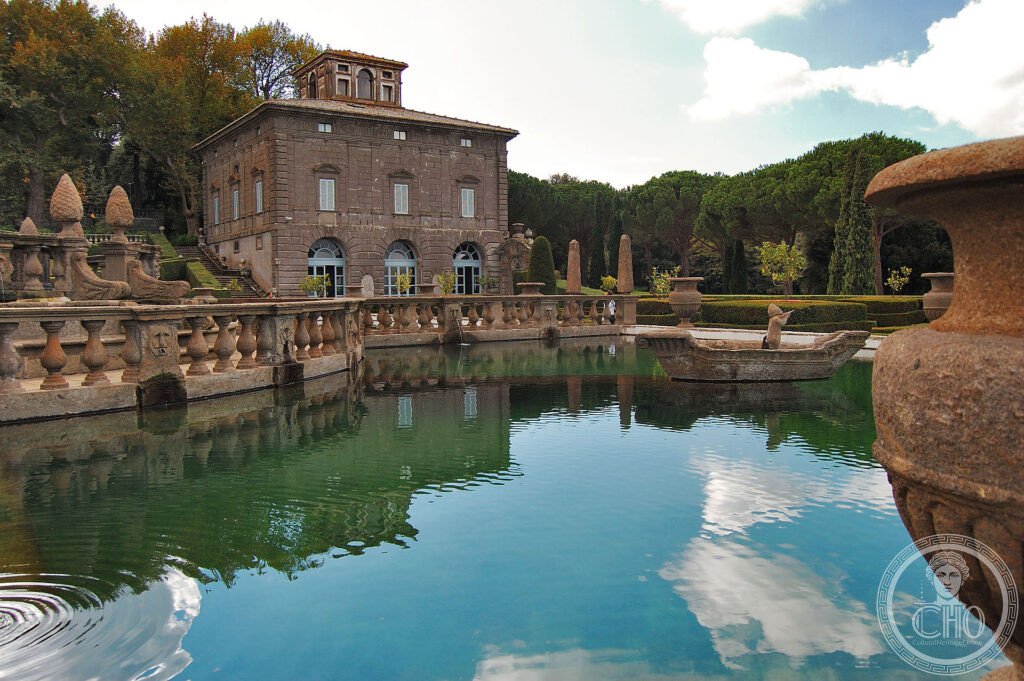
Vignola distributed the water of a natural spring into cascades, fountains and channels along a rigorous axis that descends from the wood to the flat ground — a story in stone and water of the Golden Age, from the satyrs to the Palazzo Farnese on the left.
At a glance
Villa Lante at Bagnaia, near Viterbo in northern Lazio, is widely considered the finest surviving example of an Italian Mannerist garden. Designed by Jacopo Barozzi da Vignola starting around 1568 for Cardinal Gianfrancesco Gambara, the garden occupies a slope below a medieval hunting park (barco), with the water of a natural spring distributed along a strict axial sequence from the wooded upper zone to the formal lower parterre. Two small casino buildings flank the axis — one begun by Gambara, the other completed by Cardinal Alessandro Montalto after 1587 — deliberately left separate so that the water axis itself, not a palace, becomes the narrative spine of the garden. The result is a sequence of fountain episodes that reads as an allegory of the Four Ages of Man (Gold, Silver, Bronze, Iron), from the wild spring in the wood to the geometric parterre and the town below.
Key facts
- Designer: Jacopo Barozzi da Vignola (1507–1573), starting c. 1568
- Patrons: Cardinal Gianfrancesco Gambara (begun); Cardinal Alessandro Peretti Montalto (completed, after 1587)
- Water source: natural spring in the barco above; distributed along the entire garden axis via fountains, runnels and cascades
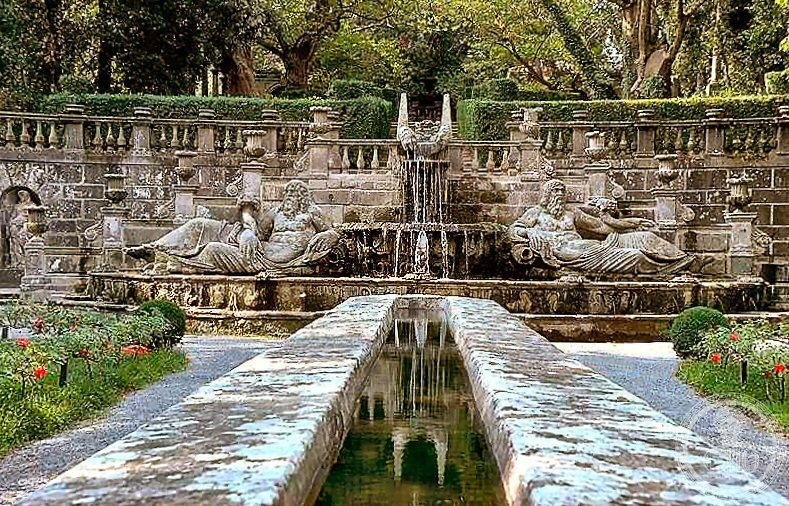
- Key features: Fontana dei Delfini, Catena d’Acqua (water-chain/river-god staircase), Fontana dei Lumini (lantern fountain), Fontana del Quadrato, Fontana dei Mori (Giambologna school)
- Two casinos: Casino Gambara and Casino Montalto — two symmetrically flanking buildings that subordinate architecture to the garden axis
- Current status: state property (Polo Museale del Lazio); open to public; entrance fee
History
Cardinal Gianfrancesco Gambara received the benefice of Bagnaia — which included a medieval hunting park — from the Bishop of Viterbo in 1568. Gambara was an ambitious patron who had already commissioned Vignola for other projects, and he immediately engaged the architect to redesign the lower portion of the park as a formal garden with a water axis. Vignola — who simultaneously produced the definitive treatise on the five orders of architecture, the Regola delli cinque ordini — conceived the garden as an allegory running from the untamed water of the wood (the Golden Age of Nature) down through progressive stages of artifice to the geometric parterre (the present age of civilisation), with the water as the continuous thread.
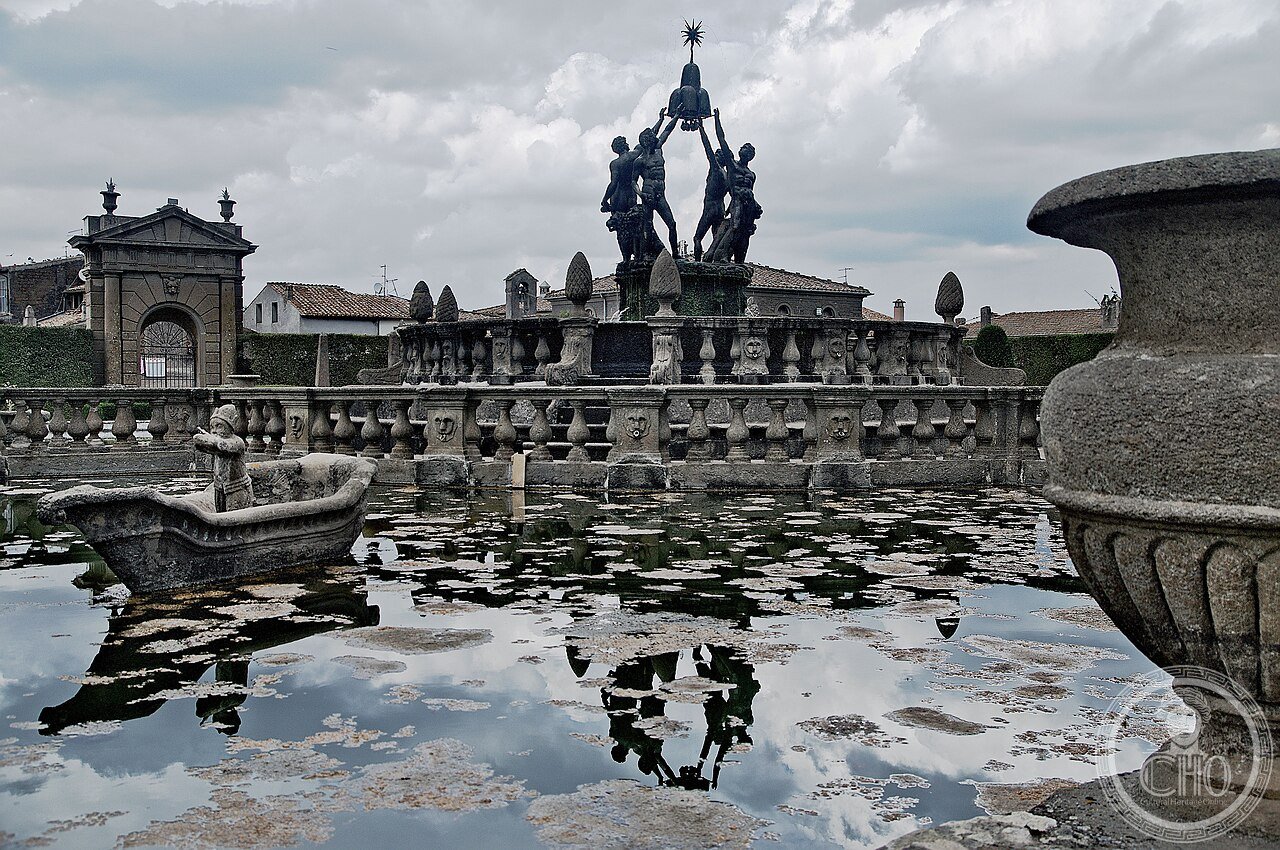
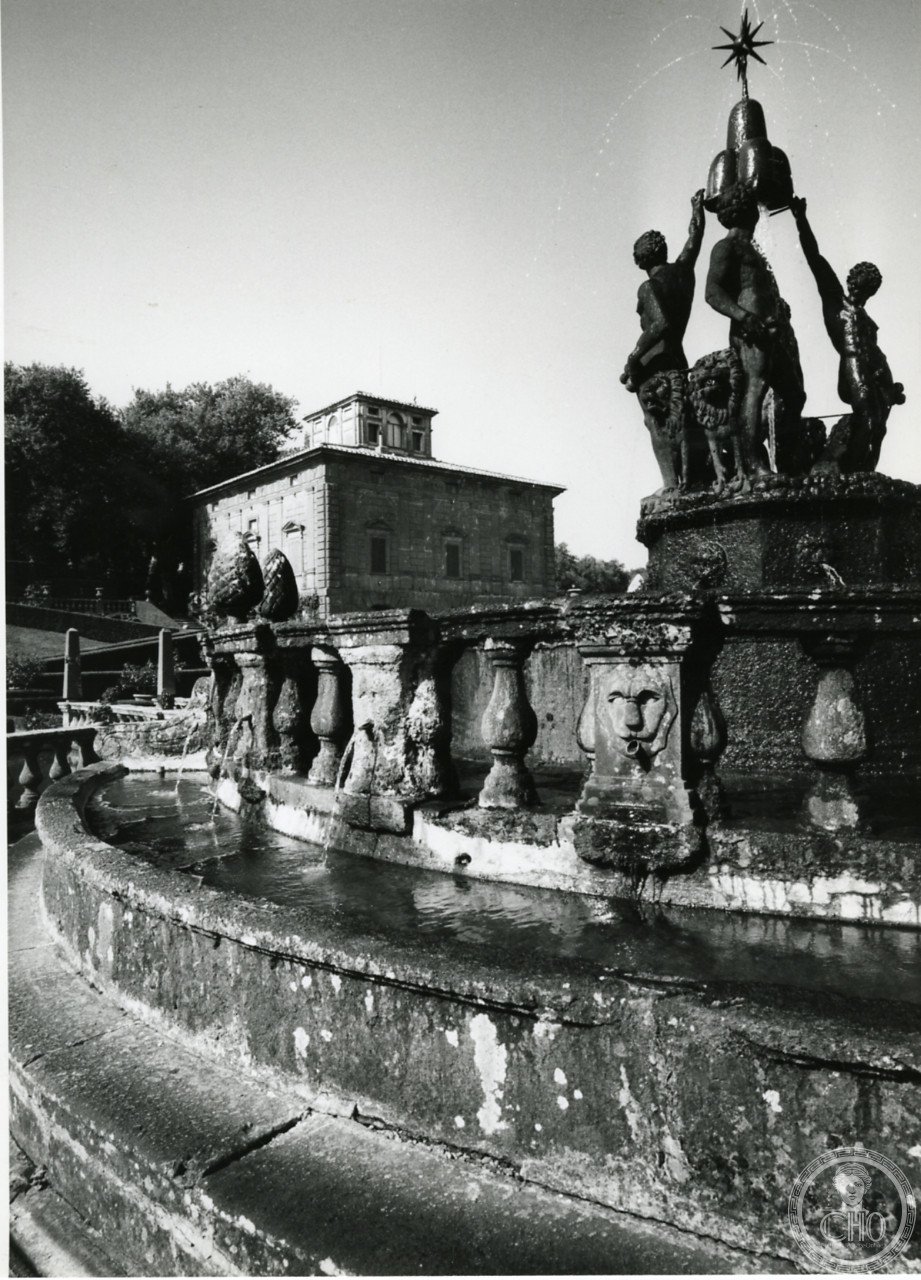
Gambara died in 1587 before the garden was complete. The second casino was built by his successor Cardinal Alessandro Peretti Montalto, and subsequent owners including the Lante della Rovere family (who gave the villa its name) maintained the garden through the 17th century. The Fontana dei Mori — four bronze Moors lifting the Montalto star — in the lower parterre is attributed to artists of the Giambologna school. The 18th and 19th centuries saw some neglect, but the garden’s hydraulic system survived intact; it was restored in the 20th century and transferred to state ownership.
What you see
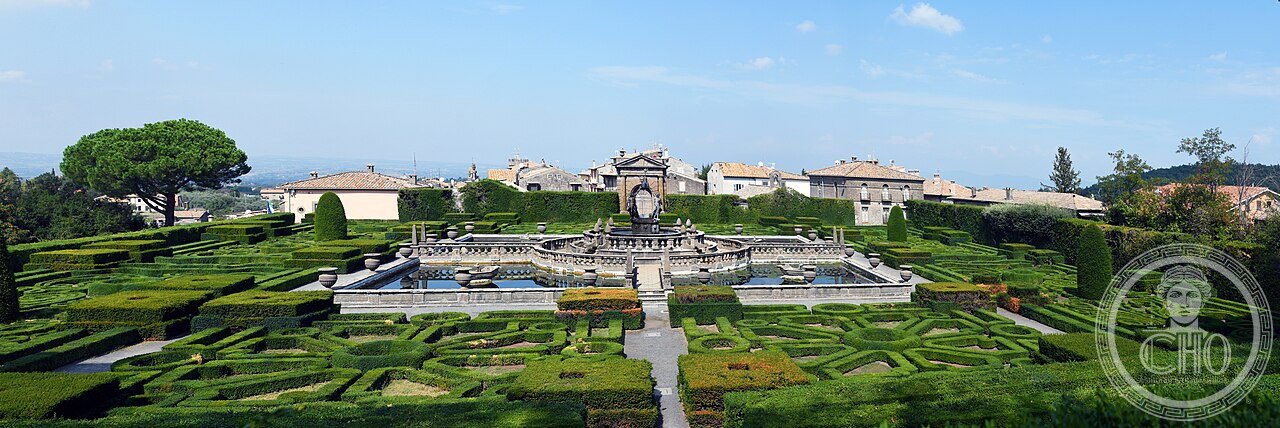
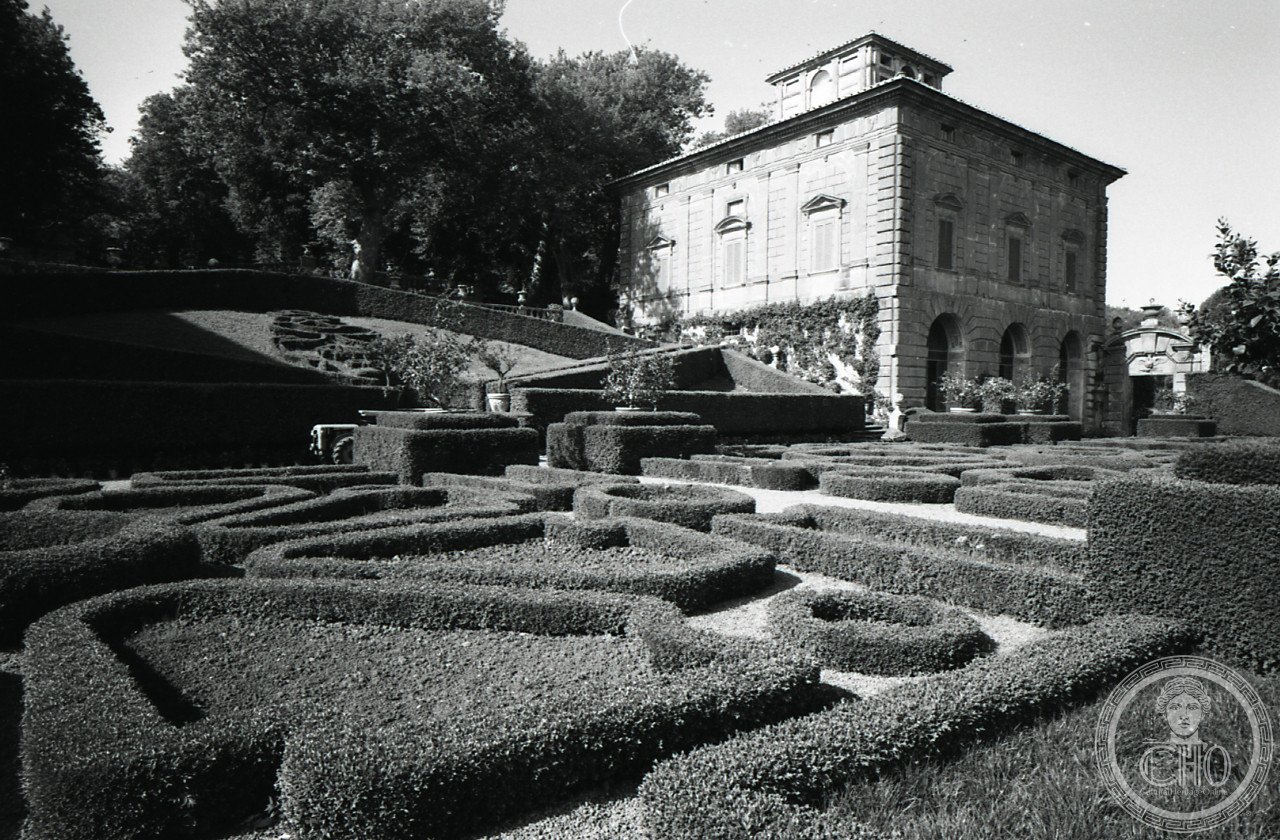
The garden unfolds from bottom to top along a single axis about 150 m long. At the base, the Fontana dei Mori in the square parterre is the most formally elaborate element: four bronze figures in a central island pool, surrounded by a grid of box-hedged parterres in geometric patterns. Ascending from the parterre, the axis passes through a sequence of fountain rooms, each slightly wilder than the last — the Fontana dei Lumini, the Catena d’Acqua (a ramp of carved stone with water flowing down the centre in a continuous rill flanked by crayfish, the Gambara heraldic animal), the Fontana del Diluvio, and finally the grotto-spring where the water emerges from the rocky hillside above the casinos.
The two casinos, flanking the axis at the middle level, are read as a pair rather than as individual buildings: their loggias face the garden, not each other, and they are deliberately left as small two-storey blocks rather than expanded into the dominant villa mass that would have crushed the garden’s priority.
Practical information
- Opening hours: Tuesday–Sunday, 08:30 to one hour before sunset (varies by season)
- Admission: moderate entrance fee; combined Lazio museum card available
- Best season: spring (April–June) for flowering box hedges and clear water in the fountains; autumn for leaf colour in the barco above
- Time needed: 1.5–2 hours for the complete garden
- Combine with: Villa Farnese di Caprarola (25 km south-east), Bomarzo Sacro Bosco (18 km north-east)
Getting there
Bagnaia is 5 km east of Viterbo. By bus from Viterbo (frequent local service); by car from Rome, A1 motorway north then SP Cassia toward Viterbo, journey 1.5 hours. From Viterbo train station, take a local bus to Bagnaia. GPS: 42.4178° N, 12.1194° E.
Nearby
- Viterbo — medieval city with Papal Palace and quartiere San Pellegrino, 5 km west
- Sacro Bosco di Bomarzo — the Monster Garden, Mannerist folly by Vicino Orsini (1552), 18 km north-east
- Villa Farnese di Caprarola — Vignola’s pentagonal villa with garden, 25 km south-east
Sources
- Wikipedia — “Villa Lante” (en.wikipedia.org/wiki/Villa_Lante)
- Claudia Lazzaro, The Italian Renaissance Garden, Yale University Press, 1990
- Polo Museale del Lazio — Villa Lante a Bagnaia (polomuseale.lazio.beniculturali.it)
- Shepherd & Jellicoe, Italian Gardens of the Renaissance, Princeton, 1993
Find it on the map
See this place and what’s around it →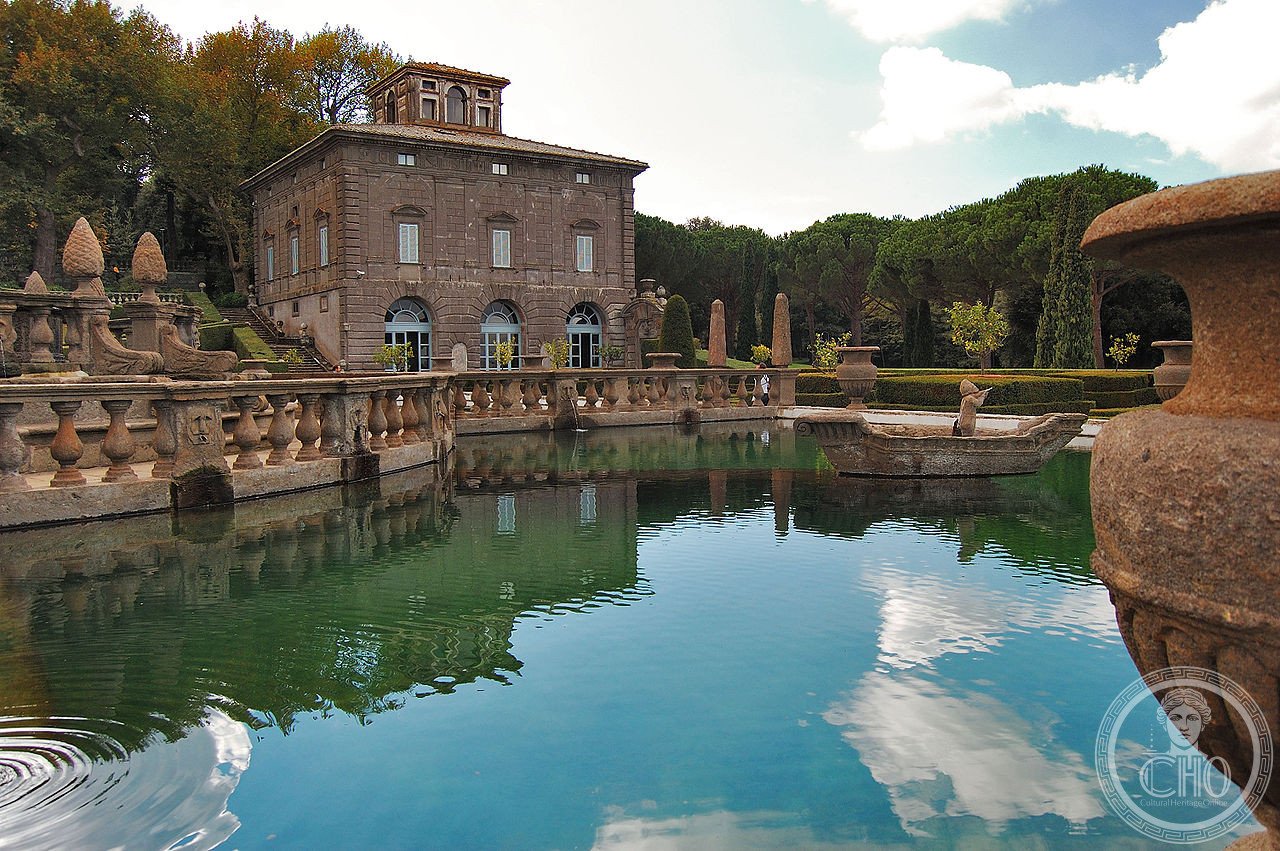
📷 Become a Cultural Heritage Online photographer
Share your photos of places: they stay published under your name as the author. The more they're seen, the more you get noticed — and soon a contest will reward the most appreciated photos.
Log in or sign up free to add a photo