
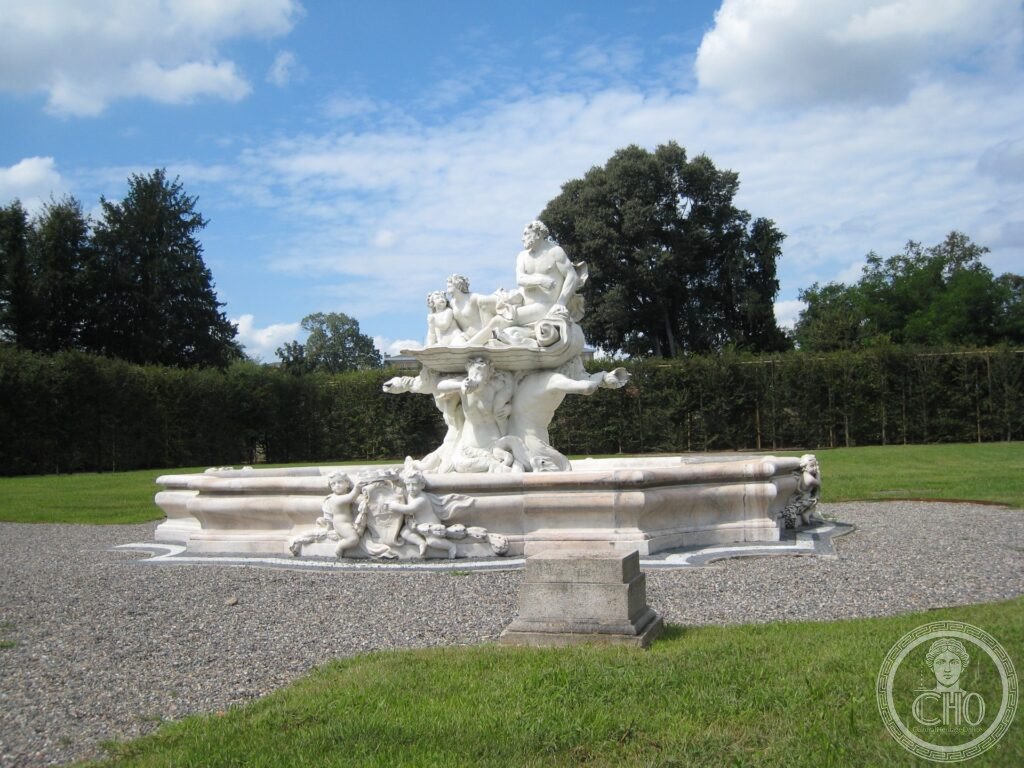
A late-Renaissance villa outside Milan whose eighteenth-century water garden features an extraordinary ninfeo — an underground grotto system that sprays water, plays music via hydraulic organs, and deploys animated figures — the most sophisticated surviving giochi d’acqua installation in Italy.
At a glance
Villa Litta was built from 1583 for Pirro I Visconti Borromeo as a summer residence outside Milan. The villa’s principal garden feature — the ninfeo, or water garden — was developed from around 1590 and extended through the seventeenth and eighteenth centuries into a complex of underground grottos, waterworks, and mechanical figures that operated on hydraulic pressure. The system was famous throughout Europe in the seventeenth century; visiting ambassadors and princes were taken here to be surprised by the jets of water concealed in the floor, the mechanical birds that sang, and the animated figures that emerged from the grotto walls. The Comune di Lainate owns the property; the FAI manages it in partnership.
Key facts
- Built: From 1583 for Pirro I Visconti Borromeo
- Ninfeo: Water garden with giochi d’acqua, developed 1590–1750
- Style: Mannerist / Baroque
- Management: Comune di Lainate + FAI partnership
- Key feature: Hydraulic organ, animated figures, floor-jet water traps
- GPS: 45.5733, 9.0019 — Google Maps
History
Pirro I Visconti Borromeo commissioned Villa Litta in 1583 as a summer residence for the Visconti family’s retreat from Milan. The initial project focused on the main block and a formal garden; the ninfeo was added from around 1590 under the direction of engineers whose names are not recorded, though the waterworks show familiarity with the hydraulic technology of the Este garden at Tivoli and the Pratolino garden near Florence — both famous for their giochi d’acqua.
The ninfeo system at its peak included fifteen rooms of grottos, an outdoor theatre with jets concealed in the floor, a hydraulic organ that played three compositions, mechanical birds in artificial trees, and a series of animated figures — a blacksmith striking an anvil, a water-breathing dragon, a figure of Neptune rising from a basin. Water was raised from a well by an ox-driven wheel and stored in a tank above the grottos; pressure from the storage height operated all the mechanisms.
The system fell progressively out of use in the nineteenth century as the Litta family’s fortunes changed. By 1900 most of the mechanisms were broken and the grottos were inaccessible. The Comune di Lainate purchased the property in 1978 and began restoration with FAI support in 1990; the hydraulic organ and some of the water jets have been restored to working order and are demonstrated during summer opening events.
What you see
The villa building itself — a U-shaped block arranged around a central courtyard — is a competent late-Renaissance design, remarkable mainly for its scale and the quality of the stucco decoration in the saloni. The garden frescoes (trompe-l’oeil loggie opening onto painted landscapes) are partially legible. But everything at Villa Litta points you toward the ninfeo: the garden descends from the villa’s rear elevation through a formal parterre to the ninfeo entrance, which appears as a low baroque gateway in the garden wall.
Inside, the grottos are cool even in August — the stone walls are coated in shell-and-pebble mosaics and artificial stalactites. The floor is set with concealed nozzles; during demonstrations, guides activate the water traps unexpectedly and visitors are splashed — exactly as seventeenth-century guests were. The hydraulic organ, which operates on the same water-pressure principle as the now-lost instrument at Pratolino, plays three pieces when demonstrated: a fragment of a villanella and two unidentified Baroque compositions found in manuscript at the villa.
Gallery
Practical information
- Opening: April–October, usually Sunday afternoons; FAI Giornate del Patrimonio events. Very limited opening hours — check FAI website before visiting.
- Admission: Variable; donation or modest fee for ninfeo demonstrations.
- Ninfeo demonstrations: Scheduled at specific times during opening days; bring a change of clothes in summer.
- Duration: 90 minutes for villa and ninfeo demonstration.
Getting there
Lainate is 18 km north-west of Milan. By car from Milan: A8 motorway direction Varese, exit Lainate, then follow signs for Villa Litta centro (20 min). No convenient rail connection; nearest station is Rho (Trenord line from Milan Porta Garibaldi, 15 min), then 8 km by taxi. Parking: in Piazza Vittorio Veneto, Lainate, 5 min walk from the villa gate.
Nearby
- Fiera di Milano (Rho-Pero) — largest exhibition centre in Italy, 10 km
- Abbazia di Morimondo — twelfth-century Cistercian abbey, 20 km south
- Villa Arconati (Castellazzo di Bollate) — Baroque villa with gardens, 8 km
Sources
- FAI – Fondo Ambiente Italiano: fondoambiente.it/luoghi/villa-litta
- Wikipedia IT: Villa Litta (Lainate)
- Attanasio, Silvia: I giardini d’acqua in Lombardia, Milan, Il Polifilo, 2001
- Zangheri, Luigi: Pratolino — il giardino delle meraviglie, Florence, 1987 (comparative)
Find it on the map
See this place and what’s around it →📷 Become a Cultural Heritage Online photographer
Share your photos of places: they stay published under your name as the author. The more they're seen, the more you get noticed — and soon a contest will reward the most appreciated photos.
Log in or sign up free to add a photoIs this page about you?
This page is read by travellers and heritage enthusiasts who find it on Google. Tell us how you are connected to this place and we will take it from there.