

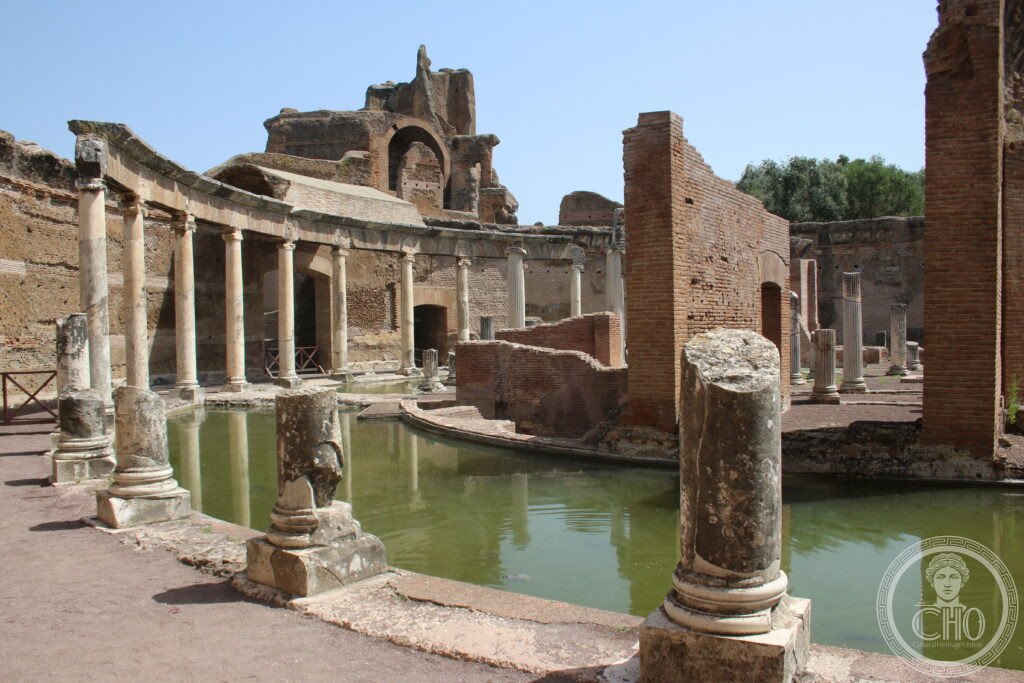
An emperor built himself a city — 120 hectares of experimental architecture below Tivoli, begun in 118 CE and continuously expanded until Hadrian’s death in 138 CE, that contains within a single imperial estate a thermal complex, a Greek theatre, a Latin theatre, a 119-metre reflecting pool modelled on the Egyptian canal at Canopus, a Platonic garden academy, libraries in both Greek and Latin, a revolving dining room, a private island retreat, and twenty-nine other separately named buildings — more architecturally diverse structures than any other single Roman site, and the most complete surviving picture of what an emperor with unlimited resources and genuine architectural curiosity could build in twenty years.
At a glance
Villa Adriana (Hadrian’s Villa) is a large Roman imperial villa complex at the foot of the Tiburtine hills near Tivoli (ancient Tibur), 28 km east of Rome, built by the Emperor Hadrian (r. 117-138 CE) beginning in 118 CE and continuously expanded until his death in 138 CE. The complex covers approximately 120 hectares (of which 40 hectares is the excavated and accessible archaeological site) and contains the remains of over 30 named structures: palaces, baths, libraries, gardens, theatres, and hydraulic works. It was inscribed on the UNESCO World Heritage List in 1999 (ref. 907) together with the Villa d’Este at Tivoli.
Key facts
- Construction: 118-138 CE; the principal construction phase was 118-125 CE (after Hadrian’s first provincial tour, 121-125 CE, which took him to Britain, Germany, the Danubian frontier, Greece, and Asia Minor); some structures were added after his return from Egypt in 130-131 CE
- Extent: 120 hectares total estate; approximately 40 hectares excavated; the accessible archaeological area covers approximately 20 hectares
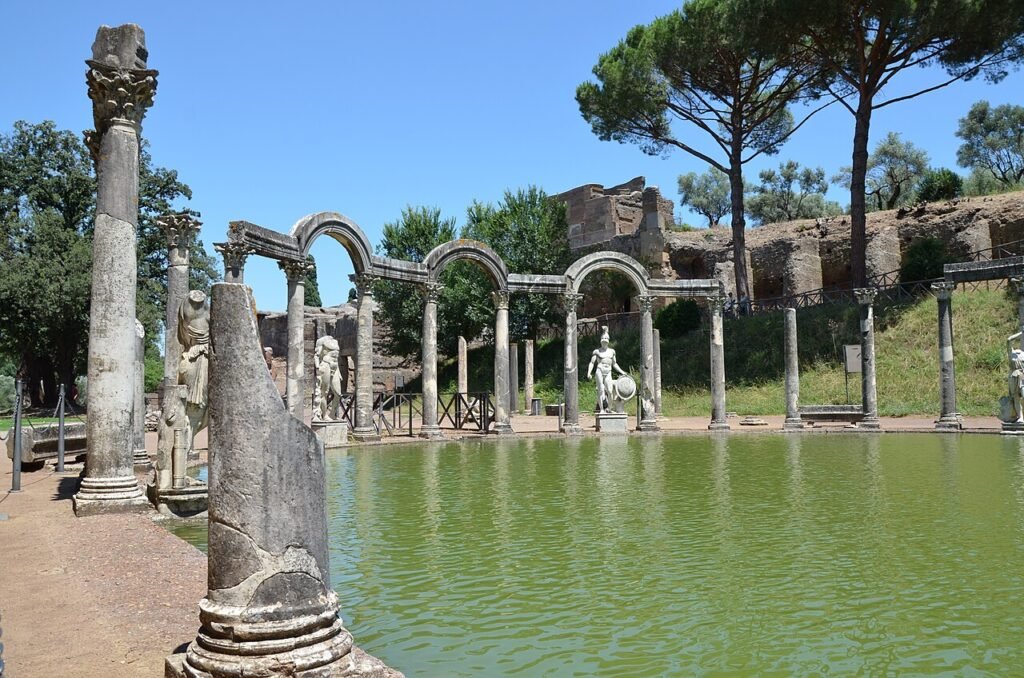
- Named structures (selected): Pecile (a rectangular pool 232 × 97 m, modelled on the Painted Stoa at Athens); Canopus (a 119 m reflecting pool with a canal, modelled on the Egyptian canal at Canopus near Alexandria; built after Hadrian’s visit to Egypt in 130-131 CE and likely connected to the memory of the drowned Antinous); the island villa (Teatro Marittimo: a circular island surrounded by a moat, with a private apartment accessible only by moveable bridges — Hadrian’s private retreat); Piazza d’Oro (a large colonnaded garden with an octagonal room); three sets of thermal baths (Terme Grandi, Terme Piccole, Terme con Heliocaminus); two libraries (Greek and Latin); a Serapeum
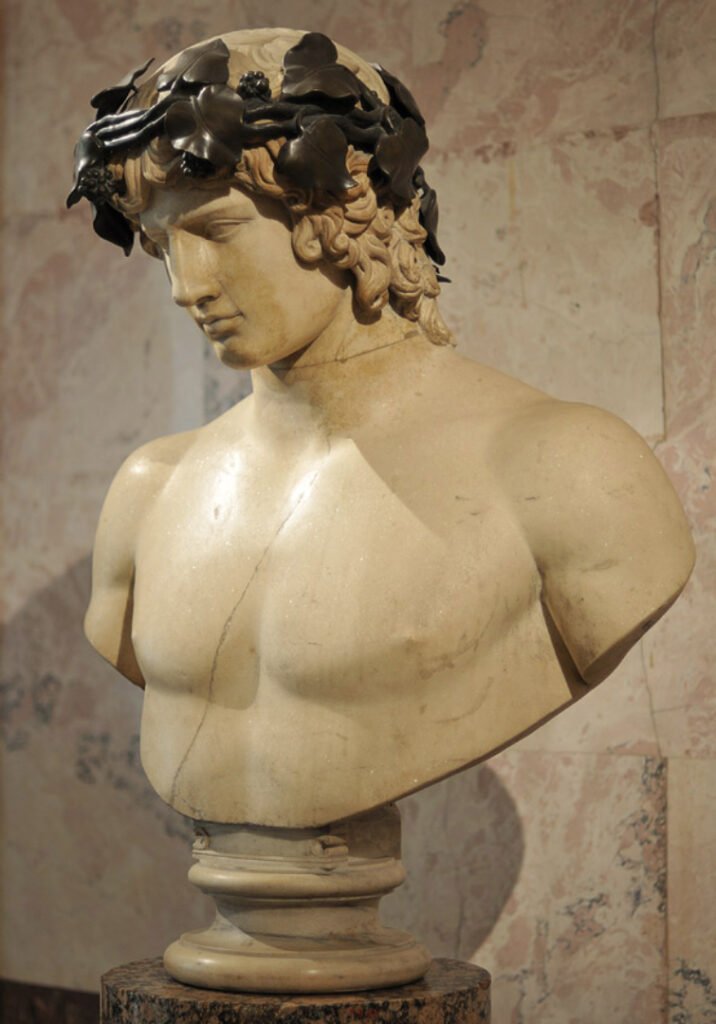
- Sculptural programme: The villa contained one of the largest sculptural collections in antiquity; most sculptures were removed in the Renaissance and are now in the Vatican Museums, Capitoline Museums, British Museum, and Louvre; the Capitoline Antinous (Vatican) and the Tivoli Amazon (Vatican) came from this site
- UNESCO: 1999, ref. 907 — “Villa Adriana (Tivoli)” (listed separately from the Villa d’Este)
- GPS: 41.9426, 12.7750 — Google Maps
History
Hadrian is unusual among Roman emperors in being an architect-emperor — he is credited (though the attribution is disputed) with the design of the Pantheon in Rome (rebuilt 118-125 CE), and his building programme at Tivoli shows a consistent architectural curiosity about non-Roman spatial and constructive ideas. The named buildings at Villa Adriana include explicit references to buildings and landscapes Hadrian had visited during his extensive provincial tours (121-125 CE and 128-131 CE): the Canopus references Egypt; the Pecile references Greece; the Serapeum references the cult of Serapis from Alexandria; the Academy references Plato’s Athenian grove. The villa is thus simultaneously a personal memory palace of an emperor who travelled more extensively than any of his predecessors and a laboratory of architectural ideas drawn from across the empire.
After Hadrian’s death in 138 CE, the villa was maintained as an imperial property under the Antonine and Severan dynasties; by the third century CE it was largely abandoned, and by the fourth century CE its lead pipes and marble revetments were being stripped for reuse. The systematic looting of sculptures began in the Renaissance (from approximately 1450 CE); by 1500 the major collections of Rome (the Farnese, the Este, the Mattei) had all acquired sculptures from Tivoli. The first systematic archaeological excavations began in the eighteenth century under the Marchese Alessandro Gregori Marcello; the site was purchased by the Italian state in 1870 and has been under systematic excavation since 1948.
What you see
The itinerary through Villa Adriana is approximately 3-4 km in total; most visitors follow the anti-clockwise route from the main entrance (west side, near the Pecile) to the Canopus (south-east) and back. The Pecile is the first major structure encountered: a large rectangular basin (232 × 97 m) surrounded by porticoes on three sides, with a cryptoporticus (underground covered gallery) running beneath the north portico. The scale is immediately apparent — the Pecile alone is larger than most archaeological sites in Italy.
The Canopus is the most visually complete structure in the complex: a 119-metre reflecting pool in the shape of an elongated oval, lined with alternating columns and caryatids (copies of the originals, which are in the on-site museum), with an apse at the southern end (the Serapeum, a dining room in the form of a semi-dome) and the original crocodile sculptures visible at the water’s edge. The reflection of the colonnade in the still water — a deliberate design effect — is the most photographed image in the site.
Gallery
Practical information
- Opening: Daily 9:00 to 1 hour before sunset (approximately 17:00 in winter, 19:30 in summer). Last entry 1 hour before closing.
- Admission: ~€8 (MIC standard ticket); free with Cultura Card / ICOM; first Sunday of the month free for EU residents. The on-site Antiquarium (museum with original sculptures and models) is included in the ticket.
- Duration: 2.5-3.5 hours for a full visit of the accessible area. The site is large and the terrain is uneven; comfortable shoes essential. Bring water (summer temperatures exceed 38°C).
- Model: A large architectural model of the complete complex (at 1:100 scale) is displayed near the entrance and is essential for orienting the ruins; plan 10 minutes here before starting the itinerary.
Getting there
Via di Villa Adriana, Tivoli (Roma), Lazio. By bus: the COTRAL bus Roma (Ponte Mammolo metro station, Line B) to Tivoli runs every 30-45 min (journey 1h); from Tivoli bus station, take local CAT bus line 4 to Villa Adriana (20 min); or taxi from Tivoli centre (~€10). By car: from Rome, 28 km east via Via Tiburtina (SS5); or via A24 (exit Tivoli Ovest) plus 4 km south; car park on site (€3). From Roma Termini by train (Trenitalia to Tivoli, 40-50 min) then taxi or local bus.
Nearby
- Villa d’Este, Tivoli — 5 km north; UNESCO 1999 (same site as Villa Adriana); a sixteenth-century terraced garden (1560-1572, Cardinal Ippolito II d’Este, architect Pirro Ligorio) built on a steep hillside with 500 fountains, water organs, a hundred cascades, and the Fontana dell’Ovato (the centrepiece, a large oval fountain with nymphs and horses); the scale of the hydraulic engineering is without parallel in any other Renaissance garden
- Santuario di Ercole Vincitore, Tivoli — 2 km north; a late Republican sanctuary (II-I century BCE) dedicated to the cult of Hercules; the largest sanctuary in Lazio after Palestrina; a vast terraced complex with a theatre and a portico now partly hidden under the industrial Tiburtino district
- Castelli Romani — 30 km west; the volcanic hill towns south-east of Rome (Frascati, Castel Gandolfo, Ariccia, Genzano) connected by the Via dei Castelli panoramica; Castel Gandolfo is the papal summer residence on the edge of the Lago Albano
More photographs
Sources
- UNESCO: whc.unesco.org/en/list/907
- Wikipedia EN: Hadrian’s Villa
- MacDonald, William L. & Pinto, John A.: Hadrian’s Villa and Its Legacy, Yale University Press, 1995
- Ministero della Cultura — Villa Adriana: villadriana.beniculturali.it
Find it on the map
See this place and what’s around it →📷 Become a Cultural Heritage Online photographer
Share your photos of places: they stay published under your name as the author. The more they're seen, the more you get noticed — and soon a contest will reward the most appreciated photos.
Log in or sign up free to add a photo