
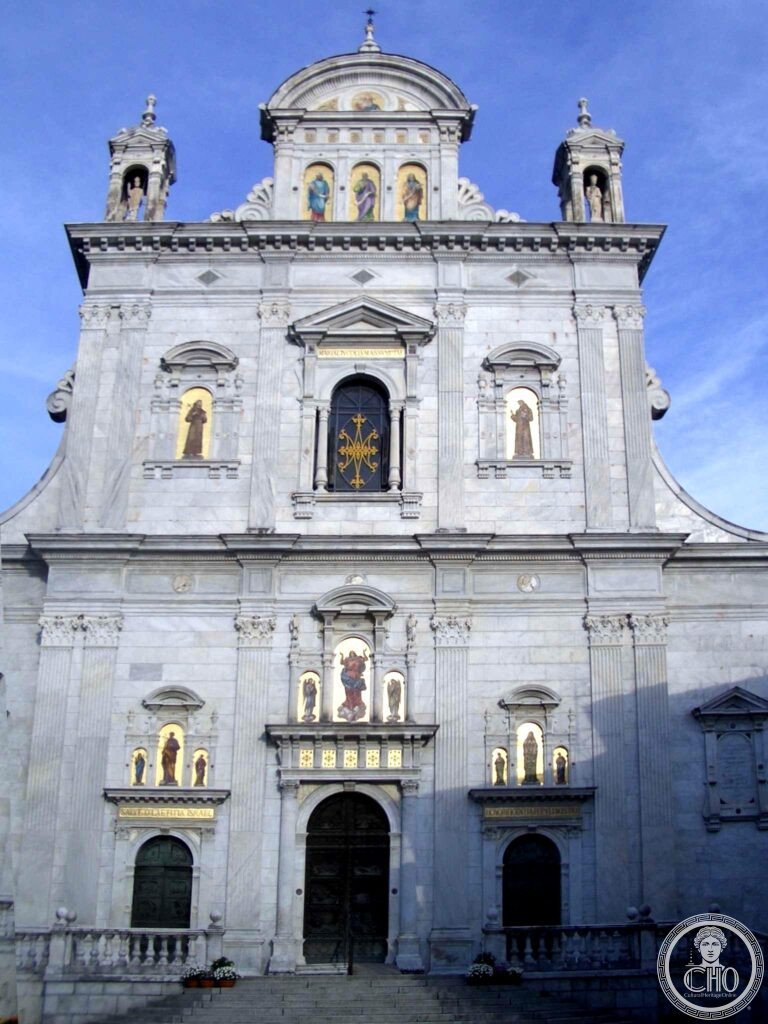
In 1491 a Franciscan friar, Bernardino Caimi (who had lived in Jerusalem for several years), obtained permission to build on a rocky hillside above Varallo in the Valsesia a replica of the holy sites of Jerusalem for those who could not make the pilgrimage — and in doing so initiated a form of total immersive religious art that would be developed over the next 150 years into 44 separate chapel-rooms, each containing life-size terracotta sculptures of New Testament scenes with painted illusionist backdrops by the major artists of the Lombard and Piedmontese Renaissance (Gaudenzio Ferrari, Tanzio da Varallo, Giovanni d’Enrico), creating the most complex and emotionally intense religious environment to survive from the Italian Renaissance.
At a glance
The Sacro Monte di Varallo is a sacred mountain (sacro monte) — a hillside complex of chapels, churches, and open-air stations of devotion — situated on a rocky spur above the town of Varallo in the Valsesia, in the province of Vercelli in Piedmont. Founded in 1491 by the Franciscan friar Bernardino Caimi (d. 1499), it was developed over the following 150 years into a complex of 44 chapels and a large basilica, containing approximately 800 life-size terracotta or wood sculptures of New Testament figures and approximately 4,000 square metres of fresco painting, making it the largest and most artistically significant of the nine Sacred Mountains of Piedmont and Lombardy inscribed on the UNESCO World Heritage List in 2003 (ref. 1052).
Key facts
- Foundation: 1491; Bernardino Caimi (Franciscan friar; custodian of the Holy Land 1477-1490; friend of Leonardo da Vinci who reportedly visited Varallo in the 1480s and made suggestions for the layout); the intention was to create a “New Jerusalem” — a replica of the holy sites that would allow northern Italian pilgrims to make a spiritual pilgrimage without crossing the Mediterranean
- Chapels: 44 chapels in the accessible complex; each chapel represents a scene from the life of Christ (from the Annunciation to the Resurrection); the chapels are built on the hillside at intervals of 50-200 m and visited in sequence as a processional route
- Sculptures: Approximately 800 life-size sculptures in terracotta (polychrome) and carved painted wood; the most important sculptor is Gaudenzio Ferrari (Valduggia 1477-Milan 1546), who worked at Varallo from approximately 1513 and is responsible for the most powerful group sculptures (Chapel of the Crucifixion; Chapel of the Nativity); later additions by Gian d’Enrico, Morazzone, Tanzio da Varallo
- Painting: Approximately 4,000 m² of fresco and oil painting on the chapel walls; the most important painters are Gaudenzio Ferrari (Chapel of the Nativity, the Passion chapels), Morazzone (1600s), Tanzio da Varallo (1620s); the combination of sculpture and painted illusionist backdrop in a single room creates the effect of a total immersive environment
- UNESCO: 2003, ref. 1052 — “Sacri Monti of Piedmont and Lombardy” (9 sacred mountains; Varallo is the oldest, largest, and artistically most important)
- GPS: 45.8192, 8.2506 — Google Maps
History
Bernardino Caimi’s founding idea was straightforward: reproduce the holy places of Jerusalem on a hillside near enough to Milan and Turin that ordinary pilgrims (who could not afford the long and dangerous pilgrimage to the real Jerusalem) could make the journey to Varallo and receive the same spiritual benefit. The first chapels (Holy Sepulchre, Adam’s Chapel) were built before 1499 (when Caimi died); the project was then taken up by the Franciscan convent of Varallo and by a succession of lay benefactors from the Piedmontese and Milanese nobility.
The key artistic development came in the 1510s with the arrival of Gaudenzio Ferrari, the most important painter-sculptor of the Lombard Renaissance after Leonardo and Bramantino. Ferrari transformed the chapel programme from a straightforward representational sequence into a series of immersive theatrical environments in which the boundary between sculpture and painting is systematically blurred: his figures in the Chapel of the Nativity and the Passion chapels are modelled with the same emotional intensity as the surrounding frescoed landscape, so that the three-dimensional sculpted figures and the two-dimensional painted space form a single perceptual field. The effect — which modern scholars have described as a forerunner of the Baroque total artwork (Gesamtkunstwerk) — was intensely powerful for contemporary pilgrims, who could walk among the scenes and touch the figures.
What you see
The Sacro Monte is accessed from the piazzale at the bottom of the hill in Varallo by a cable car (funicular) or by a footpath (approximately 25 minutes on foot). The route through the chapels follows the hillside from the first chapel (Annunciation, at the base) to the Chapel of the Crucifixion and the large Basilica dell’Assunta at the summit. Each chapel is a separate room, typically 4-8 m in diameter, with a window or iron grille at the front through which the visitor looks in at the scene; a few chapels can be entered.
The most powerful single space in the complex is the Chapel of the Crucifixion (attributed to Gaudenzio Ferrari and Giovanni d’Enrico, 1518-1543): a large hall with 120 life-size figures in terracotta arranged around the three crosses, the Roman soldiers, the weeping women, and the crowd — a scene of remarkable physical and emotional density. The painted backdrop by Giovanni d’Enrico continues the scene into an illusionistic Jerusalem cityscape, so that the boundaries between the modelled foreground figures and the painted background dissolve. The overall effect has been described by the art historian Peter Burke as “the most powerful religious environment of the Italian Renaissance.”
Gallery
Practical information
- Opening: The Sacro Monte is always accessible on foot (the outdoor paths and chapel exteriors are always open). Individual chapels are open daily from approximately 9:00 to 12:00 and 14:00 to 18:00 (may vary by season); the Basilica is open daily 8:30–18:00.
- Funicular: Runs April-October; ~€3 return. The ascent on foot (Sentiero dei Pellegrini, 25 min) is the traditional route and passes the original processional stations.
- Admission: Free to the chapels and the basilica; free parking at the base of the hill.
- Duration: 2 hours for a visit to all accessible chapels; 3 hours with the adjacent museum (Pinacoteca di Varallo, in the town, with major works by Gaudenzio Ferrari and Tanzio da Varallo).
Getting there
Piazza Sacro Monte, Varallo (VC), Piemonte. By train: from Milan Porta Garibaldi or Novara to Varallo FS (1h30-2h via Borgosesia); Varallo is the terminus of the Novara-Varallo line; from the station, 1.5 km on foot or by local bus to the Sacro Monte base. By car: from Milan, 95 km north via A26 (exit Romagnano Sesia) then SS299 north through the Valsesia; from Turin, 130 km north-east via A4 (exit Biandrate) then SS299. The Valsesia road is single-lane in sections; allow additional time in weekends and public holidays when it may be congested.
Nearby
- Pinacoteca di Varallo — in the town centre, 1.5 km from the Sacro Monte base; the municipal art gallery has important works by Gaudenzio Ferrari (the masterpiece Compianto sul Cristo Morto, 1530-1535) and by Tanzio da Varallo (San Giovanni Battista, ca.1625); open Tuesday-Sunday 10:00-12:30 and 14:30-18:00; admission ~€5
- Sacro Monte di Orta — 45 km south-west, near Orta San Giulio on Lago d’Orta; the second most important of the 9 UNESCO sacred mountains; 20 chapels (1590-1788) dedicated to Saint Francis of Assisi; the hilltop setting above the lake is among the most beautiful in northern Italy
- Riva Valdobbia e Alagna Valsesia — 30 km north on SS299; the head of the Valsesia under Monte Rosa (4634 m); Walser villages (German-speaking settlers from the 13th century); starting point for glacial hikes and ski touring on Monte Rosa; the Rifugio Città di Vigevano (3150 m) is accessible by cable car from Alagna
Sources
- UNESCO: whc.unesco.org/en/list/1052
- Wikipedia EN: Sacro Monte di Varallo
- Davidson, Roberta: Pilgrimage to Varallo: The Art and Devotion of a Franciscan Shrine, University of California Press, 1988
- Fondazione Torino Musei / Sacri Monti: sacrimontedelpiemonte.it
Find it on the map
See this place and what’s around it →📷 Become a Cultural Heritage Online photographer
Share your photos of places: they stay published under your name as the author. The more they're seen, the more you get noticed — and soon a contest will reward the most appreciated photos.
Log in or sign up free to add a photo