
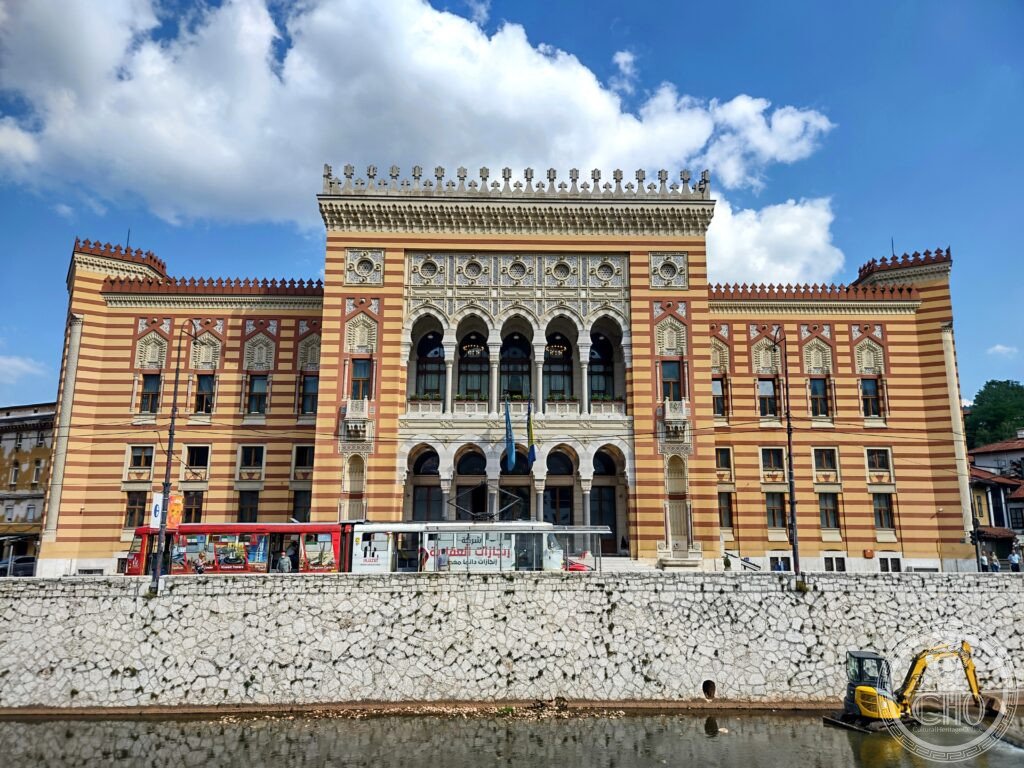
Built by the Austro-Hungarian administration in a deliberately Moorish idiom, Sarajevo’s city hall was gutted by fire in 1992 and reborn twenty-two years later, its polychrome arches intact and its shelves empty.
At a glance
The Vijećnica stands at the east end of Obala Kulina Bana, where the Miljacka river curves below the old bazaar quarter. Designed in a Pseudo-Moorish style that the Austro-Hungarian administration adopted as a statement of tolerance toward the city’s Ottoman heritage, it was completed in 1896 and served as Sarajevo’s main administrative building until the Second World War, then as the National and University Library of Bosnia and Herzegovina. On the night of 25–26 August 1992, Serbian forces shelled and firebombed the building during the Siege of Sarajevo, destroying the library and killing Aida Buturović, a librarian attempting to save the collections. Rebuilt largely with European Union and Austrian funding, the Vijećnica reopened on 9 May 2014. Its polychrome arches and geometric tiling have been meticulously restored; the reading rooms it once held are now an events space and museum.
Key facts
- Architects: Karel Pařík (initial design, 1891) with Alexander Wittek; interior decoration Ćiril M. Iveković
- Built: 1891–1896; inaugurated 6 June 1896
- Style: Pseudo-Moorish / Austro-Hungarian Orientalist; tricolour stone (red, cream, ochre) + geometric tiling
- First use: Sarajevo city hall; subsequently National and University Library of Bosnia and Herzegovina (1949–1992)
- Destruction: firebombed 25–26 August 1992, 1.5 million volumes destroyed; librarian Aida Buturović killed
- Restoration: EU-funded; reopened 9 May 2014
- GPS: 43.8592° N, 18.4333° E
History
Bosnia-Herzegovina passed from Ottoman to Austro-Hungarian administration in 1878, and the new regime faced an architectural question that was also a political one: how should imperial buildings look in a city that was Muslim, Orthodox, Catholic, and Sephardic Jewish all at once? The response, developed over two decades of building, was to hybridise Viennese Historicism with Moorish and Ottoman decorative motifs — producing what historians call Austro-Hungarian Orientalism. The Vijećnica, begun in 1891 to designs by Czech-born architect Karel Pařík, was the most ambitious expression of this tendency in Sarajevo. Its three-bay river façade uses horseshoe arches, geometric stone inlays, and alternating horizontal bands of red, cream, and ochre sandstone in patterns drawn from Alhambra-era precedents.
After the Second World War the building became the National and University Library, accumulating by the 1990s one of the largest collections of manuscripts, rare books, and periodicals in the former Yugoslavia. The destruction in August 1992 was not incidental — the library was a deliberate target, its burning understood by all parties as an act of cultural erasure. Catalogues, irreplaceable Ottoman manuscripts, and the founding collection of the University of Sarajevo were reduced to ash over two nights. The plaque on the restored facade reads: “Do not forget. Remember and warn.”
Restoration began in 1996 with funding from Austria (which had built the original) and the European Union. The work took until 2014 and involved matching the original quarry sources for the tricolour stonework. The reopening on 9 May 2014 — Victory in Europe Day — was attended by EU officials and marked by a concert in the restored interior.
What you see
The Vijećnica presents its most dramatic elevation to the Miljacka river: a three-storey façade of horseshoe-arched windows separated by slender colonettes, the whole composition banded in alternating courses of red and cream stone. Corner towers capped with pointed domes complete the Moorish silhouette. The main entrance, on the north side facing Obala Kulina Bana, uses a projecting porch with muqarnas-inspired vaulting. From the embankment, particularly at dusk when the stone warms to amber, the building reads more as a fantasia than as a municipal office — which was presumably the intention of architects who had the Alhambra in their reference library.
Inside, the restored central hall rises through two open galleries to a coffered ceiling. Geometric tiled floors, arched loggias at each level, and slender iron columns support the galleries. The restoration team recovered the original colour schemes from pre-1992 photographs, including the polychrome interlaced patterns on the column capitals. The space now functions as a concert and events hall; a permanent exhibition on the library’s destruction and rebuilding occupies the ground floor.
Practical information
- Address: Obala Kulina Bana 1, 71000 Sarajevo, Bosnia and Herzegovina
- Opening hours: Tuesday–Sunday; check local listings for current exhibition hours
- Admission: free to enter the ground-floor permanent exhibition; events ticketed separately
- Time needed: 45–60 minutes for the exhibition; longer if a concert is scheduled
- Photography: permitted in most areas; restrict during performances
Getting there
The Vijećnica stands at the eastern end of the Old Town, a ten-minute walk from Baščaršija square. Trolleybus lines 101 and 102 stop at Vijećnica. Sarajevo International Airport is approximately 12 km south-west; tram line 1 connects the airport road to the city centre in 30 minutes. GPS: 43.8592, 18.4333.
Nearby
- Baščaršija — Sarajevo’s Ottoman-era bazaar with the Gazi Husrev-beg Mosque, ten minutes west on foot
- Latin Bridge — the Ottoman footbridge where Archduke Franz Ferdinand was assassinated in 1914, two minutes north along the Miljacka
- Sarajevo Museum of the 1984 Winter Olympics — five minutes on foot
- Yellow Fortress (Žuta Tabija) — Ottoman fort above the old city offering panoramic views, 25 minutes uphill
Sources
- Wikipedia, Vijećnica, accessed June 2026
- UNESCO, “Old Town of Sarajevo,” Tentative List no. 1595
- European Commission, “Restoration of the Vijećnica in Sarajevo,” 2014 press release
- Andras Riedlmayer, Destruction of Cultural Heritage in Bosnia-Herzegovina 1992–1996, 1995
Find it on the map
See this place and what’s around it →📷 Become a Cultural Heritage Online photographer
Share your photos of places: they stay published under your name as the author. The more they're seen, the more you get noticed — and soon a contest will reward the most appreciated photos.
Log in or sign up free to add a photoIs this page about you?
This page is read by travellers and heritage enthusiasts who find it on Google. Tell us how you are connected to this place and we will take it from there.