
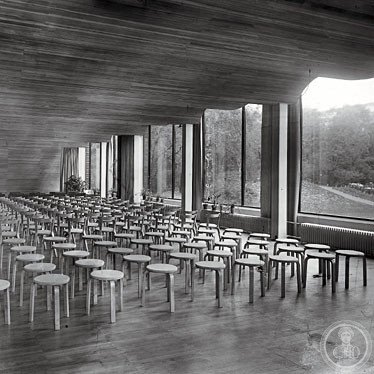
Alvar Aalto’s first major public commission, the Viipuri Library (1935) introduced circular skylights, an undulating wooden acoustic ceiling, and open shelving to European architecture — a building that was Finnish, became Soviet, and remains one of the 20th century’s most consequential libraries.
At a glance
- Type
- Public library
- Period
- 1927-1935
- Style
- Nordic Functionalism
- Location
- Alvar Aalto Square, Vyborg, Russia
- Coordinates
- 60.7090 N, 28.7470 E
- Architect
- Alvar Aalto
Overview
The Viipuri Library (known today as the Vyborg Library) is a landmark of 20th-century architecture, designed by Finnish architect Alvar Aalto for the city of Viipuri (now Vyborg, Russia). Commissioned in 1927 and completed in 1935 after eight years of iterative design, it was Aalto’s first major public building and a turning point in modern architecture. The building introduced three innovations that would define architectural culture for decades: circular ceiling skylights providing shadow-free natural light, an undulating wooden acoustic ceiling in the lecture hall (one of the first studies of acoustic form applied architecturally), and open-plan shelving that trusted readers to navigate freely. The library is now a functioning public library in Vyborg and is recognized on UNESCO’s tentative World Heritage list.
History
The library was commissioned in 1927 by the city of Viipuri, then part of Finland, as part of a cultural building program. Aalto, then a young architect in his early career, received the commission through a competition. He worked on the design for eight years, revising it substantially before construction began. Each design iteration moved away from historicism toward a deeper, more original functionalism: the final building bears almost no resemblance to the neo-Renaissance early sketches. Construction was completed in 1935. Just five years later, the 1940 Winter War ended with the Moscow Peace Treaty, by which Finland ceded the Karelian region — including Viipuri — to the Soviet Union. The library became a Soviet institution. It was damaged during World War II and the subsequent Soviet-Finnish conflict, and fell into disrepair during the Soviet period. Since the 1990s, a Finnish-Russian restoration partnership (the Alvar Aalto Foundation and Russian authorities) has worked to restore the building, which suffered significant deterioration after decades of deferred maintenance. Aalto himself, in his last years, expressed distress upon learning the building had survived in compromised condition.
Architecture and Design
The Viipuri Library is organized around two rectangular volumes of different heights: the taller reading room block and the lower lecture hall and service block, joined in an asymmetric L-shaped plan. The reading room ceiling is pierced by 57 circular skylights, each a conical shaft that diffuses daylight from above without shadows at any hour or season. The solution is as elegant as it is functional: readers are lit uniformly regardless of where they sit, and the ceiling pattern creates a quiet, rhythmic interior. The lecture hall features Aalto’s famous undulating wooden ceiling — a series of organic wave-forms in timber that deflect and distribute sound. This ceiling, designed through empirical experimentation rather than mathematical formula, remains one of the earliest examples of acoustic form-finding in architecture. The building’s exterior is quiet and almost austere: white-rendered volumes, horizontal windows, and no ornament. The interior, with its sensory precision and material warmth, provides the contrast. Open shelving throughout the reading areas — then an unusual choice — embodied Aalto’s humanist approach to the public institution as a space of trust and dignity.
Cultural significance
The Viipuri Library holds a unique position in architectural history. It is widely regarded as the building in which Aalto found his mature voice — moving decisively beyond functionalist dogma into a more humane, sensory, place-specific modernism that would define Finnish architecture and influence global practice. The circular skylights became one of the most imitated architectural devices of the 20th century. The undulating acoustic ceiling anticipated the organic spatial language of Aalto’s post-war masterworks (Finlandia Hall, Paimio Sanatorium, the MIT dormitory). The library’s complicated geopolitical history — Finnish by design, Soviet by war treaty, Russian by succession — gives it a poignant resonance as a building that transcended the political order that created it. The Alvar Aalto Foundation’s sustained engagement with its restoration across the Finnish-Russian border has made it a symbol of cultural diplomacy through architecture. It is on UNESCO’s tentative World Heritage list.
Visiting today
The Vyborg Library functions as an active public library at Alvar Aalto Square in Vyborg. Given the ongoing war in Ukraine and the general deterioration in Finnish-Russian and EU-Russian relations since 2022, travel to Russia from most Western countries is not recommended and may not be possible depending on visa restrictions and airline availability. Travelers should consult current government advisories. When open to visitors, the library has admitted architectural tourists alongside its regular users; the reading room and lecture hall are the primary spaces of architectural interest. Vyborg is approximately 130 km northwest of Saint Petersburg by road or rail.
Getting there
Vyborg is located in the Leningrad Oblast of Russia, approximately 130 km from Saint Petersburg and 30 km from the Finnish border (Vaalimaa crossing). When travel was possible, the most common routes were: by train from Helsinki (Allegro/Pendolino high-speed train, approximately 1.5 hours, discontinued since 2022 due to Russian sanctions); by train from Saint Petersburg Finlyandsky Station (Lastochka express, approximately 2 hours); by road via the E18 highway from Helsinki through the Vaalimaa/Torfyanovka border crossing. Check current border crossing status and visa requirements before any travel planning. The library is at Alvar Aallon katu 2, Vyborg.
Sources and resources
Find it on the map
See this place and what’s around it →Record researched and written by Luigi De Marchi for Cultural Heritage Online, 2026.
📷 Become a Cultural Heritage Online photographer
Share your photos of places: they stay published under your name as the author. The more they're seen, the more you get noticed — and soon a contest will reward the most appreciated photos.
Log in or sign up free to add a photoIs this page about you?
This page is read by travellers and heritage enthusiasts who find it on Google. Tell us how you are connected to this place and we will take it from there.