
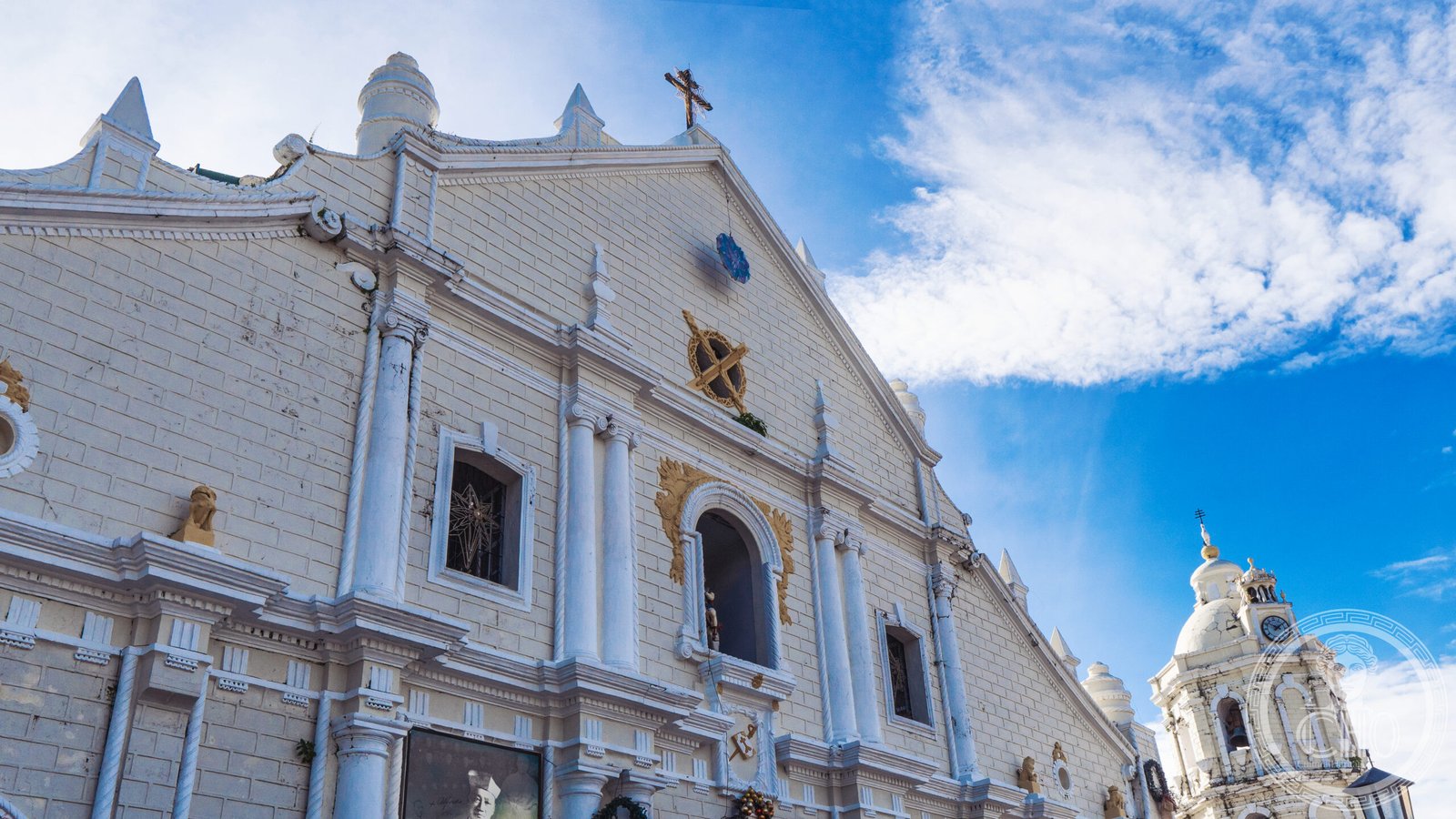
On Burgos Street, in Vigan, in the province of Ilocos Sur, in the Philippines, the metropolitan cathedral of Saint Paul is the seat of the archdiocese of Nueva Segovia. That was one of the first four Philippine dioceses, erected on 14 August 1595 by Pope Clement VIII together with Manila, Cebu and Nueva Cáceres, under the first bishop, Miguel de Benavides. The original seat stood in the town of Nueva Segovia, at the mouth of the Cagayan river, gradually destroyed by the flooding of the river and moved provisionally to Lal-lo before settling definitively at Vigan on 7 September 1758. A first church of wood and thatch was built in 1574 at the wish of the conquistador Juan de Salcedo and the Augustinian friar Alonso de Álvarado, the first parish of northern Luzon. The plan for a permanent building, agreed in 1575, was slowed by the withdrawal of the Augustinians from the region in 1577; a church was finally completed by 1641, after earthquake damage in 1619 and in 1627, only to be damaged by fire in 1739 and rebuilt. The present building, the fourth on the same site, was commissioned in 1786 by Governor General José de Basco and built by the Augustinians between 1790 and 1800; the name of the architect is not documented in any source. The style, known as earthquake baroque, typical of the colonial Philippines, combines massive buttresses with decorative elements that are Gothic Revival, Romanesque and Chinese in influence. Its distinctive feature is the freestanding bell tower, raised apart from the church, about ten metres away, on Plaza Burgos, precisely according to the logic of earthquake baroque, so that the collapse of one structure would not bring down the other: an octagonal tower of three storeys, about twenty-five metres high, topped by a bronze weathervane in the shape of a cockerel, the symbol of Saint Peter. No damage to the cathedral during the Second World War is documented. An earlier claim to that effect, found during the research, in fact referred to the nearby church of Bantay, a separate building, and Vigan as a whole was spared wartime destruction, according to some sources thanks in part to the mediation of a local priest with the Japanese forces. On 27 July 2022 an earthquake of magnitude 7.0, with its epicentre in the province of Abra, badly damaged both the front of the cathedral and the freestanding bell tower, which led to the closing of the building under a Code Red alert while structural checks were made. The mayor of Vigan announced a restoration fund of about one hundred million pesos for the cathedral, the bell tower and the archbishop’s palace, work that according to a United Nations report of 2024 was given priority over the restoration of the private heritage houses of the town. The historic town of Vigan, of which the cathedral is an integral part together with the archbishop’s palace and the civic buildings that define the two central squares, was inscribed on the UNESCO World Heritage list in 1999, recognised as the best preserved example of a planned Spanish colonial town in Asia.
About the Cathedral
St. Paul Metropolitan Cathedral, on Burgos Street in Vigan, Ilocos Sur, Philippines, is the seat of the Archdiocese of Nueva Segovia, one of the Philippines’ original four dioceses, established in 1595. The current “earthquake baroque” cathedral, built 1790–1800, anchors Vigan’s UNESCO-listed historic Spanish colonial townscape.
Key facts
- 14 August 1595: Diocese of Nueva Segovia established by Pope Clement VIII, one of the Philippines’ first four dioceses.
- 7 September 1758: the diocese’s seat permanently transferred to Vigan.
- 1790–1800: current cathedral built under order of Governor-General José de Basco.
- A freestanding octagonal bell tower stands separately on Plaza Burgos, built apart so an earthquake couldn’t topple both structures together.
- 1999: the Historic City of Vigan, including the cathedral, inscribed as a UNESCO World Heritage Site.
- 27 July 2022: a magnitude-7.0 earthquake severely damages the cathedral’s facade and its freestanding bell tower.
History
Built at the end of the 18th century in the “earthquake baroque” style common to Spanish colonial Philippine churches, Vigan Cathedral has served since 1758 as the seat of one of the country’s founding dioceses. Its detached bell tower, a deliberate seismic-safety measure, was itself among the structures most severely damaged in the 2022 Luzon earthquake, prompting a major restoration effort within a townscape recognized by UNESCO since 1999 as the best-preserved planned Spanish colonial city in Asia.
What you see
A pale coral-stone facade with a stepped, pinnacled gable in the earthquake-resistant “earthquake baroque” style, massive buttresses, and a freestanding octagonal bell tower nearby, its silver-paneled Neo-Baroque interior spanning three naves.
Practical information
- Opening hours: generally open outside services; access may be restricted during ongoing post-earthquake restoration, check current status before visiting.
- Address: Burgos Street, Vigan City, Ilocos Sur, Philippines.
Getting there
The cathedral stands on Burgos Street in Vigan’s historic center. GPS: 17.5748°N, 120.3887°E.
Nearby
- Plaza Burgos and Plaza Salcedo — Vigan’s twin central plazas, anchored by the cathedral, Archbishop’s Palace and civic buildings.
- Bantay Church — a separate historic church in the neighboring town of Bantay, sometimes confused with Vigan Cathedral in secondary sources.
Sources
- Wikipedia — “Vigan Cathedral,” “Archdiocese of Nueva Segovia”
- UNESCO World Heritage Centre — “Historic City of Vigan”
- Rappler, Manila Bulletin, Esquire Philippines — coverage of the 27 July 2022 earthquake damage.
- UN Philippines — 2024 report on Vigan heritage restoration priorities.
- New Advent Catholic Encyclopedia — Archdiocese of Nueva Segovia.
Find it on the map
See this place and what’s around it →📷 Become a Cultural Heritage Online photographer
Share your photos of places: they stay published under your name as the author. The more they're seen, the more you get noticed — and soon a contest will reward the most appreciated photos.
Log in or sign up free to add a photo