
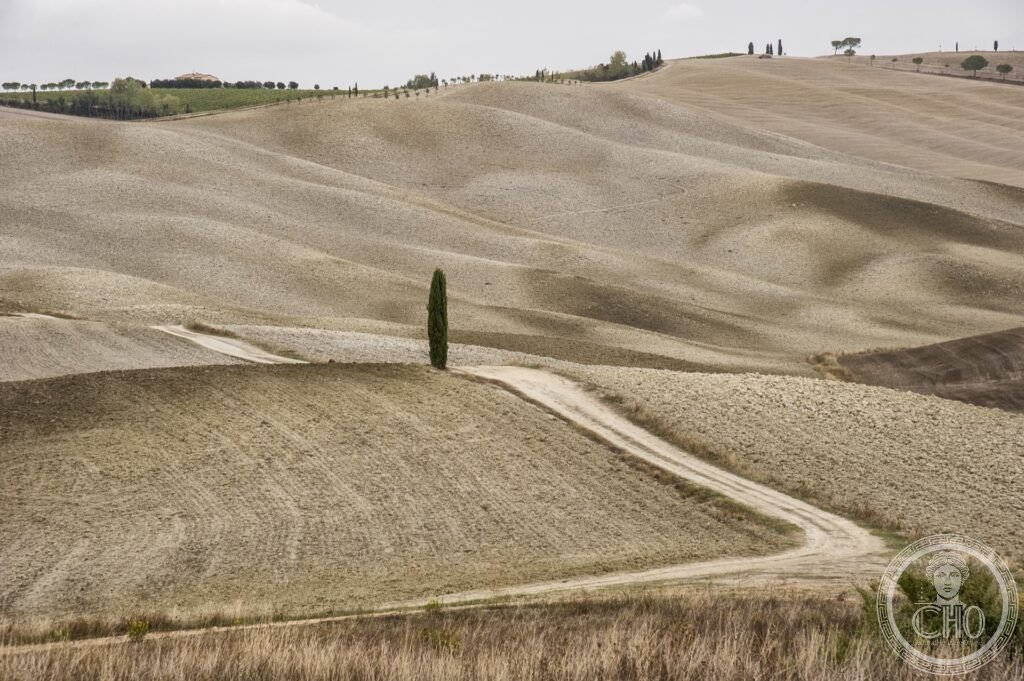
The Val d’Orcia — the broad Sienese valley between the town of San Quirico d’Orcia to the north and Monte Amiata to the south, managed by the Republic of Siena from the 14th century onward as a model agricultural landscape on the principles of good government illustrated by Ambrogio Lorenzetti in his famous fresco in the Palazzo Pubblico — is the most influential landscape painting model in the history of Western art: the rolling hills, isolated farmhouses, winding roads lined with cypresses, and broad wheat fields that Lorenzetti depicted in 1338-1340 became the international visual shorthand for “the Tuscan countryside” that still fills millions of calendar photographs and desktop wallpapers each year.
At a glance
The Val d’Orcia (province of Siena, Tuscany; UNESCO 2004, ref. 1139) was inscribed as an “evolved cultural landscape”: a landscape that reflects the values and aesthetics of the society that shaped it, rather than a purely utilitarian or functional landscape. The WHC Outstanding Universal Value citation recognizes: (1) the visual coherence of the Val d’Orcia landscape as a physical realization of Renaissance Sienese ideas about the “ideal landscape”, as depicted by Lorenzetti in the “Allegory of Good Government” fresco (1338-1340) and as built at Pienza by Pope Pius II in 1459-1464; and (2) the survival of this landscape essentially intact despite mechanized agriculture, because the predominance of olive groves, wheat fields, vineyards, and cypresses on clay soil (crete senesi) has resisted the large-scale land consolidation that transformed most European agricultural landscapes in the 20th century.
Key facts
- Ambrogio Lorenzetti and the good landscape (1338-1340): Lorenzetti’s “Effects of Good and Bad Government” fresco in the Sala dei Nove of the Palazzo Pubblico in Siena (1338-1340) is the first large-scale secular landscape painting in the Western tradition. The right panel (“Effects of Good Government on the City and the Countryside”) shows a panoramic view of the Sienese countryside, with hills, roads, farms, olive trees, and people at work, that has been recognized as a topographically accurate representation of the area south of Siena, the Val d’Orcia region. It is also the first painting in which a specific Italian landscape is portrayed for its own beauty and civic significance, not as a backdrop for a religious scene.
- Pienza (Pius II, 1459-1464): Pope Pius II Piccolomini, born Enea Silvio Piccolomini in Corsignano, the village that he rebuilt, commissioned Bernardo Rossellino to transform his birthplace into the “ideal Renaissance city” of Pienza between 1459 and 1464. The result is a small-scale model of the Renaissance urban ideal: the Piazza Pio II, with the Duomo, the Palazzo Piccolomini, the Palazzo Comunale, and the Palazzo Vescovile arranged in a precise compositional relationship. UNESCO inscribed it as a separate property (ref. 789, 1996). The Val d’Orcia inscription (2004) extends the recognized value to the landscape surrounding Pienza.
- Le crete senesi: The “Sienese clays” (crete senesi) are an unusual geological formation: a marine sediment clay, from the Pliocene sea that covered the Val d’Orcia 3-5 million years ago, that weathers into smooth, rounded hills with a distinctive “biancane” morphology, bleached white clay outcrops on eroded hillsides, and “calanchi”, deeply eroded gully formations. The crete senesi are essentially non-arable on a commercial scale, since clay-dominant soils have a high shrinkage-swell coefficient, and are therefore not suitable for intensive monoculture. This ecological constraint is the primary reason the Val d’Orcia landscape has survived essentially intact while the surrounding Tuscan landscapes were transformed.
- UNESCO: 2004, ref. 1139.
- GPS: 43.0648, 11.6688 — Google Maps (San Quirico d’Orcia, Val d’Orcia).
History
The Val d’Orcia was part of the Sienese contado (rural territory) from the 13th century. The Republic of Siena managed the landscape as a model agricultural territory and built a network of farms, roads, and hospices, including the famous Vitaleta chapel, on the pilgrimage route of the Via Francigena crossing the valley at San Quirico d’Orcia. The Sienese painted the Val d’Orcia as the quintessential “good landscape” in a series of frescoes, altarpieces, and book miniatures from 1300 to 1450, by Lorenzetti, Sassetta, Giovanni di Paolo, and Sano di Pietro, giving the valley its international cultural significance as a painted landscape. After the Medici conquest of Siena (1555) the valley came under Florentine administration. It was documented and photographed extensively in the 19th and early 20th centuries, and entered international cultural consciousness as the “Tuscan landscape” through magazine photography and Hollywood films from the 1970s onward.
What you see
The Val d’Orcia is a driving landscape: the most celebrated viewpoints are along the SP88 (the Cassia bis from San Quirico d’Orcia toward Pienza and Montepulciano) and the SP146 (the Lauretana from Pienza to Montalcino). The iconic cypress-lined road images are found at three places. The Cappella della Madonna di Vitaleta is a chapel in an open field with a single-file cypress row, 3 km from San Quirico d’Orcia on the SP40. The Baccoleno farmhouse, near Asciano, 20 km north-east of the Val d’Orcia core, is one of the most-photographed Val d’Orcia farm landscapes. The rolling hills south of Pienza run along the SP88 south from Pienza for 5 km toward Monticchiello. Town stops include San Quirico d’Orcia, with the Collegiata di San Quirico, a 12th-century Romanesque portal, one of the finest in Tuscany, and the Horti Leonini, a 16th-century Italian formal garden; Pienza, with the Piazza Pio II and Palazzo Piccolomini, and pecorino di Pienza cheese shops; and Montalcino, with the fortress-winery producing Brunello di Montalcino DOCG, among Italy’s most important reds, and the Enoteca Fortezza.
Gallery
Practical information
- Best time to visit: May and June, with green hills and red poppy fields, and September and October, harvest time with warm golden light. August is hot and dry and the hills turn brown/gold. February-March has the most dramatic rolling fog and moody light; snow is occasional but produces spectacular landscape images.
- San Quirico d’Orcia: Piazza della Libertà, San Quirico d’Orcia (SI). The Collegiata is open daily 08:00-12:00 and 15:00-18:00. The Horti Leonini garden is always open, free. The tourist office is in Piazza della Libertà for driving itinerary maps.
- Pienza: Piazza Pio II, Pienza (SI). Palazzo Piccolomini is open Tuesday-Sunday 10:00-16:30, admission ~€7, including a tour of the cardinal’s apartments. Cheese shops (pecorino stagionato, pecorino alle nocciole) are on Corso Rossellino. The best time for the famous Pienza-valley view is the late afternoon from the terrace of the Palazzo Vescovile.
Getting there
Val d’Orcia, centred on San Quirico d’Orcia (SI), Tuscany. GPS 43.0648, 11.6688. By car: from Siena, Via Cassia SR2 south (50 km, 45 min); from Rome, A1 → Chiusi exit → SR478 north (200 km, 2h15); from Florence, A1 → Chiusi → SR478 (180 km, 2h). Public transport: very limited; Tiemme buses from Siena to San Quirico d’Orcia and Pienza (several daily, 1h+). A car is essentially required to explore the landscape (the key viewpoints are not walkable from the towns).
Nearby
- Siena — 50 km north; the Gothic city with the Piazza del Campo (the world’s most beautiful medieval civic square), the Duomo (the Pisano pulpit, the Piccolomini Library frescoes), and the Palio di Siena (horse race, July 2 and August 16).
- Montepulciano — 20 km east; the Renaissance hill town with Vino Nobile di Montepulciano DOCG (the oldest Italian DOC wine, documented 1350) and the Tempio di San Biagio (1518, Antonio da Sangallo the Elder).
- Terme di Bagno Vignoni — 10 km south of San Quirico; the medieval spa village with a natural hot-spring thermal pool (42°C) in the Piazza delle Sorgenti — unique in Italy as a piazza that IS a spa pool; the medieval village has changed little since the 15th century.
Sources
- UNESCO: whc.unesco.org/en/list/1139..
- Wikipedia EN: Val d’Orcia..
- Lorenzetti fresco: Palazzo Pubblico, Siena, Sala dei Nove (1338-1340).
- Valori, G. et al.: Il paesaggio della Val d’Orcia, Siena: Monte dei Paschi, 2003.
Find it on the map
See this place and what’s around it →📷 Become a Cultural Heritage Online photographer
Share your photos of places: they stay published under your name as the author. The more they're seen, the more you get noticed — and soon a contest will reward the most appreciated photos.
Log in or sign up free to add a photo