
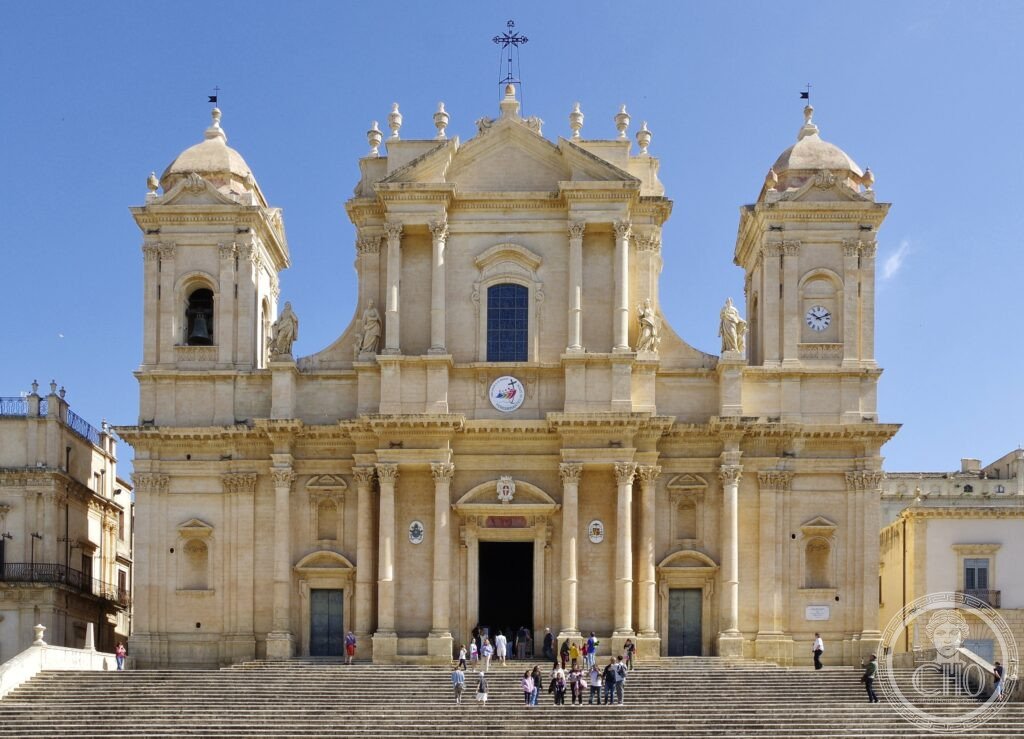
Val di Noto
Il Val di Noto (UNESCO 2002, rif. 1024) è il paesaggio barocco più coerente d’Europa: 8 città della Sicilia orientale ricostruite dal 1693 al 1740 CE su griglie pianificate, dopo che il terremoto dell’11 gennaio 1693 CE (M7.4; 60.000 morti) aveva distrutto interamente i centri urbani medievali, liberando i progettisti da ogni vincolo preesistente.
At a glance
Val di Noto Sicilia (the most precisely Val di Noto zone Noto Siracusa Sicilia Italy 36.8908 N 15.0756 E UNESCO WHS 2002 reference 1024 Late Baroque Towns of the Val di Noto (South-Eastern Sicily): the site (the 8 serial sites: (1) Noto (the “capital of the Baroque”: entirely new city built after 1693 CE on a ridge 10 km from the destroyed medieval Noto (the “Noto Antica”: now a ruin); (2) Ragusa Ibla (the lower part of the medieval city: rebuilt on the original site with a new Baroque street plan); (3) Modica (rebuilt with 2 parallel main streets at different levels connected by stairways); (4) Scicli (the narrow city at the bottom of 3 converging valleys); (5) Catania (the largest city: rebuilt with the Via Etnea as the main axis pointing directly at Mount Etna); (6) Caltagirone (the ceramics city; the Scala di Santa Maria del Monte: 142 steps covered with handmade ceramic tiles); (7) Palazzolo Acreide (the most rural of the 8 cities); (8) Militello in Val di Catania (the smallest); the earthquake (the earthquake of January 11, 1693 CE: the largest seismic event in Italian history since 1693 CE (the M7.4 earthquake on the Scicli fault; the epicentre: the Ibleo plateau under the Iblean Mountains; the impact: 60,000–70,000 deaths (c.33% of the population of southeastern Sicily (the estimated pre-earthquake population: 180,000); 45 cities and towns destroyed; the Baroque rebuilding (the window of opportunity (the “clean slate” urbanization): the earthquake destroyed not only buildings but also existing property boundaries and street patterns; the rebuilding commission authorized a completely new city plan for each of the 8 cities (the “commissario regio” system: the viceregal commissioner for each city); the architects (the 3 key architects: (1) Rosario Gagliardi (1698–1762 CE): the Noto-based architect who designed the Duomo di Noto (1703 CE), the Duomo di Modica, the Duomo di Ragusa Ibla, and the church of San Giorgio at Ragusa Ibla (1738 CE: the concave-convex facade with the central tower); (2) Vincenzo Sinatra (?–1765 CE): the architect of the Palazzo Villadorata at Noto (the 6 stone groteschi (grimacing faces) supporting the balconies: the most famous architectural detail of the Baroque Noto); (3) Andrea Palma (?–1730 CE): the architect of the Noto Cathedral facade (1703 CE) and the Church of the Santissimo Salvatore (Noto)).
Key facts
- Il cioccolato di Modica (il più antico cioccolato d’Europa) e il suo percorso dall’Aztechi del XV sec. CE alla Sicilia del XVI sec. CE passando per i Conti di Modica eredi del debito nobiliare spagnolo: the Modica chocolate (the “cioccolato di Modica” (the Modica chocolate: the oldest continuously produced chocolate recipe in Europe: the history (the Aztec origin: the Aztecs of the Mexica Triple Alliance (the Aztec Empire at its height under Montezuma II (1466–1520 CE)) made “xocolatl” (the Nahuatl word for “bitter water”): the recipe: cacao beans (roasted + ground) + water + hot chilies + vanilla; the Aztec technique: the cold mixing (not heating the chocolate: adding spices and chili to the ground cacao without melting the cocoa butter); the Spanish transmission (1519 CE: Hernán Cortés (1485–1547 CE) received the “xocolatl” from Montezuma II at the Aztec court; the Spanish brought the recipe to Spain: the court of Carlos V; the Modica connection (the Count of Modica): the County of Modica was one of the most powerful feudal territories in the Kingdom of Sicily; in the 15th–16th century CE, the Counts of Modica were the Chiaramonte-Aragona family (the Spanish crown controlled Sicily from 1282 CE to 1816 CE); the Spanish cacao recipe arrived in Modica via the Spanish court connection (the exact date is debated: 1520s CE is the traditional claim; the first documentary evidence of cacao in Sicily: 1577 CE in a Palermo apothecary’s inventory)); the recipe (the Modica chocolate technique: the cold mixing (exactly the Aztec technique, unchanged): cacao paste + cane sugar + spices (cinnamon, vanilla, chili) ground cold at 35°C (no heating above 40°C: the cocoa butter doesn’t melt); the result: a grainy, friable bar with visible sugar crystals (not smooth like modern chocolate); the IGP protection (the “Cioccolato di Modica IGP”: Protected Geographical Indication registered with the EU in 2018 CE; the production zone: the municipality of Modica (RG) only))
- GPS (Cattedrale di San Nicolò, Noto; ingresso Corso Vittorio Emanuele): 36.8908° N, 15.0756° E; Ragusa Ibla (San Giorgio 1738 CE): 36.9268° N, 14.7262° E; Modica (San Giorgio 1702 CE): 36.8592° N, 14.7714° E
History
Da 1693 CE al UNESCO 2002 (the most precisely Val di Noto zone history: the earthquake (the 1693 CE earthquake (the January 11, 1693 CE Val di Noto earthquake: the most powerful seismic event in the Mediterranean between 1500 CE and 1993 CE; the seismic sequence: 3 foreshocks in the 3 days preceding the main event; the main event (M7.4): the rupture of the Scicli fault (a 40 km NW-SE fault under the Iblean plateau; the epicentre: 7 km from Noto Antica); the 1693 CE event was felt as far as Rome and Malta); the rebuilding (the “Commissione dei Regi Ingegneri” (the Royal Engineers Commission): established by the Viceroy of Sicily (the Duke of Uzeda) in March 1693 CE: 3 months after the earthquake; the commission toured the 45 destroyed cities and classified each as: “to be rebuilt on the same site” OR “to be rebuilt on a new site”; the Noto decision (the most controversial decision): the commission ordered the new Noto to be built on the Manta Maddamma ridge 10 km from the old site (the “Noto Antica”); the citizens wanted to rebuild on the old site; the commission prevailed: the new Noto was built from 1703 CE to 1760 CE on the new site; the “Noto Antica” was abandoned and is now a ruin on a hill 10 km from the new city); the Catania rebirth (Catania was also completely destroyed in 1693 CE; the plan (the Benedictine monk Fra Tedeschi’s plan (1694 CE): the straight axis of the Via Etnea pointing directly at Mount Etna (an act of symbolic defiance: the mountain had destroyed Catania; the city placed its main street aimed directly at the source of destruction)); the UNESCO inscription (2002 CE: reference 1024).
What you see
Noto Corso Vittorio Emanuele, Palazzo Villadorata (6 groteschi), Ragusa Ibla San Giorgio 1738 CE, Modica San Giorgio 1702 CE, Scicli San Matteo (the most precisely Val di Noto zone visit (3 days minimum for all 8 cities or 1 day for Noto+Ragusa Ibla): the Noto visit (3–4 hours): the Corso Vittorio Emanuele (the main axis: 1.2 km; the walk from Porta Reale (the triumphal arch, 1838 CE: neo-classical; the “welcome gate” to Noto) to the Cattedrale (the Cathedral of San Nicolò (1703 CE; the dome collapsed 1996 CE and was rebuilt 2007 CE); the most photographed view in the Val di Noto: the staircase (28 steps) + the 3-tier facade + the honey-colored calcarea stone (the Iblean limestone: the “pietra di Noto”; the golden color deepens at sunset); the Palazzo Villadorata (1737 CE; via Nicolaci 1; the private palazzo owned by the Nicolaci-Villadorata family; the 6 balconies on the facade with the “mensole antropomorfe” (the stone grotesque faces supporting the balconies: 6 different faces each representing a different social type: the horse, the centaur, the female figure, the male figure, the lion): the most extreme decorative element of the entire Sicilian Baroque; €2 to visit the frescoed rooms)); the Ragusa Ibla visit (2–3 hours): the Church of San Giorgio (1738 CE; Rosario Gagliardi; the concave-convex facade (the convex center section and the concave flanking walls: a theatrical architectural effect that makes the facade “wave”; the central tower (40 m) framing the facade); the Giardino Ibleo (the garden at the eastern end of Ibla: the panorama of the Irminio valley gorge below the city)).
Practical information
- Come visitare Noto, Ragusa Ibla e Modica in 2 giorni con i mezzi pubblici da Catania o Siracusa, e dove comprare il cioccolato IGP di Modica originale: il trasporto (Catania → Noto: Interbus (2h; €6.80; partenze ore 6:30/9:00/12:30/16:00 da Catania); Siracusa → Noto: Interbus (45 min; €3.20; ogni 30 min); Noto → Ragusa: Interbus (1h15; €5.50; 4 corse/giorno); Ragusa → Modica: AST autobus (20 min; €1.30; ogni ora)); il programma 2 giorni: Giorno 1: Noto (mattina 9:00–13:00: Corso Vittorio Emanuele + Palazzo Villadorata + Cattedrale; pomeriggio 15:00–18:00: bus per Ragusa Ibla; San Giorgio + Giardino Ibleo; dormire a Ragusa Ibla); Giorno 2: mattina Modica (09:00–13:00: il cioccolato: Antica Dolceria Bonajuto (Corso Umberto I 159: fondata 1880 CE; la più antica cioccolateria di Modica e della Sicilia; la degustazione: €2/3 varietà: cioccolato alla cannella (il sapore azteco originale) + al peperoncino + alla vaniglia IGP) + la Chiesa di San Giorgio (1702 CE: la precedente versione 1693-distrutta; Rosario Gagliardi 1695–1726 CE; la navata a 3 colonne per lato; la cupola ottagonale); Scicli pomeriggio (15:00–18:00: auto o taxi; le chiese sulle tre valli; il set del Commissario Montalbano (Andrea Camilleri): la Caserma dei Carabinieri + il Municipio))
Getting there
Interbus da Catania (2h, €6.80) o Siracusa (45 min, €3.20). GPS Noto Cattedrale: 36.8908/15.0756. Palazzo Villadorata €2. Cattedrale gratuita. 9:00–13:00/15:00–18:00.
Nearby
- Siracusa e l’Isola di Ortigia (UNESCO 2005 rif. 1200 — Duomo V sec. BCE, Piazza del Duomo, Fonte Aretusa) — 30 km da Noto (Interbus 45 min; €3.20; il Duomo di Siracusa: il tempio dorico di Athena V sec. BCE trasformato in cattedrale nel VII sec. CE (le 34 colonne doriche inglobate nelle mura della navata sono visibili dall’interno); la Fonte Aretusa (il mito: la ninfa Aretusa trasformata in sorgente d’acqua dolce da Artemide mentre fuggiva dal fiume Alfeo; la fontana circolare con papiri e anatre sul lungomare di Ortigia))
- Pantalica (UNESCO 2005 rif. 1200 — necropoli rupestre 5.000 tombe; 1270–730 BCE) — 50 km da Noto (auto 1h; la Valle dell’Anapo; 5.000 tombe rupestri scavate nelle pareti del canyon dal Bronzo Tardo (1270 BCE) all’Età del Ferro (730 BCE); l’Anaktoron (il palazzo del principe: la struttura politica del XIV sec. BCE))
Gallery


Sources
- Wikipedia, Noto, Sicily; 1693 Sicily earthquake; Rosario Gagliardi; Modica chocolate, accessed June 2026
- UNESCO, Late Baroque Towns of the Val di Noto (South-Eastern Sicily), WHS reference 1024, inscribed 2002
- Dufour, Liliane; La Duca, Rosario. Immagini di una città. Catania tra ‘600 e ‘800. Palermo: ILA Palma, 1983 (on the 1693 CE rebuilding)
Find it on the map
See this place and what’s around it →📷 Diventa un fotografo di Cultural Heritage Online
Condividi le tue foto dei luoghi: restano pubblicate con la tua firma come autore. Più vengono viste, più ti fai conoscere — e presto un concorso premierà le foto più apprezzate.
Accedi o registrati gratis per aggiungere una foto