
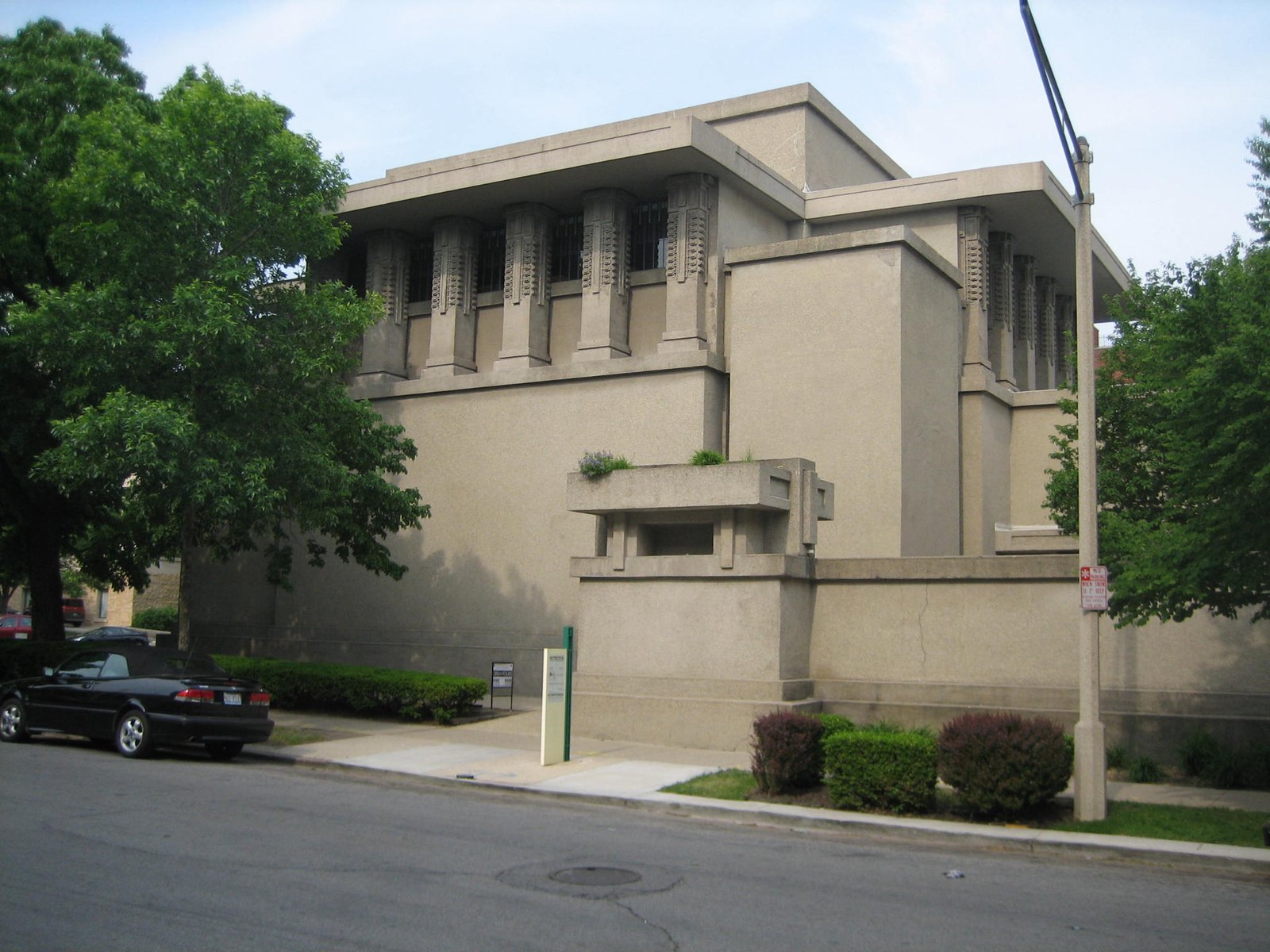
Frank Lloyd Wright’s “little jewel” — the first major American public building of poured reinforced concrete and one of the twelve UNESCO World Heritage sites in the Wright serial nomination — is still a living Unitarian Universalist church a century after it opened.
At a glance
Built 1905–1908 in Oak Park, Illinois, to replace a wood-frame Unitarian Universalist church destroyed by lightning, Unity Temple forced Wright to solve a design problem through constraint: a budget of only $45,000. His answer was to use poured reinforced concrete throughout — then a largely industrial material — and to organise the programme into two linked cubes joined by a low entrance vestibule. The result was the first demonstration in America that a sacred space could be created without vaulted ceilings, pointed arches, or historical quotation. The sanctuary is still in active weekly use alongside its life as a UNESCO World Heritage museum.
Key facts
- Architect: Frank Lloyd Wright
- Built: 1905–1908
- UNESCO WHS: 2019 (part of “The Architectural Work of Frank Lloyd Wright,” serial nomination of 8 buildings)
- Construction budget: $45,000 (the constraint that determined the material)
- Structure: Poured reinforced concrete — first major American public building of this material
- Programme: Two cubes — Unity Temple (sanctuary) + Unity House (social hall) + low entrance vestibule
- Congregation: Unitarian Universalist Congregation of Oak Park (still active every Sunday)
- Location: 875 Lake Street, Oak Park, Illinois (suburb of Chicago; 14 km west of the Loop)
History
The original Unitarian church on the corner of Lake Street and Kenilworth Avenue was a wood-frame structure built in 1871 and struck by lightning in 1905. The congregation’s building committee turned to Frank Lloyd Wright — then 38 and already the most talked-about architect in Chicago — and gave him the entire project budget of $45,000. Wright accepted the constraint and used it as a creative engine: concrete could be poured into any shape, required no skilled masonry, and could produce monolithic walls, roofs, and ornamental elements as a single continuous material.
Construction took three years. The building was completed in 1908 and dedicated on 26 September 1909, when the congregation moved in. Over the following century the building was altered several times — interior paint colours changed, some art-glass panels were replaced, acoustic tiles were added to the ceiling — before a comprehensive $25 million restoration project (2015–2017) returned it to Wright’s original 1909 design intent, using microscopic paint analysis, surviving drawings, and period photographs.
Unity Temple was listed on the National Register of Historic Places in 1970. In 2019 it was inscribed on the UNESCO World Heritage List as part of the serial nomination “The Architectural Work of Frank Lloyd Wright,” which encompasses eight buildings across six US states including Fallingwater, the Guggenheim Museum in New York, and Taliesin West in Scottsdale.
What you see
The exterior is a lesson in geometric abstraction: four massive concrete piers at the corners of the sanctuary cube rise above a flat roof-slab, their surfaces decorated with cast ornamental bands in a pattern derived from Prairie-style geometry. There is no tower, no spire, no rose window — nothing to signal “church” in any traditional vocabulary. The entrance is deliberately concealed: visitors must pass between the two cubes, enter a low vestibule that compresses the space, and then climb stairs before the full interior is revealed.
Inside, the sanctuary is a cube of natural light. The ceiling is a flat concrete tray pierced by 25 skylights — amber art glass set into the concrete — that flood the interior with warm, diffused light regardless of weather. Four hollow concrete piers at the corners carry the roof and conceal the mechanical systems; the congregation sits on three sides of the space in a continuous balcony, so that no seat is more than a few rows from the central speaker’s platform. The oak trim, leaded glass, and warm concrete create an interior of extraordinary tactile richness.
Wright called Unity Temple “my little jewel” — and considered it the breakthrough that proved his theory: a new democratic sacred space was possible in the horizontal American form, without reaching upward to a transcendent God, but by enclosing and honouring the congregation gathered together on earth.
Practical information
- Address: 875 Lake Street, Oak Park, IL 60301, USA
- Tours: Self-guided and docent-led tours available most days; check unittemple.org for current schedule
- Sunday services: The building is closed to tourists during Unitarian Universalist services (typically 10:00 am Sunday)
- Admission: Ticketed museum entry; free for active congregation members
- Photography: Allowed inside during museum hours; tripods require advance permission
- Accessibility: The building is a heritage structure; partial wheelchair access; contact in advance
Getting there
Oak Park is 14 km west of downtown Chicago and is served directly by the CTA Green Line (Oak Park station, 2 blocks from the building) and the Metra Union Pacific West line (Oak Park station). By car from Chicago, take I-290 West to Harlem Avenue (Exit 20), then north to Lake Street. Parking is available on street and in nearby public lots. Unity Temple is a 10-minute walk from the Frank Lloyd Wright Home and Studio (951 Chicago Avenue), which together make a logical half-day architectural itinerary.
Nearby
- Frank Lloyd Wright Home and Studio (951 Chicago Ave, Oak Park) — Wright’s personal home and drafting studio 1889–1909; the place where Prairie Style was invented; UNESCO WHS 2019
- Ernest Hemingway Birthplace (339 N Oak Park Ave) — the Nobel laureate was born here in 1899; now a museum
- Cheney House (520 N East Ave, Oak Park) — another Wright Prairie masterpiece (1904); private residence but visible from street
- Chicago Loop (30 min by CTA) — Sullivan’s Carson Pirie Scott, Adler & Sullivan’s Auditorium Theatre, and the Chicago Architecture Center river tours
Sources
- UNESCO World Heritage List — “The Architectural Work of Frank Lloyd Wright” (whc.unesco.org, 2019)
- Unity Temple Unitarian Universalist Congregation — unittemple.org
- Frank Lloyd Wright Foundation — franklloydwright.org
- National Park Service — National Register of Historic Places (nps.gov, 1970)
- Storrer, William Allin. The Frank Lloyd Wright Companion. University of Chicago Press, 2006.
- Sergeant, John. Frank Lloyd Wright’s Usonian Houses. Whitney Library of Design, 1984.
Find it on the map
See this place and what’s around it →📷 Become a Cultural Heritage Online photographer
Share your photos of places: they stay published under your name as the author. The more they're seen, the more you get noticed — and soon a contest will reward the most appreciated photos.
Log in or sign up free to add a photo