

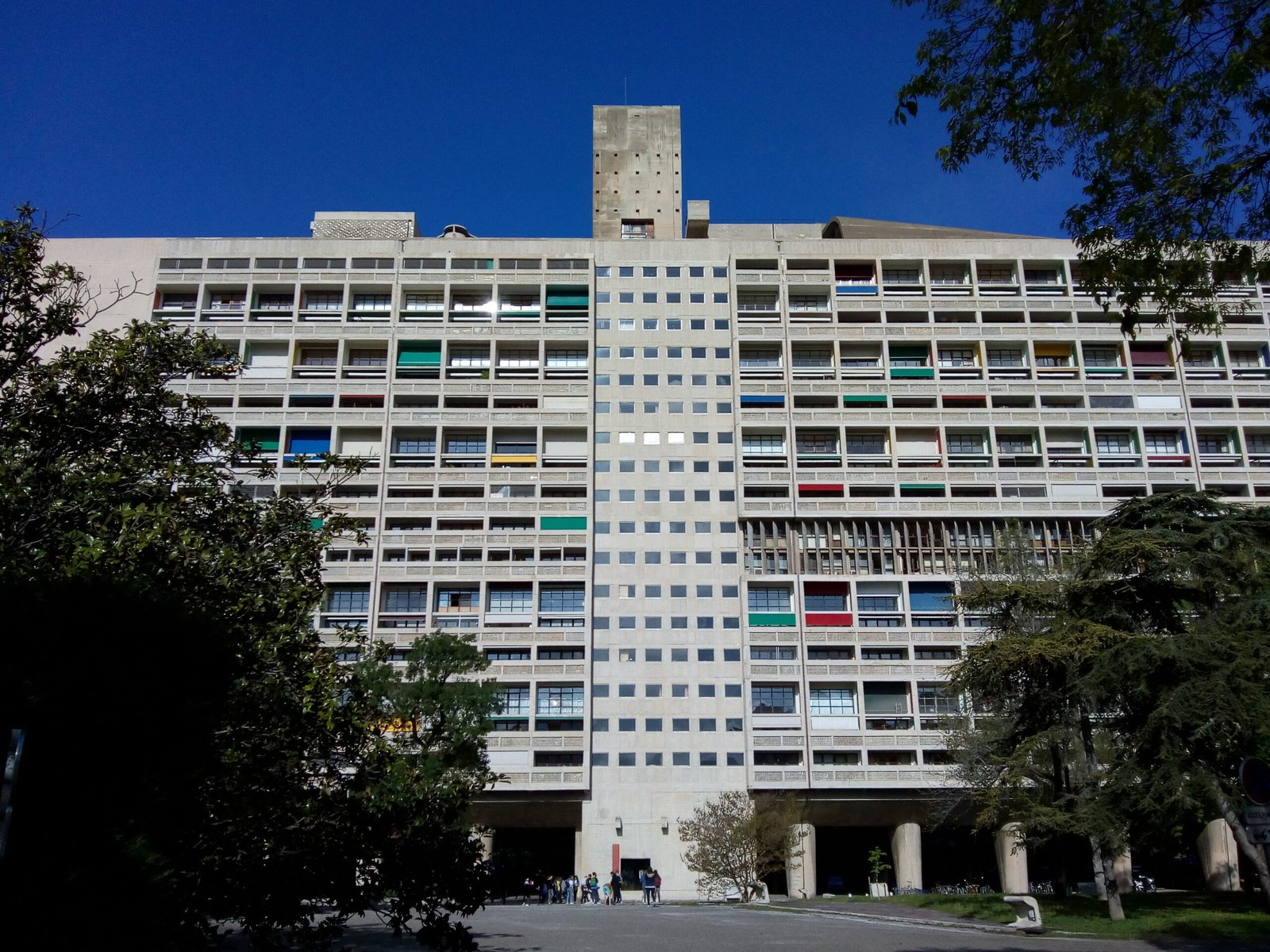
Le Corbusier’s revolutionary 17-storey vertical city raised on sculpted concrete pilotis in Marseille — the building that named Brutalism, reshaped social housing worldwide, and remains one of France’s most desirable addresses.
At a glance
Completed in 1952 on the outskirts of Marseille, the Unite d’Habitation is a self-sufficient housing block for 1,600 residents. Its 337 duplex apartments in 23 configurations are stacked in a concrete slab raised on massive pilotis. Within the block: a shopping street on floors 7–8, a hotel, nursery school, gymnasium, and a dramatic roof landscape with running track, paddling pool, open-air theatre, and sculptural ventilation towers. UNESCO inscribed the building in 2016 as part of the transnational Le Corbusier serial nomination.
Key facts
- Architect: Le Corbusier
- Construction: 1947–1952
- UNESCO inscription: 2016 (transnational Le Corbusier serial site)
- Height: 56 m (18 floors including roof)
- Apartments: 337 units in 23 types
- Capacity: ~1,600 residents
- Also known as: Cite Radieuse (Radiant City)
- Movement: Post-war Modernism / Brutalism
History
After World War II, France faced a catastrophic housing shortage. The Ministry of Reconstruction commissioned Le Corbusier to build a prototype for mass social housing — a single structure housing an entire neighbourhood. Construction began in 1947 and the building opened in 1952. It was immediately controversial: Parisian architects called it the Maison du Fada (House of the Madman). The rough exposed concrete — beton brut — was partly a result of post-war material shortages, but became a deliberate aesthetic. The term Brutalism derives from the French beton brut, and the Marseille Unite launched a movement that shaped public architecture for 30 years.
Le Corbusier built four more Unites after Marseille: Reze, Briey, Firminy, and Berlin. Today the Marseille building is listed as a French historic monument and UNESCO World Heritage Site. Apartments sell at significant premiums over comparable Marseille flats.
What you see
The pilotis. Massive sculpted concrete legs raise the entire building off the ground, freeing the landscape beneath for garden and parking. This is Le Corbusier’s first point of new architecture made monumental.
The facade and loggias. Each apartment has a private loggia running the full width of the flat. The loggia side walls are painted in primary colours, so the building face becomes a grid of concrete frames and coloured recesses.
The duplex apartments. Each flat occupies two floors with a double-height living room. Apartments span from east to west face with loggias on both sides, interlocking so no corridor is needed on alternate floors.
The internal shopping street. Floors 7–8 house a commercial street — originally butcher, baker, laundry, post office, pharmacy, cafe. Today: a hotel and shops. Residents need never leave the building for daily needs.
The rooftop. One of the most dramatic architectural spaces in France. Sculptural ventilation towers in primary red, yellow, blue; a 300 m running track; paddling pool; gymnasium; open-air theatre. The Mediterranean is visible in the distance.
Practical information
- Address: 280 Boulevard Michelet, 13008 Marseille, France
- Access: Functioning apartment block; rooftop, museum (MAMO), and hotel open to the public
- MAMO art centre: Rooftop exhibitions and museum; see mamo.fr for current hours
- Hotel Le Corbusier: 23 rooms in original hotel section (floor 3); bookable directly
- Rooftop visits: Via hotel reception or organised tours; best at dawn or dusk
Getting there
The Unite is 4 km south of central Marseille. Take Metro Line 2 to Rond-Point du Prado, then bus 21 or 22 south to Boulevard Michelet (approx. 15 minutes from the Vieux-Port). By car, exit the A50 at Prado and drive south on Boulevard Michelet. Marseille-Provence Airport is 28 km north-west.
Nearby
- Vieux-Port de Marseille — the ancient harbour at the heart of the city, 4 km north
- MuCEM — Musee des Civilisations de l’Europe et de la Mediterranee at the Vieux-Port entrance
- Basilique Notre-Dame de la Garde — Marseille’s iconic hilltop basilica with panoramic city views
Sources
Find it on the map
See this place and what’s around it →📷 Become a Cultural Heritage Online photographer
Share your photos of places: they stay published under your name as the author. The more they're seen, the more you get noticed — and soon a contest will reward the most appreciated photos.
Log in or sign up free to add a photoIs this page about you?
This page is read by travellers and heritage enthusiasts who find it on Google. Tell us how you are connected to this place and we will take it from there.