
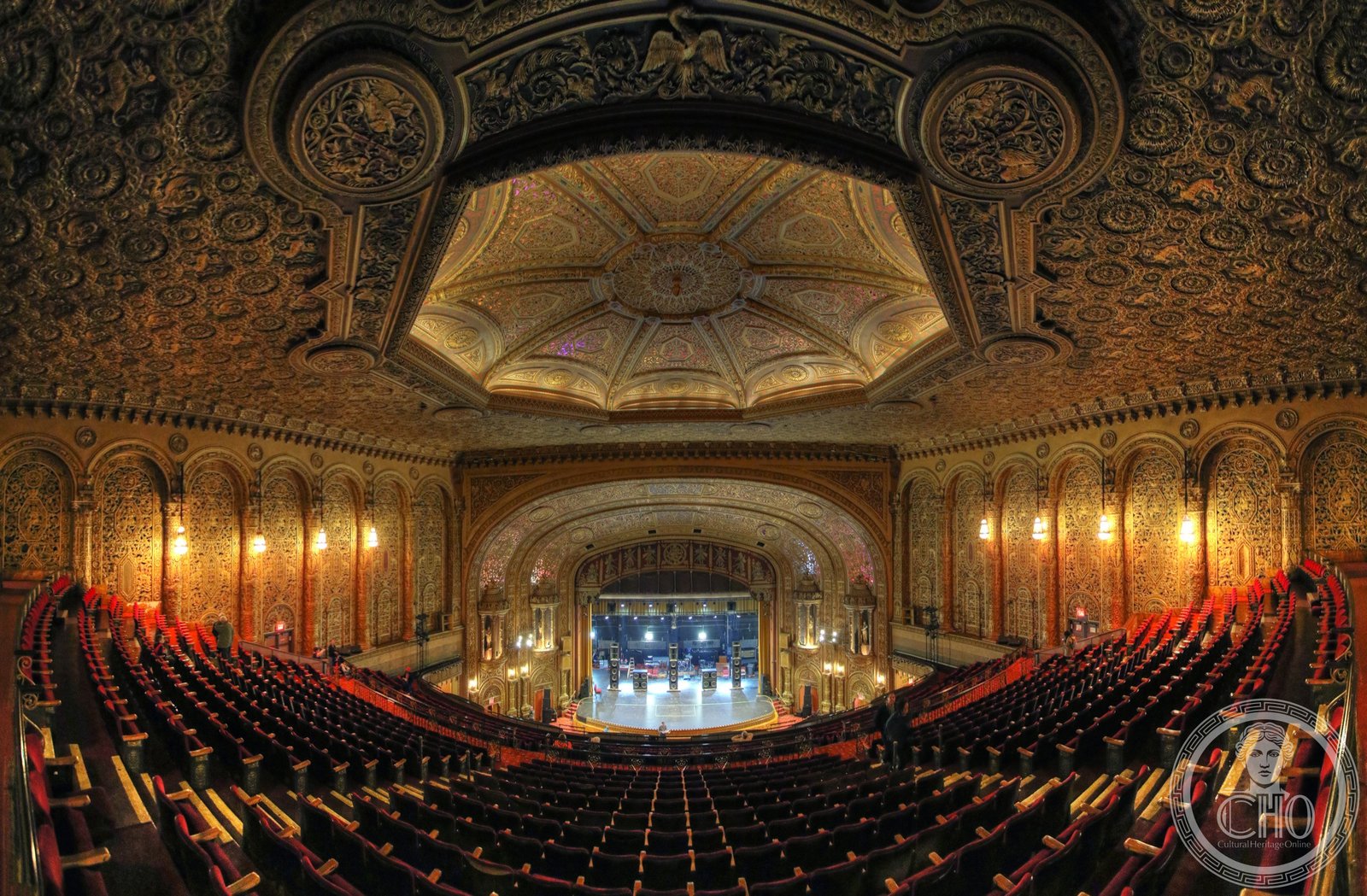
One of the five Loew’s Wonder Theatres built across the New York metropolitan area between 1929 and 1931, the United Palace opened in 1930 as Loew’s 175th Street Theatre, a 3,371-seat atmospheric palace by Thomas W. Lamb whose Indo-Saracenic interior remains the most extravagantly ornamented theater space in New York City.
At a glance
The United Palace occupies the northeast corner of Broadway and West 175th Street in Washington Heights, a densely built residential district on upper Manhattan. Thomas W. Lamb designed it for Loew’s Theatres as the northernmost of five Wonder Theatres — a deliberate program of super-palaces built to compete for the metropolitan audience by offering interiors that matched or exceeded the best midtown houses. The Indo-Saracenic vocabulary Lamb chose has no equivalent in the New York theater landscape: a complete environment of gilded vaults, ornamental grilles, minaret towers rising from the side walls, and a painted atmospheric ceiling that spreads across the full auditorium. New York City designated the building a Landmark in 1984; it was individually listed on the National Register of Historic Places in 2003. Today it operates as United Palace, a concert venue and event space that has made the building accessible to a generation for whom the Loew’s program is remote history.
Key facts
- Address: 4140 Broadway, New York, NY 10033
- Opened: 1930 (as Loew’s 175th Street Theatre)
- Architect: Thomas W. Lamb
- Style: Indo-Saracenic Revival / Atmospheric
- Original capacity: 3,371 seats
- NYC Landmark: Yes (designated 1984)
- NRHP: Yes (individually listed 2003, refnum 03000527)
- Current use: Concert venue and events (United Palace)
History
Thomas W. Lamb was the busiest theater architect in America when Loew’s commissioned him in 1929 to design five major theaters across the New York metropolitan area. The Wonder Theatre program — named by the press rather than the company — produced the Kings Theatre in Brooklyn, the Paradise in the Bronx, the Valencia in Jamaica, the Jersey in Jersey City, and the 175th Street in Washington Heights, all within a two-year window. Each was conceived as a destination theater drawing from the full regional audience, not merely the immediate neighborhood, and each received a distinct architectural treatment. Lamb gave the 175th Street house the most extravagant theme of the five: an Indo-Saracenic interior drawing on Mughal, Persian, and Moorish sources filtered through the atmospheric style that had become the dominant format for American movie palaces since the mid-1920s.
The theater opened in 1930 serving Washington Heights and Inwood, an upper Manhattan district with a large working-class immigrant population that had no reason to envy the midtown audience for the quality of its cinema. Through the Hollywood studio era the 175th Street Theatre screened first-run releases under the Loew’s brand and operated as a full-service movie palace with live presentation elements. The postwar decline of the format — television, suburban flight, the multiplex — eroded the business model as it did everywhere, and Loew’s eventually closed the house as a cinema. The building passed to Reverend Ike, whose United Church took over the space and, crucially, maintained the building through the decades when preservation investment was unavailable. The City’s Landmark designation in 1984 created the framework for the restoration work that followed. The building has operated as United Palace — a concert and events venue — since being returned to full public use.
The four other Wonder Theatres followed a range of trajectories: the Kings in Brooklyn was closed and largely sealed for decades before a major restoration returned it to use in 2015; the others have had varying fates. The United Palace stands as the most continuously accessible of the five and one of the best-preserved examples of the Loew’s Wonder Theatre concept.
What you see
The facade on Broadway presents a broad terra-cotta composition at street level with ornamental arches and tilework in the Moorish manner, surmounted by the plain brick mass of the auditorium block and fly tower. The entrance pavilion, centered on the Broadway frontage, announces the interior program through the density and scale of its ornament, which reads as genuine architecture rather than applied decoration from across the street. The original marquee has been retained in restored or reconstructed form.
The auditorium interior is the building’s central achievement. Lamb arranged the seating under a composition that reads as a complete Mughal/Moorish environment: ornamental grilles of extraordinary delicacy covering the side walls and organ chambers; gilded and painted vaults in the ceiling panels; minaret towers rising from the auditorium walls; and the atmospheric ceiling above the orchestra carrying a painted sky that still operates the illusion for which the type was designed. The proscenium arch receives deep plasterwork in the Indo-Saracenic manner. The Wurlitzer pipe organ, one of the largest installed in any New York theater, remains in the building. At 3,371 original seats distributed across orchestra and multiple balcony levels, the house operates at a scale that allows the ornamental density to read across the full room without overwhelming any individual element.
Practical information
- Address: 4140 Broadway at West 175th Street, New York, NY 10033
- Transit: A train, 175th Street station (IND Eighth Avenue Line) — entrance adjacent to theater
- Events: Check unitedpalace.org for current programming
- Tours: Interior accessible via ticketed events and occasional public open days
Getting there
The United Palace is served directly by the A train (175th Street station), with a station entrance adjacent to the theater’s Broadway facade. From Midtown Manhattan the journey is approximately 25 minutes. The M4 and M5 bus routes also run along Broadway. No on-site parking is available; street parking in Washington Heights is limited and the subway is the standard approach for events.
Nearby
- The Cloisters, Metropolitan Museum of Art (Fort Tryon Park, 15-minute walk north)
- George Washington Bridge and Little Red Lighthouse (10-minute walk northwest)
- Audubon Terrace Historic District (Broadway at 155th Street, 20-minute walk south)
Sources
- Wikipedia, “United Palace” — history, architect Thomas W. Lamb, Wonder Theatres program, NYC Landmark 1984, NRHP 2003, Kings Theatre restoration
- New York City Landmarks Preservation Commission, Designation Report (1984)
- National Register of Historic Places, refnum 03000527 (United Palace, individually listed 2003)
- Cinema Treasures, “Loew’s 175th Street Theatre / United Palace” — original capacity, Wurlitzer organ, adaptive reuse history
Find it on the map
See this place and what’s around it →Record researched and written by Luigi De Marchi for Cultural Heritage Online, 2026.
📷 Become a Cultural Heritage Online photographer
Share your photos of places: they stay published under your name as the author. The more they're seen, the more you get noticed — and soon a contest will reward the most appreciated photos.
Log in or sign up free to add a photoIs this page about you?
This page is read by travellers and heritage enthusiasts who find it on Google. Tell us how you are connected to this place and we will take it from there.