
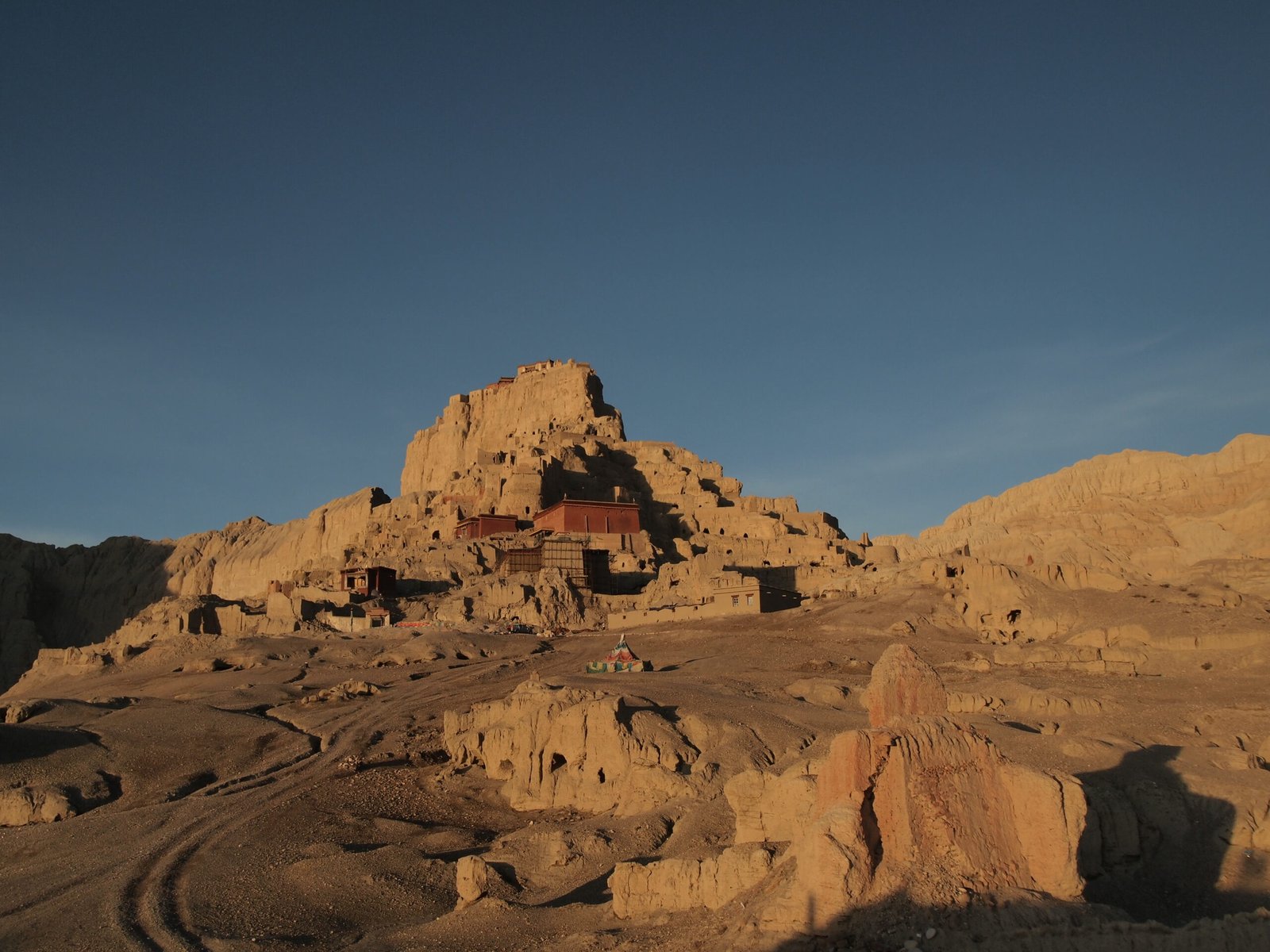
In the extreme western Tibetan plateau, the ruins of Tsaparang crown a 300-metre erosional butte above the Sutlej River — the abandoned capital of the Kingdom of Guge, whose royal chapels contain what the art historian Pratapaditya Pal called the finest Buddhist wall paintings in Central Asia, 600 years old and preserved in near-perfect condition by the extreme aridity of the Sutlej valley.
At a glance
Tsaparang, 25 km west of Zanda in the Tibet Autonomous Region of China, was the capital of the Kingdom of Guge from approximately 950 to 1630 AD. The site is a dramatic clay butte approximately 300 metres high crowded with the ruins of thousands of residential caves, defensive towers, royal palaces, and — at its summit — two royal chapels whose interior walls are covered in murals blending Kashmiri, Pala Indian, and early Tibetan artistic traditions. The kingdom was a crucial link in the transmission of Tantric Buddhism from Kashmir and India to Tibet during the 11th-century Second Diffusion. Its violent end in 1630 left the site inhabited by a handful of monks until the 18th century, then abandoned entirely until Italian scholar Giuseppe Tucci visited in 1933.
Key facts
- Kingdom period: c. 950–1630 AD (Purang-Guge dynasty)
- Location: Sutlej River valley, Zanda County, Tibet Autonomous Region, China; approximately 25 km west of Zanda town
- Site dimensions: butte approximately 300 metres high; ruins extend over the full summit and multiple cliff terraces
- Wall paintings: two royal chapels (White Temple, Red Temple) with murals c. 600 years old in a distinctive Kashmiri-Pala-Tibetan synthetic style; considered among the finest Buddhist paintings in Central Asia
- Historical significance: key centre of the Buddhist Second Diffusion (phyi dar); site of Atiśa’s court visit in 1042 AD; home of translator Rinchen Zangpo
- Rediscovered: by Italian orientalist Giuseppe Tucci in 1933; subsequent excavations and conservation by Chinese authorities
- Access: requires Tibet Travel Permit + Alien Travel Permit; accessible only via organised tour from Lhasa or Kashgar
History
The Kingdom of Guge was founded around 950 AD by Nyima Gon, a great-grandson of Langdarma — the last king of the Yarlung Tibetan Empire, whose assassination in 842 AD ended the first period of Buddhist dominance in Tibet and whose descendants fled west to establish new dynasties in the remote valleys of the Tibetan plateau’s western edge. From its capital at Tsaparang, the Kingdom of Guge controlled the lucrative trade routes through the Sutlej valley connecting India, Kashmir, and the Tibetan interior. Its kings became enthusiastic patrons of the Buddhist restoration: in 1042 AD the Guge king Yeshe-O invited the Bengali Buddhist master Atiśa (Dipankara Śrījñāna) to his court, beginning a collaboration that — combined with the prodigious translation work of the royal scholar Rinchen Zangpo (c. 958–1055 AD), who translated over 150 Sanskrit Buddhist texts into Tibetan — established the doctrinal and artistic foundations for the Second Diffusion of Buddhism across Tibet.
The wall paintings commissioned by the Guge kings during the 11th–15th centuries represent the principal artistic legacy of the kingdom. The White Temple (Lhakhang Karpo) and Red Temple (Lhakhang Marpo) at the summit of the Tsaparang butte preserve murals on every interior wall and ceiling — scenes from the life of the Buddha, Bodhisattva assemblies, Tantric deity mandalas, and portraits of royal donors — painted in a style that shows the full synthesis of the Kashmiri Shahi workshop tradition (with its characteristic warm palette, elongated figures, and elaborate jewellery detail), the Pala Indian tradition of Bengal (with its dynamic postures and narrative density), and distinctively Tibetan conventions of spatial organisation and iconographic detail. The art historian Pratapaditya Pal, who examined the murals in the 1980s, called them superior to anything surviving in either Kashmir or Bengal.
The kingdom’s end in 1630 AD was violent and poorly documented. The primary account describes a siege of Tsaparang by the king of Ladakh in alliance with the Guge king’s rebellious brother — a conflict apparently rooted in the king’s conversion to Catholicism under the influence of Jesuit missionaries from the Agra mission, which alienated the Buddhist clergy and nobility. The Guge king is said to have surrendered himself to the besieging army to prevent the massacre of his people, after which the nobles and Buddhist clergy were executed, the city was stripped, and the population was forcibly resettled in Ladakh. The city was inhabited by a small monastic community until the 18th century and then abandoned entirely.
What you see
The Tsaparang site rises in distinct levels from the valley floor. At the base, the eroded clay slopes are honeeycombed with domestic cave dwellings — hundreds of rooms carved into the cliff face, many with intact plastered walls, niches, and storage chambers, representing the residential quarters of the kingdom’s artisan and merchant population. Climbing upward through a series of passages and ladders, the terraces of the middle level contain the remains of larger structures — administrative buildings, temples, and the upper residential quarters — before the summit is reached via a narrow passage through the rock face.
The summit chapels are the goal of every serious visitor. The White Temple, approximately 15 × 10 metres, preserves its original wooden door frames and floor-to-ceiling murals in remarkable condition — the extreme aridity of the Sutlej valley (annual rainfall under 100 mm) has protected the pigments from moisture damage. The colours — lapis lazuli blue, malachite green, cinnabar red, gold leaf — remain vivid. The Red Temple, slightly larger, houses a principal Buddha image on a throne platform with murals of the Thirty-five Confessional Buddhas and donor portraits of the Guge royal family in their finest court dress. A small Victory Chapel (Khorchag) contains earlier paintings attributed to the 11th century and considered the oldest surviving Guge murals.
Practical information
- Tibet Travel Permit: required for all foreign visitors; must be arranged through a licensed Chinese travel agency; obtainable through authorised tour operators in Lhasa
- Alien Travel Permit: additionally required for Ngari prefecture (western Tibet); issued in Shigatse or Lhasa
- Organised tours only: independent travel to Ngari is not permitted for foreign visitors
- Best season: June–September; the Sutlej valley road can be blocked by snow or rain-caused landslides outside this window
- Site opening: Tsaparang is an administered archaeological site; standard opening hours apply; modest entrance fee
- Photography: permitted on site exterior; restrictions may apply inside the chapels; check with local authorities
Getting there
Tsaparang is accessed from Zanda town (also written Tholing), approximately 25 km east on the Sutlej valley road. Zanda is reached from Lhasa via a 4–5 day overland journey through Shigatse and the Manasarovar area, or from the Ali (Shiquanhe) airport served by flights from Lhasa and Chengdu. The standard route for foreign visitors is an organised circuit from Lhasa combining Manasarovar, Mount Kailash, and the Guge sites — a journey of approximately 10–14 days covering some of the most remote terrain on earth.
Nearby
- Tholing Monastery — in Zanda town, 25 km east; 11th-century monastery founded by Rinchen Zangpo with surviving murals and a large assembly hall
- Mount Kailash (Gang Rinpoche) — the most sacred mountain in Asia for Hindus, Buddhists, Jains, and Bon followers; 4-day kora (circumambulation); approximately 2 days drive northeast
- Lake Manasarovar (Mapam Yumco) — sacred high-altitude lake at 4,590 m near Mount Kailash; ritual bathing site for Himalayan pilgrims
- Zanda Earth Forest — the dramatic erosional badlands of the Sutlej valley, characteristic of the region’s geological history
Sources
- Tucci, Giuseppe. Indo-Tibetica, vol. III–IV. Reale Accademia d’Italia, 1935–1936. (First systematic documentation of Tsaparang.)
- Pal, Pratapaditya. Himalayas: An Aesthetic Adventure. Art Institute of Chicago / University of California Press, 2003.
- Heller, Amy. Early Himalayan Art. In Tibetan Art: Tracing the Development of Spiritual Ideals. Jain Publishing, 1999.
- Wikipedia contributors. Tsaparang. Accessed June 2026.
Find it on the map
See this place and what’s around it →📷 Become a Cultural Heritage Online photographer
Share your photos of places: they stay published under your name as the author. The more they're seen, the more you get noticed — and soon a contest will reward the most appreciated photos.
Log in or sign up free to add a photo