
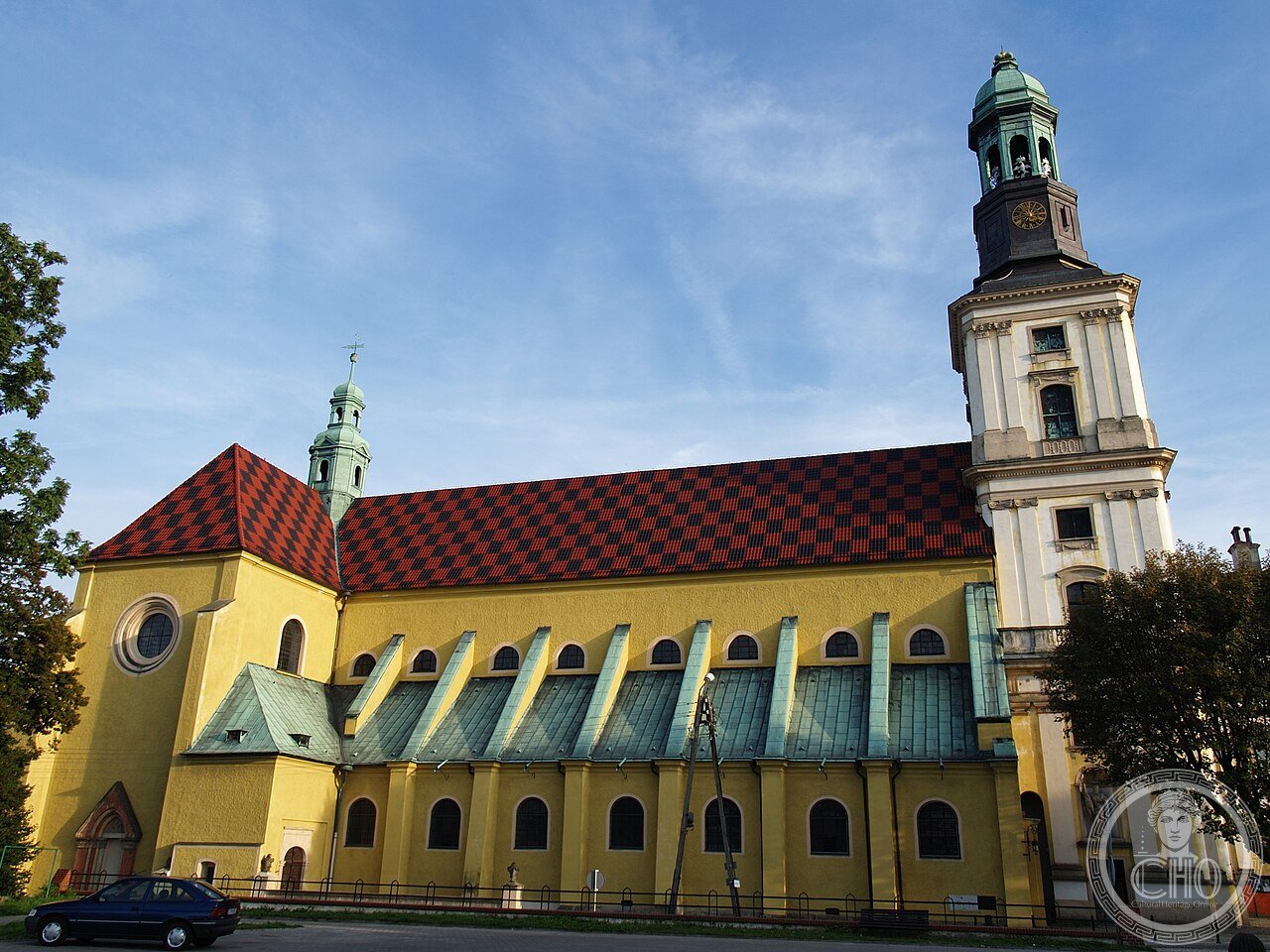
Nel 1202, il duca Enrico il Barbuto e sua moglie Edvige di Andechs fondarono a Trzebnica il primo convento femminile della Polonia, popolato inizialmente da benedettine giunte dalla Baviera. Dopo la canonizzazione di Edvige nel 1267, i pellegrini iniziarono ad affluire in massa, e il nipote della santa, arcivescovo di Salisburgo, fece costruire tra il 1268 e il 1269 la Cappella di Santa Edvige — il primo edificio interamente gotico mai costruito in Polonia. Nel corso dei secoli, la basilica divenne il mausoleo dinastico dei Piast di Slesia: vi furono sepolti in tutto 22 membri della casata.
About the Basilica of Trzebnica
The nunnery at Trzebnica was founded in 1202 by the Silesian Piast Duke Henry I the Bearded and his wife, Saint Hedwig of Andechs, with the foundation formally confirmed by Pope Innocent III. Trzebnica became the seat of the first female convent established in Poland, initially populated by Benedictine nuns brought a year later from the monastery of St. Theodor in Bamberg, Bavaria; Duke Henry endowed the community generously, granting it Trzebnica itself along with twelve surrounding villages, while Cistercian monks from nearby Lubiąż also provided assistance in the community’s early establishment. Soon after the convent’s arrival, construction began on one of the first brick churches built in the Romanesque style anywhere in Poland — a three-aisle basilica with a transept, a chancel closed by an apse, and two flanking chapels, dedicated to St. Bartholomew the Apostle and, later, to St. Hedwig herself. Following Hedwig’s canonisation in 1267, a mass influx of pilgrims began arriving at Trzebnica, and in 1268-1269 her grandson, Władysław, Archbishop of Salzburg, funded the construction of the Chapel of St. Hedwig — recognised as the first building in Poland constructed entirely in the Gothic style, marking a significant moment in the architectural history of the country. From its earliest years, the basilica also served as a dynastic mausoleum for the Silesian Piasts: a total of 22 members of the family were ultimately buried within its walls, and until 1515 every abbess of the convent was drawn from among the dynasty’s own female members, cementing Trzebnica’s status as both a major pilgrimage site and the central religious institution of the Silesian Piast dynasty.
Key facts
- 1202: founded by Duke Henry the Bearded and Saint Hedwig of Andechs
- 1203: Benedictine nuns arrive from Bamberg, Bavaria
- Early 13th century: one of the first brick Romanesque churches in Poland built
- 1267: Hedwig canonised, sparking mass pilgrimage
- 1268-1269: Chapel of St. Hedwig built, Poland’s first fully Gothic building
- Until 1515: all abbesses drawn from the Silesian Piast dynasty
- Dynastic mausoleum: 22 members of the Silesian Piasts buried here
History
Trzebnica’s founding as Poland’s first female convent, established under direct ducal and papal patronage, situates the community at the very origin of organised female monasticism in the country, its early Benedictine population imported directly from Bavaria reflecting the close dynastic and ecclesiastical ties between Silesia and southern Germany in the early 13th century. The Chapel of St. Hedwig’s status as the first fully Gothic building in Poland, commissioned by the saint’s own grandson within just two years of her canonisation, marks a genuinely foundational moment in Polish architectural history, introducing the Gothic style to the country through an explicitly dynastic and devotional commission.
The basilica’s role as burial site for 22 members of the Silesian Piast dynasty, sustained by the tradition of electing only dynastic abbesses until 1515, gave Trzebnica an institutional continuity binding religious governance directly to noble bloodline for roughly three centuries — an unusually close fusion of monastic and dynastic authority within a single medieval Polish religious house.
What you see
The basilica preserves its early 13th-century Romanesque brick core, a three-aisle plan with transept and apse-closed chancel, one of the earliest surviving examples of this architectural type in Poland. The adjoining Chapel of St. Hedwig, built 1268-1269, presents the country’s first fully Gothic architectural forms, standing in direct contrast to the older Romanesque fabric of the main church. Within the basilica, the tombs of numerous Silesian Piast dukes and duchesses remain visible, testifying to the site’s long dynastic mausoleum function.
Practical information
- Opening hours: generally open daily with seasonal variation; check current hours before visiting; free admission
- Address: Jana Pawła II 3, 55-100 Trzebnica, Poland
Getting there
The Basilica of St. Bartholomew and St. Hedwig is located in the town of Trzebnica, north of Wrocław, in Lower Silesia, Poland, reachable by road. GPS: 51.3095° N, 17.0670° E.
Nearby
- Trzebnica old town — the historic centre surrounding the basilica
- Trzebnickie Hills Landscape Park — the surrounding protected landscape
- Wrocław — the nearest major city, roughly 25 kilometres away
Sources
- Wikipedia — “Sanctuary of St. Jadwiga, Trzebnica” (en.wikipedia.org)
- MedievalHeritage.eu — “Trzebnica – Cistercian Nunnery” (medievalheritage.eu)
- Zabytek.pl — “Trzebnica – Former Cistercian Female Monastery Complex” (zabytek.pl)
Find it on the map
See this place and what’s around it →📷 Become a Cultural Heritage Online photographer
Share your photos of places: they stay published under your name as the author. The more they're seen, the more you get noticed — and soon a contest will reward the most appreciated photos.
Log in or sign up free to add a photo