
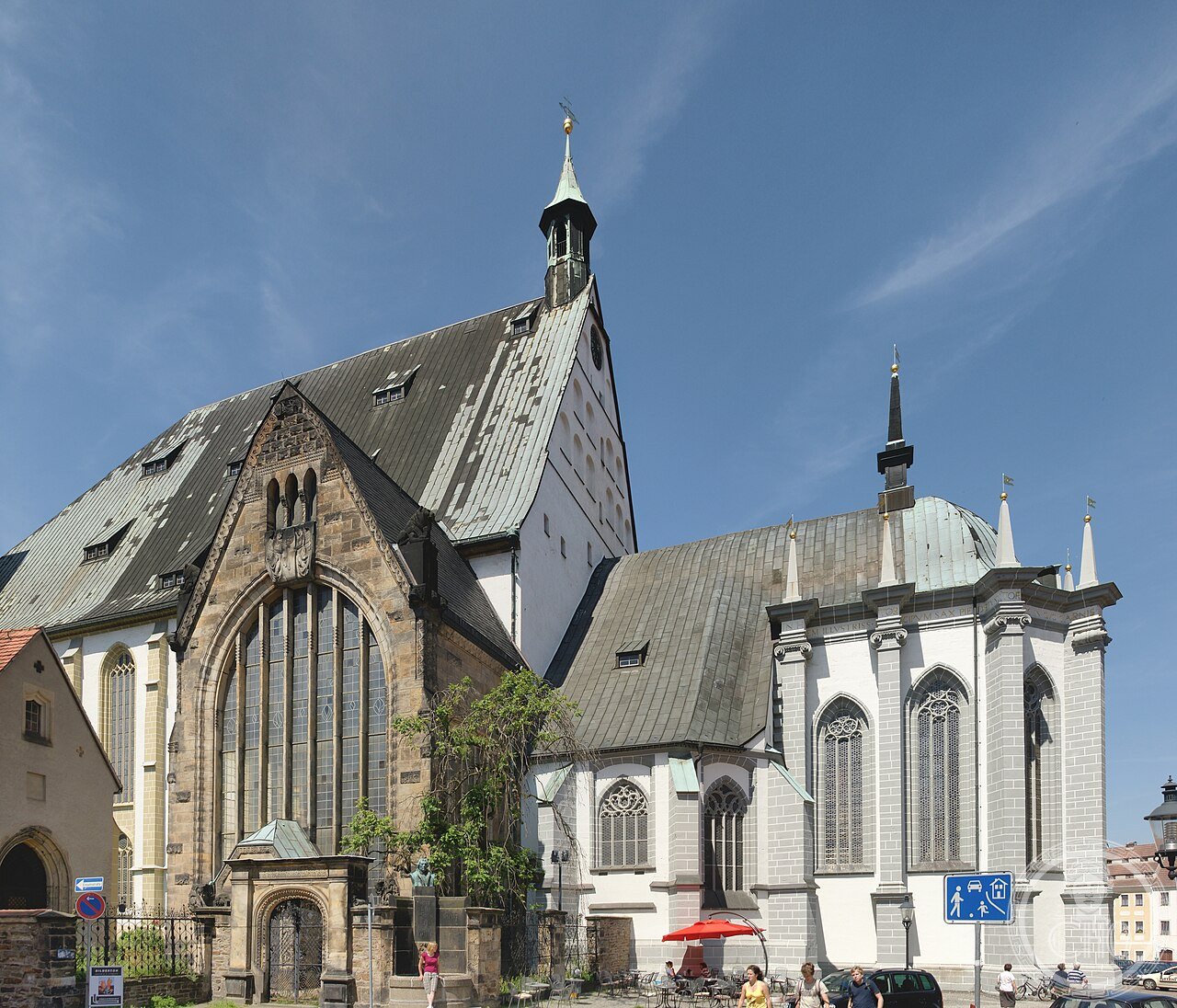
Around 1180 the discovery of rich silver veins in the Ore Mountains turned Freiberg into one of the wealthiest towns in Saxony, and on that wealth the basilica of Our Lady rose. In 1230 the Golden Gate was finished, a richly carved and once gilded Romanesque portal. In the choir, remade in the sixteenth century as a dynastic mausoleum, nine rulers of the house of Wettin rest. And on the west gallery, between 1711 and 1714, a twenty-seven-year-old organ builder named Gottfried Silbermann built his first great organ — the beginning of one of the most celebrated organ-building traditions in Europe.
About Freiberg Cathedral
Around 1180, a basilica dedicated to Our Lady was built in Freiberg, a town then rapidly developing thanks to the recent discovery of rich silver deposits in the nearby Ore Mountains; over more than eight centuries of subsequent mining, Freiberg’s silver mine would produce roughly 8,000 tonnes of the precious metal, earning the town its lasting nickname as Germany’s “Silver City.” The cathedral’s most celebrated medieval feature is the Golden Gate, a late Romanesque sandstone portal dating from 1230, richly carved and originally painted in vivid colours, whose name — first documented as “gulden thure” in 1524 — likely reflects that original gilded polychromy. The Golden Gate’s tympanum depicts the enthroned Virgin holding the Christ Child, surrounded by the Three Magi, Saint Joseph, and angels, with further sculptural programmes depicting Old Testament figures and scenes of salvation and the Last Judgment. Following a major fire in 1484, the portal was relocated to the cathedral’s southern side during its rebuilding, and in 1902-1903 an protective extension was constructed to shield the sculpture from weathering. The cathedral’s single-nave choir was redesigned during the 16th century to serve as the dynastic burial chapel of the House of Wettin, and between 1541 and the conversion of Augustus the Strong to Catholicism, nine rulers of Saxony were interred within the choir, making Freiberg Cathedral one of the principal Wettin dynastic mausoleums. On the western gallery stands the great organ built between 1711 and 1714 by Gottfried Silbermann — his first large-scale instrument, completed when the organ builder was just 27 years old, featuring three manuals, 44 stops, and 2,574 pipes; a smaller second Silbermann organ, with 14 stops, stands opposite it, together making Freiberg Cathedral home to two of the most significant surviving instruments by one of the greatest organ builders in European history.
Key facts
- c. 1180: basilica built, funded by newly discovered silver wealth
- 1230: the Golden Gate Romanesque portal completed
- 1484: fire prompts rebuilding; the Golden Gate relocated to the south side
- 1541-Augustus the Strong’s conversion: nine rulers of Saxony buried in the choir
- 1711-1714: Gottfried Silbermann’s first great organ built, aged 27
- 1902-1903: protective extension built to shield the Golden Gate
- Over 800 years: Freiberg’s silver mining tradition, producing around 8,000 tonnes of silver
History
Freiberg Cathedral’s origins as a direct product of the town’s sudden 12th-century silver wealth situates the church within a broader medieval European pattern of resource-driven urban and ecclesiastical development, in which mineral wealth translated rapidly into monumental religious architecture — here made explicit by the Golden Gate’s very name, likely referencing gilded decoration funded by the same silver economy that built the town around it. The cathedral’s 16th-century transformation into the principal burial site of the House of Wettin, one of the most significant ruling dynasties of the Holy Roman Empire, gave Freiberg lasting dynastic and political importance well beyond its origins as a mining town’s parish church.
Gottfried Silbermann’s 1711-1714 organ at Freiberg, completed at the very start of his career, marked the beginning of a body of work that would establish him as one of the most influential organ builders in German musical history, his instruments later admired and studied by figures including Johann Sebastian Bach — making the Freiberg organ a foundational monument in the wider history of German Baroque organ building.
What you see
The Golden Gate remains the cathedral’s most celebrated exterior feature, its richly carved Romanesque sculptural programme protected since 1902-1903 by a dedicated architectural extension. Inside, the Wettin dynastic choir houses the tombs of nine Saxon rulers amid elaborate 16th-century tracery and pilasters, while the west gallery’s great 1714 Silbermann organ, alongside its smaller companion instrument, remains in active use for concerts and services, its sound still considered among the finest examples of historic German organ building.
Practical information
- Opening hours: generally open daily with seasonal variation; check current hours before visiting; admission fee applies
- Address: Am Dom 7, 09599 Freiberg, Germany
Getting there
Freiberg Cathedral is located in the historic centre of Freiberg, in the Ore Mountains region of Saxony, easily reachable on foot. GPS: 50.9201° N, 13.3437° E.
Nearby
- Freiberg Silver Mine — one of Saxony’s oldest and largest historic silver mines, nearby
- Freiberg Old Town — the surrounding historic centre
- Mining Region of the Erzgebirge/Krušnohoří — the wider UNESCO-listed mining landscape
Sources
- Wikipedia — “Freiberg Cathedral” (en.wikipedia.org)
- Ev.-luth. Domgemeinde Freiberg — “Golden Gate” and “The Great Organ by Gottfried Silbermann” (freiberger-dom.de)
- Silberstadt Freiberg — “Cathedral of St. Mary with Silbermann Organs” (freiberg.de)
Find it on the map
See this place and what’s around it →📷 Become a Cultural Heritage Online photographer
Share your photos of places: they stay published under your name as the author. The more they're seen, the more you get noticed — and soon a contest will reward the most appreciated photos.
Log in or sign up free to add a photo