
Japan first government-operated silk reeling factory, built in 1872 under French direction, launched the industrialisation of Meiji Japan and transformed the country into the world largest silk exporter. UNESCO World Heritage Site since 2014.
At a glance
The Tomioka Silk Mill stands in Tomioka City, Gunma Prefecture, roughly 100 km northwest of Tokyo. Constructed in 1872 on the direct orders of the Meiji government and designed by French engineer Paul Brunat, it represents Japan first deliberate, large-scale technology transfer from Western industrial practice. The mill operated continuously for 115 years, from 1872 to 1987, and its principal buildings survive in extraordinary condition, still containing much of their original French machinery. UNESCO World Heritage Site 2014 as part of Tomioka Silk Mill and Related Sites.
Key facts
- Built: 1872, operational from June 1872
- Engineer: Paul Brunat, France, directed construction and trained first workers
- Operated: 1872 to 1987, 115 years; owned successively by Meiji government, Mitsui, Katakura Industries
- UNESCO: Inscribed 2014, serial nomination, 4 components in Gunma Prefecture
- Area: Approx. 5.5 hectares; main buildings in red brick with timber frame interiors
- Machinery: Original French reeling machines partly still in place inside the Silk Reeling Building
- Workers: Initially 400 female operatives trained by French instructors, then disseminated techniques nationwide
- Peak output: Japan became world largest silk exporter by early 20th century, directly from Tomioka model
History
When Japan opened to the world after the Meiji Restoration of 1868, silk was the country primary export earner and its quality was declining. The new Meiji government, determined to modernise the economy, recruited Paul Brunat, a French silk merchant based in Yokohama, to oversee construction of a model reeling factory using the best available French technology.
Construction began in 1871 and the mill opened in June 1872. The government recruited several hundred young women from samurai families across Japan to be trained as operatives. Those who trained at Tomioka returned to their home regions and spread modern silk reeling throughout the industry. Within a generation, Japan silk industry had been transformed and dominated world markets.
The mill passed from government to private hands, Mitsui in 1893 and Katakura Industries in 1939, and continued operating with gradual modernisation until closure in 1987. Tomioka City acquired the site in 2005 and opened it to visitors.
What you see
The dominant impression is of French industrial architecture transplanted intact to rural Japan. The East and West Cocoon Warehouses are enormous two-storey red-brick structures, each approximately 100 metres long, built with French bond brickwork and large windows designed to ventilate stored cocoons. The brick was fired on site from local deposits.
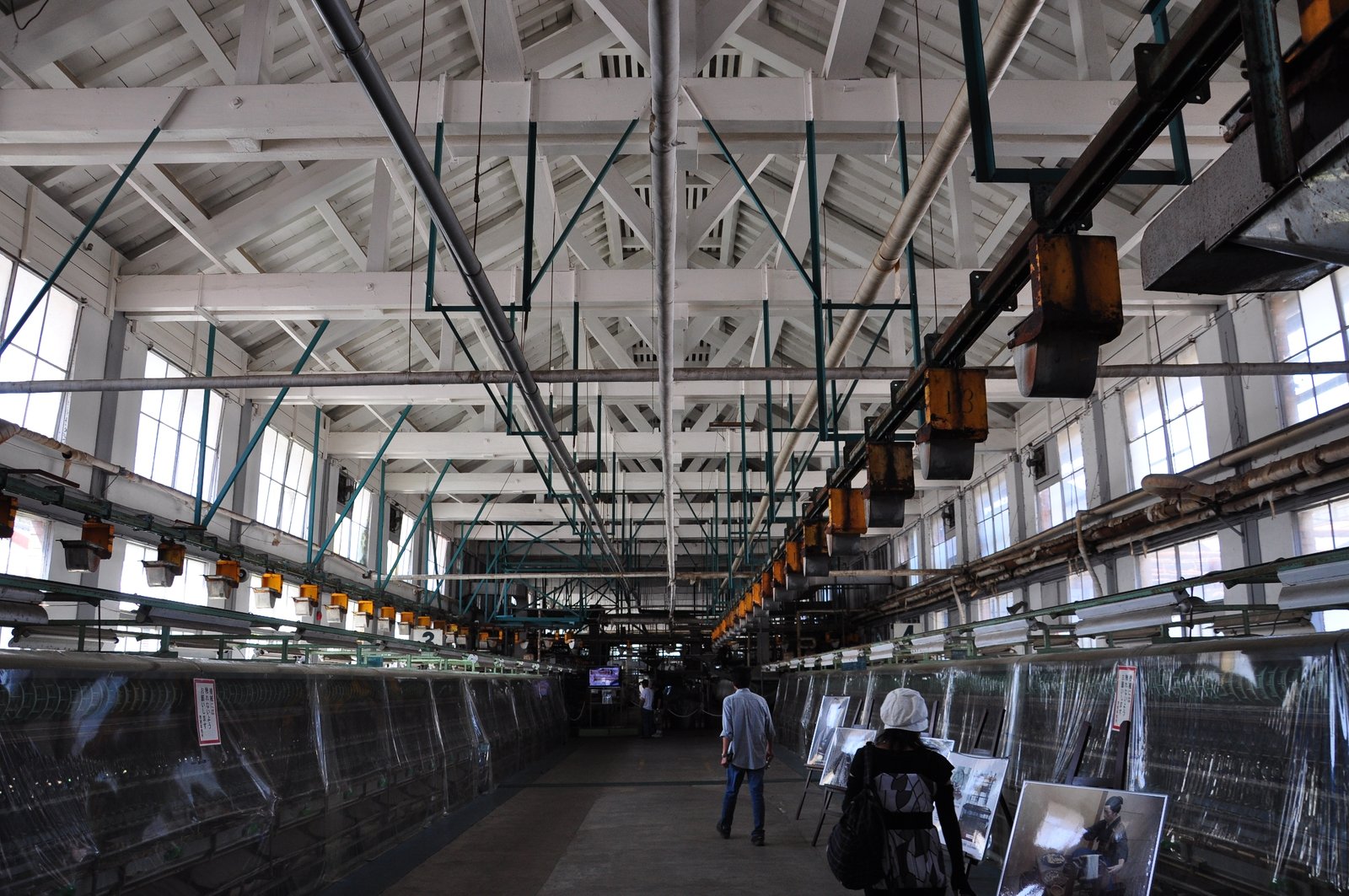
The central Silk Reeling Building, where actual reeling took place, is a grand structure with a high interior space designed to accommodate steam-powered machinery. Original Gosselin reeling machines, some still present, were imported directly from France. The complex retains workers housing, a residence for Paul Brunat, a hospital, and ancillary structures giving a complete picture of a 19th-century industrial community.
The four UNESCO components also include Tajima Yahei Sericulture Farm, Takayama-sha Sericulture School, and Arafune Cold Storage, together tracing the complete silk production chain from egg to thread.
World Heritage significance
The UNESCO inscription recognises Tomioka as a document of how Japan achieved technology transfer in the 19th century: a deliberate government decision to import foreign expertise, train a local workforce, and systematically disseminate the technology nationwide. This model transformed Japan from a declining silk producer into the world largest exporter within a single generation.
Tomioka is one of a group of sites inscribed to represent Meiji-era industrialisation, alongside the Sites of Japan Meiji Industrial Revolution which includes Hashima Island. Unlike Hashima, Tomioka inscription has been uncontroversial: there is no record of forced labour, and the site preservation is exemplary.
Practical information
- Address: 1-1 Tomioka, Tomioka City, Gunma Prefecture 370-2316, Japan
- Opening hours: Daily 09:00 to 17:00, entry until 16:30; closed 29-31 December
- Admission: Adults 1,000 yen; reductions for students and groups
- Guided tours: Available in Japanese; audio guides for other languages on-site
- Photography: Permitted throughout including inside the Silk Reeling Building
Getting there
From Tokyo: Shinkansen to Takasaki, approximately 50 minutes, then local train on the Joshin Dentetsu Line to Joshu-Tomioka Station, approximately 30 minutes, then 15 minutes walk. Total journey approximately 1.5 to 2 hours. Direct highway buses also operate from Shinjuku bus terminal taking approximately 2 hours. Car parking is available at the site.
Nearby
- Arafune Cold Storage – natural silkworm egg refrigeration cave, part of the same UNESCO serial nomination, approx. 40 km northwest
- Shimonita – historic post town in the Karabori valley, 30 km west
- Kusatsu Onsen – one of Japan most celebrated hot spring resorts, approximately 90 km northwest
Sources
- UNESCO World Heritage Centre – Tomioka Silk Mill and Related Sites, whc.unesco.org/en/list/1449
- Tomioka City official site, tomioka-silk.jp
- Wikipedia – Tomioka Silk Mill, en.wikipedia.org/wiki/Tomioka_Silk_Mill
Find it on the map
See this place and what’s around it →📷 Become a Cultural Heritage Online photographer
Share your photos of places: they stay published under your name as the author. The more they're seen, the more you get noticed — and soon a contest will reward the most appreciated photos.
Log in or sign up free to add a photoIs this page about you?
This page is read by travellers and heritage enthusiasts who find it on Google. Tell us how you are connected to this place and we will take it from there.