
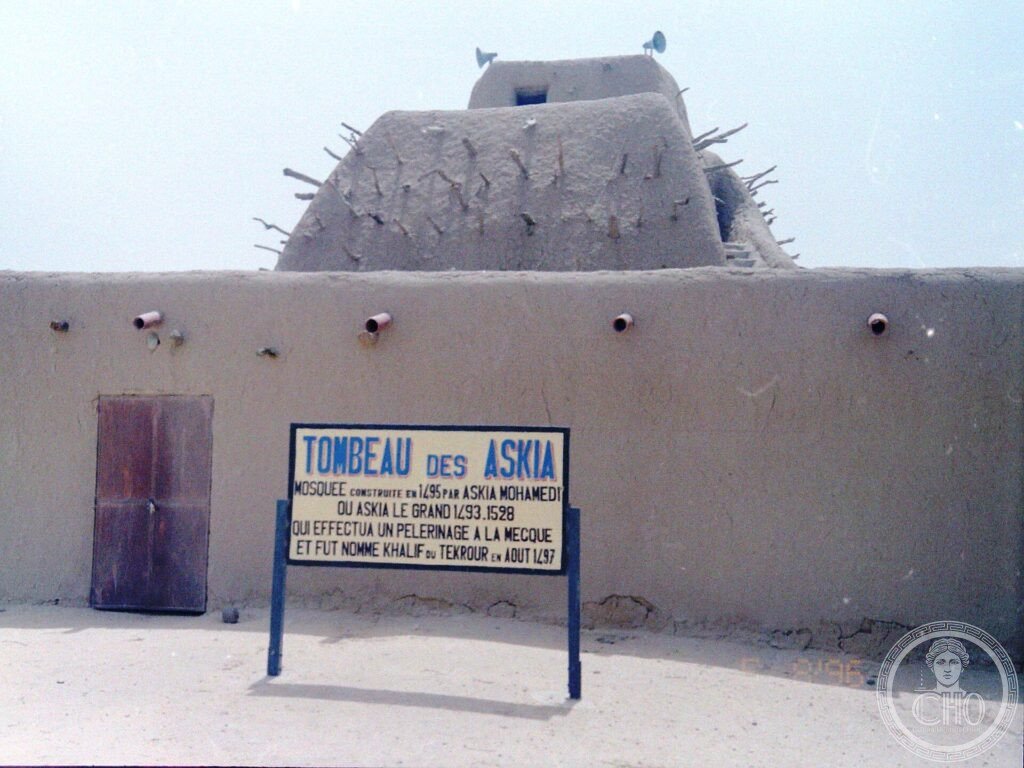
At Gao, on the banks of the Niger, rises a mud tower in the shape of a truncated pyramid, bristling with the palm beams that make its annual repair possible: it is the tomb of Askia Mohammad, the great emperor of Songhai, built in 1495. A masterpiece of the earthen architecture of West Africa, and still a place of worship.
At a glance
The Tomb of Askia, in the city of Gao on the Niger River in Mali, is a striking 17-metre stepped pyramid of mud, built in 1495 for Askia Mohammad I, the most powerful ruler of the Songhai Empire. Bristling with the projecting palm beams that allow its mud surface to be re-plastered each year, it is a masterpiece of West African earthen architecture and a reflection of the wealth and Islamic faith of one of the great empires of the Sahel. The complex, which includes two mosques and a cemetery, was inscribed by UNESCO in 2004.
Key facts
- UNESCO: World Heritage since 2004 (Tomb of Askia)
- Built 1495: for the Songhai emperor Askia Mohammad I
- Earthen pyramid: a 17 m stepped tower of mud
- Songhai Empire: one of the great empires of the West African Sahel
- Sudano-Sahelian style: mud architecture with projecting beams
- Living monument: still a place of worship, re-plastered yearly
History
In the late 15th century the Songhai Empire, ruled from Gao, was one of the largest and richest states in African history, controlling the trans-Saharan trade and the famed centres of learning at Timbuktu. Its ruler Askia Mohammad, who made a celebrated pilgrimage to Mecca and promoted Islam across his realm, had this monumental tomb built around 1495, blending local building traditions with influences from his pilgrimage.
The pyramidal earthen tomb, with its mosques and burial ground, has been maintained ever since by the community, who re-plaster its mud surface in an annual ritual using the embedded wooden beams as scaffolding. A symbol of the Songhai golden age, it was inscribed by UNESCO in 2004, and has at times been listed in danger amid conflict in northern Mali.
What you see
The tomb rises as a tapering, stepped cone of smooth ochre mud, studded all over with the protruding ends of palm-wood beams (toron), with stairways and a flat top. Around it stand two flat-roofed mud mosques and an open-air prayer ground and cemetery, the whole forming a living religious complex in the heart of Gao.
The sculptural earthen pyramid, bristling with beams against the desert sky, is the image of Songhai grandeur.
Practical information
- Site: a living mosque-and-tomb complex in Gao
- Note: check current travel advice for northern Mali; on the danger list
- Time needed: under an hour
- Setting: on the Niger River in eastern Mali
Getting there
The Tomb of Askia is in the city of Gao, on the Niger River in eastern Mali. Access depends on the security situation in northern Mali. GPS: 16.29° N, 0.04° W.
Nearby
- Gao — the historic Songhai capital around the tomb
- Niger River — the great river along the city
- Timbuktu — the famed UNESCO city of learning, upriver
Sources
- UNESCO World Heritage Centre — “Tomb of Askia” (ref. 1139)
- Malian Ministry of Culture — official body
- Encyclopaedia Britannica — Songhai Empire; Askia Muhammad I
Find it on the map
See this place and what’s around it →📷 Become a Cultural Heritage Online photographer
Share your photos of places: they stay published under your name as the author. The more they're seen, the more you get noticed — and soon a contest will reward the most appreciated photos.
Log in or sign up free to add a photoIs this page about you?
This page is read by travellers and heritage enthusiasts who find it on Google. Tell us how you are connected to this place and we will take it from there.