
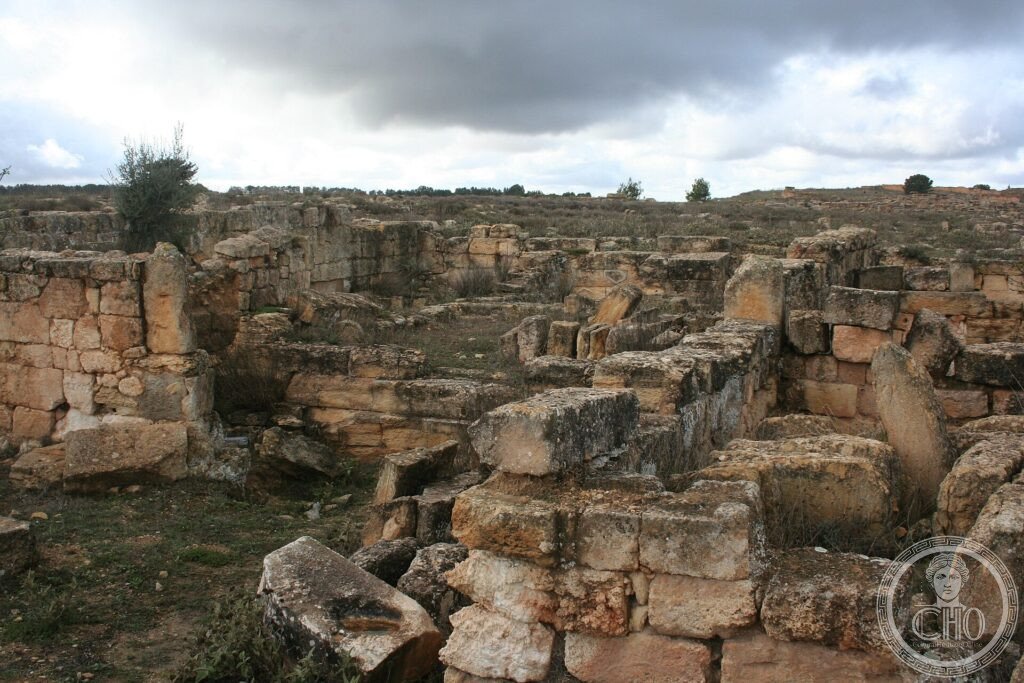
Founded by Greek colonists in the seventh century BC on a plateau overlooking the Mediterranean, Cyrene became one of the most splendid cities of the Greek world and gave its name to an entire region, Cyrenaica. Temples, theatres, necropolises and the sanctuary of Apollo bear witness to more than a thousand years of Greek and Roman history on the Libyan coast.
At a glance
Cyrene, in the Cyrenaica region of north-eastern Libya, was one of the greatest cities of the ancient Greek world. Founded by Greek colonists from the island of Thera in the 7th century BC, it grew rich and renowned, a centre of learning that gave its name to the whole surrounding region. Later a Roman city, it left a vast field of ruins on its hillside above the sea — the sanctuary of Apollo, temples, a theatre, agora and extensive necropolises — spanning more than a thousand years. It was inscribed by UNESCO in 1982.
Key facts
- UNESCO: World Heritage since 1982 (Archaeological Site of Cyrene)
- Founded: 7th century BC, by Greek colonists from Thera
- Cyrenaica: the city gave its name to the whole region
- Sanctuary of Apollo: the great religious heart of the city
- Greek and Roman: over a thousand years of building
- Necropolises: vast cemeteries of carved tombs
History
According to tradition, Greeks from the island of Thera, guided by the oracle of Delphi, founded Cyrene around 631 BC on a fertile upland near the Libyan coast. It flourished as the chief city of a group of Greek colonies, a centre of philosophy, medicine and the arts, and home to the philosopher Aristippus and the mathematician Eratosthenes. The region became famous, too, for the now-extinct medicinal plant silphium.
Passing under Ptolemaic and then Roman rule, Cyrene remained important for centuries, adorned with temples, baths and monuments, before earthquakes and changing times brought decline. Its extensive ruins, excavated in modern times, were inscribed by UNESCO in 1982, though the instability of Libya has since placed the country’s World Heritage sites on the danger list.
What you see
The ruins spread across the hillside: the sanctuary of Apollo with its temple and sacred spring below the upper town, the temple of Zeus, the agora, theatre and gymnasium, and the streets of the Greek and Roman city. Carved into the slopes and valleys around are great necropolises with rock-cut tombs and sarcophagi.
The scale of the ancient city, set on its green upland above the Mediterranean, conveys the grandeur of Greek Cyrenaica.
Practical information
- Site: an extensive archaeological site near the town of Shahhat
- Note: check current travel advice for Libya; the site is on the danger list
- Time needed: half a day or more
- Setting: on the Jebel Akhdar uplands of Cyrenaica
Getting there
Cyrene is by the town of Shahhat, in the Jebel Akhdar uplands of north-eastern Libya (Cyrenaica), inland from the Mediterranean coast. Access depends on the situation in Libya. GPS: 32.82° N, 21.86° E.
Nearby
- Apollonia — the ancient port of Cyrene on the coast
- Jebel Akhdar — the “green mountain” uplands
- Shahhat — the modern town beside the ruins
Sources
- UNESCO World Heritage Centre — “Archaeological Site of Cyrene” (ref. 190)
- Libyan Department of Antiquities — official body
- Encyclopaedia Britannica — Cyrene
Find it on the map
See this place and what’s around it →📷 Become a Cultural Heritage Online photographer
Share your photos of places: they stay published under your name as the author. The more they're seen, the more you get noticed — and soon a contest will reward the most appreciated photos.
Log in or sign up free to add a photo