

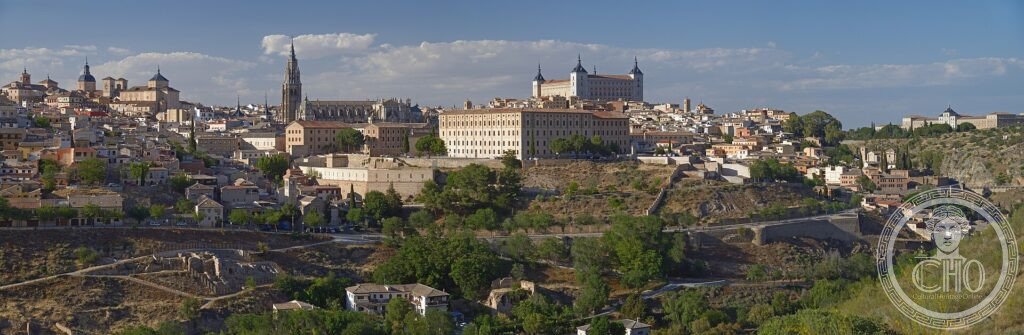
Perched on a hill encircled by the meanders of the Tagus, Toledo is a museum-city of absolute rarity: Christians, Muslims and Jews lived side by side here in a tolerance that survives in the street names, in the hybrid buildings, in the paintings of El Greco. Capital of Spain until Philip II, it remains intact and suspended in time.
At a glance
Toledo is one of the most spectacularly situated cities in Europe, perched on a steep rocky knoll entirely surrounded by three sides of the Tagus (Tajo) River. For more than a millennium it was the meeting point of Christian, Muslim and Jewish cultures—a crucible of coexistence that produced a unique artistic and intellectual synthesis. The narrow medieval streets, the Cathedral, the Alcázar fortress, the paintings of El Greco, and the remains of the medieval wall all speak to this layered history. The entire historic centre was inscribed by UNESCO in 1986.
Key facts
- UNESCO: World Heritage since 1986
- Medieval core: largely unchanged from the 15th–16th centuries, with original street plan
- Capital of Spain: from the 8th century (as a Muslim stronghold) until 1561, when Felipe II moved the court to Madrid
- Cathedral (1226–1493): one of the finest Gothic cathedrals in Spain, with paintings by El Greco
- El Greco: the painter lived and worked in Toledo; many of his works remain in the city
- Tri-cultural heritage: the Synagogue of Santa María la Blanca, the Mosque of Cristo de la Luz (now a church), and Jewish quarter (judería) survive intact
History
Toledo was known to the Romans as Toletum and became a major stronghold during the Visigothic kingdom. After the Muslim conquest in 711, it served as a frontier fortress and, later, a centre of Islamic learning. The Christian Reconquista brought Ferdinand I of Castile to the gates in 1085; the city fell and Toledo became Christian capital. What followed was a rare period of convivencia—coexistence—in which Christian, Muslim and Jewish scholars, craftsmen and merchants worked in close proximity, producing a unique cultural synthesis.
This golden age continued through the late medieval period, but began to fade when King Felipe II moved the royal court to Madrid in 1561. Yet in the 16th and 17th centuries, the painter Domenikos Theotokopoulos—known as El Greco—chose Toledo for his adopted home, and his distinctive manner infused the city’s visual identity with an unmistakable spirituality and elongation that has come to define it.
What you see
The Cathedral dominates the skyline and interior; its Gothic spire rises above the old town. Inside is a treasure of altarpieces and paintings, including works by El Greco. The Alcázar fortress crowns the highest point, commanding views over the Tajo gorge. The medieval street plan winds narrowly through the old quarter, with the synagogue of Santa María la Blanca (now a museum), the Mosque of Cristo de la Luz (a mosque repurposed as a church, with original Islamic stucco), and the small museum house of El Greco all preserved. The city walls, punctuated by gates and towers, still largely enclose the medieval town.
Practical information
- Getting there: from Madrid by train (30 min) or car (80 km); bus services also available
- Time needed: a full day to explore the Cathedral, museums, and the old quarter thoroughly
- Museum highlights: El Greco Museum, Synagogue of Santa María la Blanca, Mosque of Cristo de la Luz, Cathedral sacristy
- Note: many streets are very steep and narrow; wear comfortable shoes
Getting there
Toledo is located in Castilla-La Mancha, about 80 km south of Madrid. Direct trains run from Madrid-Atocha station in approximately 30 minutes. By car, it is a scenic drive through the Meseta. The old city is car-free; visitors park in the lower town or use the escalators and lifts built into the rock. GPS: 39.8581° N, 4.0268° W.
Nearby
- La Mancha windmills — the immortal landscape of Cervantes, about 60 km south-east
- Segovia — another medieval UNESCO city, about 150 km north-west
- Madrid — the Prado Museum and royal palace, 80 km north
Sources
- UNESCO World Heritage Centre — “Historic City of Toledo” (ref. 588)
- Ayuntamiento de Toledo — official city guide
- El Greco Museum — biographical essays and artwork documentation
- Encyclopaedia Britannica — Toledo, Spain
Find it on the map
See this place and what’s around it →📷 Become a Cultural Heritage Online photographer
Share your photos of places: they stay published under your name as the author. The more they're seen, the more you get noticed — and soon a contest will reward the most appreciated photos.
Log in or sign up free to add a photo