
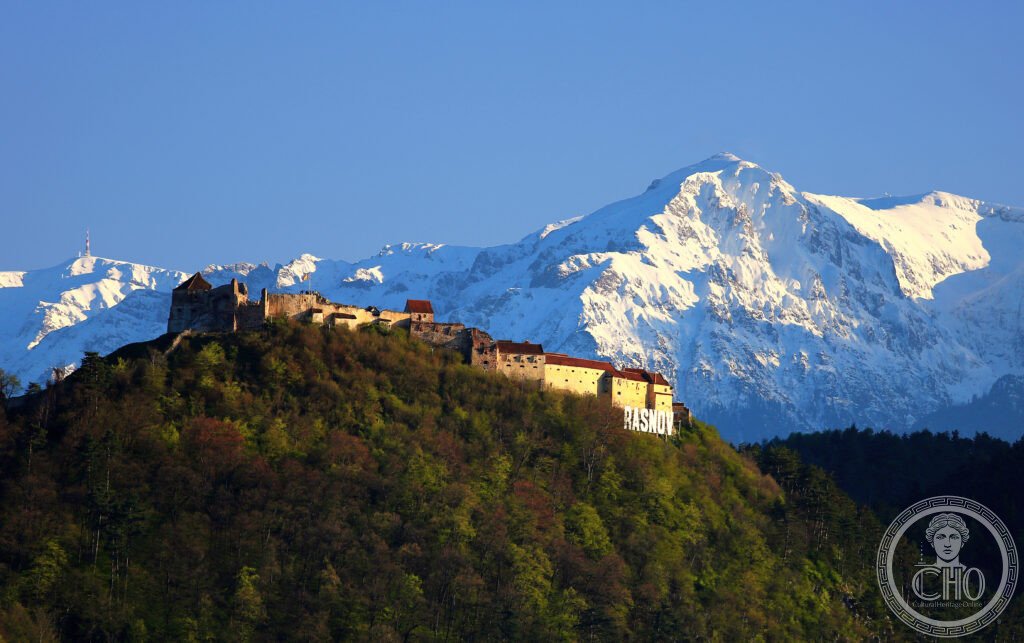
Above the village of Râșnov, between Brașov and Bran, stands one of the best preserved Saxon peasant fortresses of Transylvania: a collective refuge into which the whole community withdrew during raids. Its walls enclose houses, a school and a chapel, with spectacular views over the Carpathians.
At a glance
Râșnov Citadel crowns a rocky hill above the town of Râșnov, between Brașov and Bran in the Carpathian foothills. It is one of the best-preserved examples of a Transylvanian Saxon peasant fortress (Bauernburg) — not a lord’s castle but a communal refuge, where the inhabitants of the village and surrounding farms could shelter, with their provisions, during the frequent raids of the medieval and early-modern frontier. Within its walls are not just defences but a whole miniature town: houses, a school, a chapel and a deep well. From the ramparts there are sweeping views over the valley and mountains.
Key facts
- Built: from the 13th century, expanded through the 15th–17th centuries
- Type: Saxon peasant fortress (Bauernburg) — a communal refuge, not a noble castle
- Purpose: shelter for the population during Ottoman and Tatar raids
- Interior: a small fortified settlement with houses, school, chapel and a deep well
- Well: a famous deep well, said by legend to have been dug by Ottoman prisoners
- Position: commanding views over the Râșnov valley and the road between Brașov and Bran
History
Like other Transylvanian Saxon communities, the people of Râșnov built a hilltop fortress as collective protection against the raids that swept the Carpathian frontier — Tatars, Ottomans and others — from the 13th century onward. Unlike a feudal castle held by a lord, this was a Bauernburg: a refuge maintained and used by the whole peasant community. Families kept storerooms within the walls, and in time a small permanent settlement grew inside, with its own chapel and school.
The citadel was besieged and damaged at various points but remained a place of refuge into the early modern period. It later fell into disuse and partial ruin, but has been consolidated and opened to visitors, becoming, together with nearby Bran, one of the popular heritage sites of the Brașov area.
What you see
The approach climbs to a ring of stone walls and towers following the contour of the hilltop. Inside, narrow lanes wind between the small houses and storerooms that once sheltered the community, past the chapel and the remains of the school. The celebrated deep well plunges through the rock at the centre. From the walls and the upper terraces, the views extend over the red roofs of Râșnov, the patchwork of fields, and the wall of the Carpathians toward Bran and the Bucegi. Interpretive displays explain the life of a Saxon peasant fortress.
Practical information
- Getting there: between Brașov (about 15 km) and Bran (about 12 km); easy to combine with both
- Access: on foot up the hill, or by a small road train / shuttle from the town
- Time needed: about an hour; longer for the views and displays
- Combine with: Bran Castle and Brașov on the same day
Getting there
Râșnov lies on the road between Brașov and Bran, in Brașov county. The citadel sits on the hill above the town and is reached on foot or by a shuttle. GPS: 45.5879° N, 25.4604° E.
Nearby
- Bran Castle — the “Dracula” castle, about 12 km south
- Brașov and the Black Church — the great Saxon city, about 15 km north-east
- Bucegi and Piatra Craiului mountains — hiking and dramatic scenery nearby
Sources
- Râșnov local heritage and tourism documentation
- Studies of Transylvanian Saxon peasant fortresses (Bauernburgen)
- Encyclopaedia Britannica — Transylvania; the Saxons
- Institutul Național al Patrimoniului — Romanian heritage register
Find it on the map
See this place and what’s around it →📷 Become a Cultural Heritage Online photographer
Share your photos of places: they stay published under your name as the author. The more they're seen, the more you get noticed — and soon a contest will reward the most appreciated photos.
Log in or sign up free to add a photoIs this page about you?
This page is read by travellers and heritage enthusiasts who find it on Google. Tell us how you are connected to this place and we will take it from there.