

A 27-metre Anglo-Saxon longship dissolved in the acid Suffolk soil, leaving only the ghost of its iron rivets in the earth. When excavators traced that ghost in 1939, they found the greatest treasure hoard in British history — and the most important single find for understanding the world of Beowulf.
At a Glance
- Date
- c. 625 AD (Early Anglo-Saxon period)
- Type
- Ship burial mound cemetery (18+ mounds)
- Identity
- Likely King Rædwald of East Anglia (r. c. 599–624 AD)
- Excavated
- 1939 by Basil Brown; further work 1965–2005
- Key object
- Sutton Hoo Helmet (now British Museum’s most iconic Anglo-Saxon artefact)
- Body found
- No — either dissolved in acid soil or a cenotaph
- Film
- The Dig (Netflix, 2021) — Carey Mulligan, Ralph Fiennes
- Access
- National Trust, Sutton Hoo, Woodbridge, Suffolk IP12 3DJ
The Ghost Ship
Wood rots. In the slightly acidic soil of Suffolk, a timber ship buried for 1,300 years vanishes entirely — leaving behind only the iron rivets that once held its planks together. In 1939, those rivets were still in position, their arrangement tracing the outline of a 27-metre clinker-built longship in perfect silhouette in the sandy earth. The wood had gone. The shape remained.
Basil Brown, a self-taught archaeologist from Rickinghall, was hired by the landowner Edith Pretty for £2 per week to investigate the burial mounds on her estate at Sutton Hoo. Working methodically, he identified the rivet patterns and realised he was standing inside the outline of a ship. He excavated carefully around the central burial chamber, which had survived in a wooden-framed compartment within the ship’s hull. Inside it, he found one of the most extraordinary collections of objects ever uncovered on British soil.
The Treasure
The burial chamber contained objects that indicated a person of exceptional status. The Sutton Hoo Helmet is an iron face-mask helmet decorated with interlaced patterns and a distinctive full-face visor, and it has become the most recognised image of Anglo-Saxon England. With it were a ceremonial sword with a gold and garnet pommel, a decorated circular shield of Scandinavian type, a large silver dish of Byzantine origin, a set of silver tableware, a mail coat, a lyre in its beaver-fur bag, drinking horns with silver-gilt mounts and a ceremonial whetstone sceptre. A purse held 37 Merovingian gold coins plus 3 blank flans and 2 gold billets — a total of 40 items, interpreted by scholars as symbolic payment for the 40 oarsmen needed to ferry the dead to the afterlife.
No body was found in the chamber. The acid soil destroys bone as completely as wood. Whether a body was originally present and dissolved, or whether the mound was a cenotaph (a monument to someone buried elsewhere), has not been resolved. Most historians believe a body was present. The circumstantial identification with King Rædwald — the most powerful Anglo-Saxon king of his era, who appears to have hedged his bets between paganism and Christianity — is based on the coin dates, the burial’s grandeur, and its location in the East Anglian royal heartland.
Basil Brown and the Establishment
Basil Brown’s role in the Sutton Hoo discovery became a matter of historical dispute for decades. Brown was not a university-trained archaeologist. He was a local farmworker’s son who had taught himself surveying, astronomy, and excavation techniques largely from books. When the significance of his discovery became apparent, officials from the Cambridge-based establishment — including Charles Phillips of the British Museum — effectively took over the dig, with Brown relegated to an assistant’s role in the very trench he had opened.
The 2021 Netflix film The Dig dramatised this displacement, with Ralph Fiennes playing Brown with quiet dignity against institutional condescension. In official post-war accounts, Brown’s name was initially marginalised. It took decades of historical revision to restore him to full credit. The National Trust, which now manages the site, prominently honours Brown’s contribution. The find is now formally described in most archaeological literature as Basil Brown’s discovery.
Edith Pretty, the landowner, donated the entire treasure to the British Museum at the outbreak of World War II — at the time described as the most generous gift to the nation in the museum’s history. She died in 1942. A memorial to her stands at the site.
Sutton Hoo and Beowulf
The Old English poem Beowulf opens with a ship funeral: the body of the Danish king Scyld Scefing is laid in a treasure-laden ship and set adrift at sea. Scholars have long noted the parallels between this description and the Sutton Hoo burial. The poem was almost certainly composed in East Anglia or its cultural orbit, around the time the Sutton Hoo burial was made. Some scholars argue the poet may have had direct knowledge of the burial rite practised here.
Whether or not there is a direct connection, Sutton Hoo demonstrates that the heroic warrior world described in Beowulf was not purely literary invention. The objects found in the burial chamber — the helmet, the sword, the shield, the mead-drinking vessels, the Scandinavian stylistic influences — match the material culture the poem describes with remarkable fidelity. Sutton Hoo is the closest thing we have to physical evidence that Beowulf’s world was real.
The Wider Cemetery and Later Research
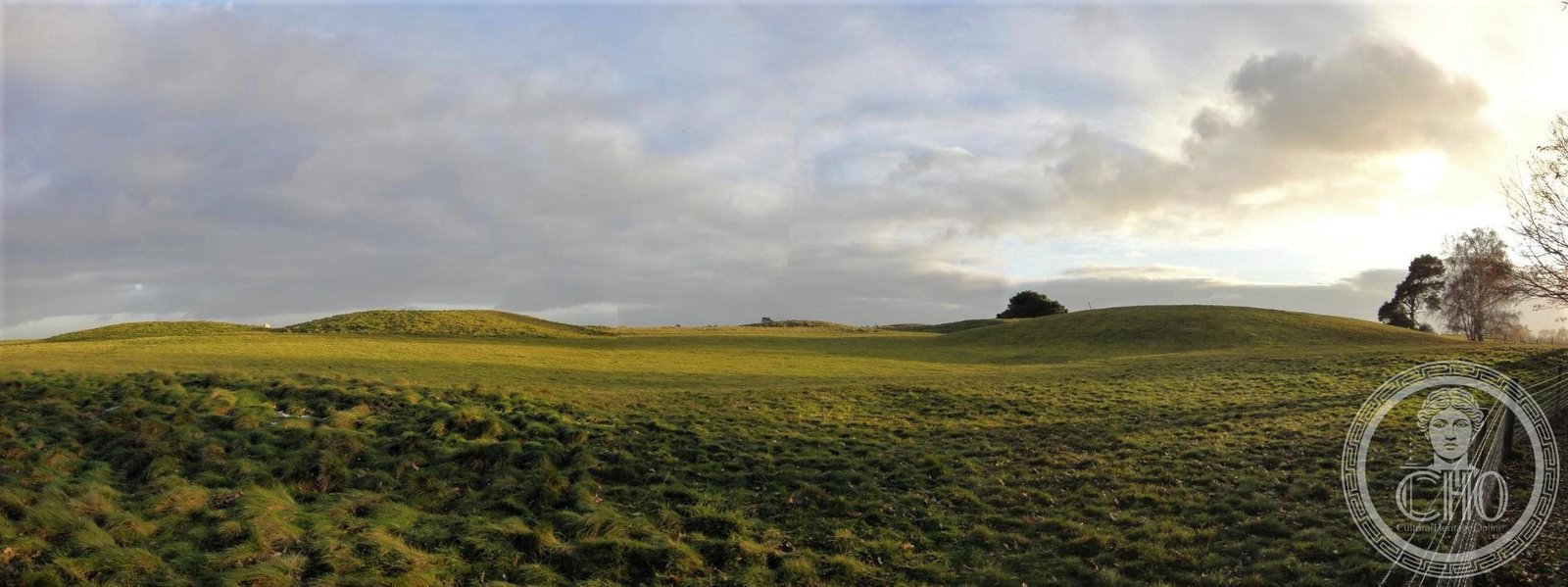
Sutton Hoo is not a single mound: it is a cemetery of at least 18 burial mounds on a promontory overlooking the River Deben estuary. The ship burial is in Mound 1, which survives visibly. Other mounds were excavated in the 1980s and 1990s by the British Museum, revealing further burials — some richly furnished, some containing cremated remains in bronze bowls, one containing a horse — across several centuries of use.
More recent investigations have used ground-penetrating radar and LiDAR to identify additional sub-surface features. The landscape around Sutton Hoo continues to yield evidence of a royal or aristocratic estate that functioned as the ceremonial centre of early East Anglia. The National Trust has laid out a trail connecting the mounds, the River Deben viewpoint, and the visitor exhibition at Tranmer House.
The Dig — Netflix (2021)
Director Simon Stone’s film dramatises the summer of 1939: Edith Pretty (Carey Mulligan), a wealthy widow in declining health, hires Basil Brown (Ralph Fiennes) to investigate the mounds on her Suffolk estate. The excavation unfolds against the gathering shadow of World War II. The film is notable for its fidelity to the emotional reality of the discovery — the underplayed wonder of Brown’s professionalism, the awkward arrival of the Cambridge archaeologists, Pretty’s quiet insistence on Brown receiving credit.
The Dig was released on Netflix in January 2021 and brought Sutton Hoo to a worldwide audience. Visitor numbers to the National Trust site increased substantially in the years following the film’s release. It is widely regarded as one of the most accurate and moving historical films of its decade.
Plan Your Visit
- National Trust Sutton Hoo, Tranmer House, Sutton Hoo, Woodbridge, Suffolk IP12 3DJ.
- Open year-round (hours vary by season); visitor exhibition at Tranmer House includes a full-scale replica of the ship burial chamber and a reproduction of the Sutton Hoo Helmet.
- The original helmet and treasure are at the British Museum, Room 41 (Early Medieval Europe), London.
- Driving: approximately 2 hours from London via A12 to Woodbridge; follow brown heritage signs to Sutton Hoo.
- National Trust members free; standard admission applies to non-members.
Find it on the map
See this place and what’s around it →Historical events at this place (2)
📷 Become a Cultural Heritage Online photographer
Share your photos of places: they stay published under your name as the author. The more they're seen, the more you get noticed — and soon a contest will reward the most appreciated photos.
Log in or sign up free to add a photoIs this page about you?
This page is read by travellers and heritage enthusiasts who find it on Google. Tell us how you are connected to this place and we will take it from there.