

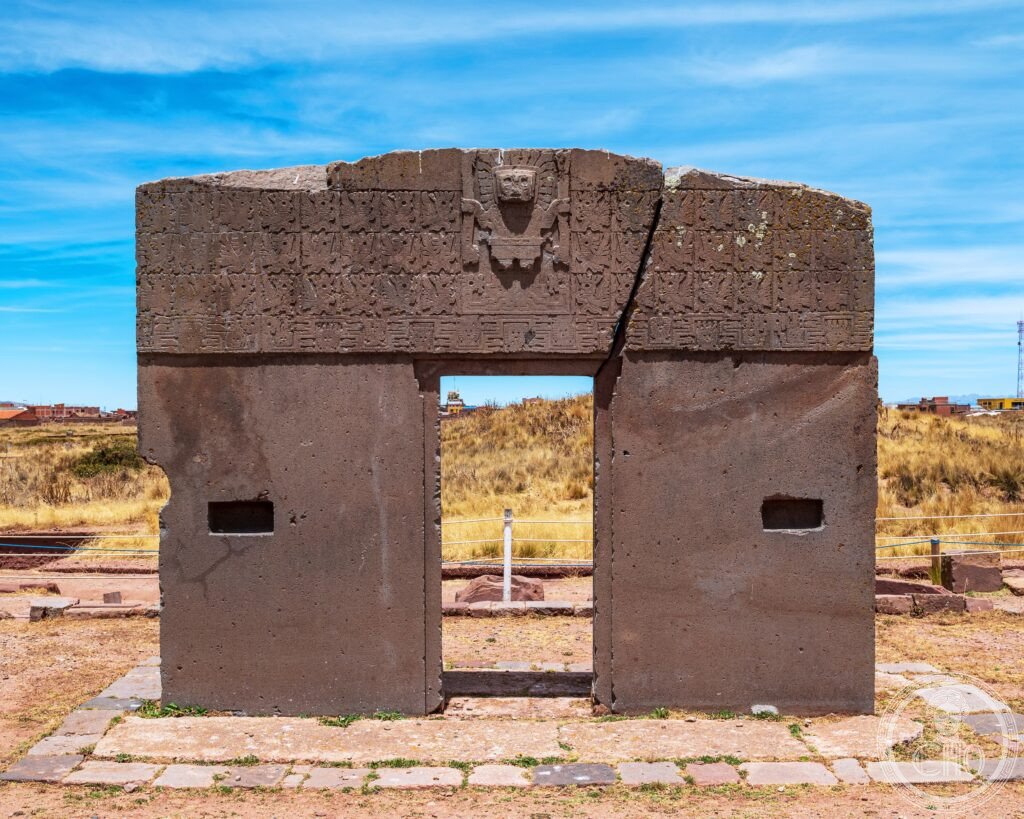
On the Bolivian Altiplano, at nearly 3,850 metres above sea level, stand the ruins of the pre-Inca capital that shaped Andean religion for eight centuries. Its carved gateways and monoliths, above all the Gate of the Sun, remain the clearest surviving record of a civilisation whose gods the Inca later made their own.
At a glance
Tiwanaku lies on the Bolivian Altiplano near Lake Titicaca, in Ingavi Province, La Paz Department. Built and expanded between roughly 200 BCE and 1000 CE, it was one of the earliest urban civilisations in the Americas and, at its height, one of the highest cities ever built by a pre-industrial society. Its influence, carried through religious imagery and trade, reached from southern Peru to northern Chile and Argentina.
The site is inscribed as a UNESCO World Heritage Site, recognised in 2000. Its principal monuments are the Akapana pyramid, the Kalasasaya temple compound with its Gate of the Sun, and the Pumapunku complex, whose precisely cut stone blocks remain the subject of ongoing archaeological study.
Key facts
- Location: Tiwanaku, Ingavi Province, La Paz Department, Bolivia, on the Altiplano near Lake Titicaca, at an altitude of around 3,850 metres.
- Period: Tiwanaku culture, roughly 200 BCE to 1000 CE, with the city at its height around 700–900 CE.
- Scale of influence: at its peak the ceremonial centre held a population estimated at 10,000–20,000, with an agricultural hinterland said to have supported around a million people across the Altiplano; cultural influence extended over an area of roughly 600,000 square kilometres.
- Heritage status: UNESCO World Heritage Site, inscribed in 2000.
- Principal monuments: the Gate of the Sun, the Kalasasaya temple compound, the Akapana pyramid and the Pumapunku complex.
History
Tiwanaku grew from a lakeside settlement on the Altiplano into the centre of an empire that, between roughly 400 and 900 CE, established colonies well beyond the high plateau. Settlements in the Moquegua valley of southern Peru, including the Omo temple complex, gave access to coastal fish and marine products the Altiplano lacked. A colony in the Cochabamba valley grew maize, which could not be cultivated at Tiwanaku’s altitude, while further outposts reached into the Atacama region of northern Chile. During the same centuries the rival Wari state flourished elsewhere in the Andes, in what archaeologists call the Middle Horizon.
Around 1000 CE a severe drought, lasting some three generations, caused Lake Titicaca to fall and the raised-field farming system that had sustained the city’s population to collapse. Tiwanaku was depopulated over several generations as people dispersed into smaller farming communities. The Inca, who rose later in the same region, absorbed much of Tiwanaku’s religious tradition: their creator god Viracocha derives from the Tiwanaku Staff God, and their founding ancestor Manco Capac was said to have emerged from Lake Titicaca, the sacred origin point of both cultures.
The ruins entered the European record through the Spanish chronicler Pedro Cieza de León, who described them in the mid-sixteenth century, followed by Agustín de Zárate and, a century later, Bernabé Cobo. The site was photographed by Ephraim Squier in 1877, and systematic excavation began with Wendell Bennett’s work in 1932, which uncovered the monolith that bears his name.
What you see
The Gate of the Sun stands in the Kalasasaya temple compound, though not in its original position: an earthquake in antiquity is thought to have moved it from the centre of the compound to its present place in the northwest corner. Carved from a single block of andesite weighing around ten tonnes, the gateway is about three metres tall and four metres wide. Its central tympanum shows the Staff God, holding two staffs topped with condor heads, flanked by twenty-four kneeling attendant figures arranged in rows, each with a human body and condor wings, running toward the central deity.
The Kalasasaya compound itself measures roughly 130 by 120 metres and is aligned so that its eastern entrance catches the sunrise, functioning as a solar calendar tied to the equinoxes and solstices. Inside stand two carved monoliths, the Ponce Monolith, regarded as the finest carved figure at the site, and the smaller Fraile Monolith. Nearby, the Akapana pyramid rises in stepped terraces to about eighteen metres over a 200 by 200 metre base; seen from above its plan is cross-shaped, and it contains an internal drainage system that once directed rainwater through the structure.
Some 500 metres to the southwest lies Pumapunku, the most debated of the site’s structures. Its H-shaped andesite blocks, some weighing up to ten tonnes and quarried from sites several kilometres and tens of kilometres away, now lie collapsed and scattered across the ground, though their right-angled joints and mortarless fit remain visible at close range. Claims that this precision could not have been achieved by the Tiwanaku themselves are not supported by the archaeological evidence, which shows tool marks consistent with copper and bronze implements and abrasion using sand. The adjacent site museum, the Museo Arqueológico Regional, houses the Bennett Monolith, at around seven metres the largest carved stone figure known from the Andes, which was removed to La Paz after its excavation in 1932 and returned to Tiwanaku in 2002.
Practical information
- Altitude: the site sits at nearly 3,850 metres, and visitors coming from lower elevations should allow time to acclimatise.
- Tickets: admission covers both the archaeological site and the adjoining museum; current prices and opening times are best checked with the site’s official visitor information before travelling.
- On site: paths lead visitors between the Kalasasaya, Akapana and Pumapunku areas, with the museum a short walk from the main compound.
Getting there
Tiwanaku lies to the west of La Paz, Bolivia’s de facto capital, a journey of some 72 kilometres. Tourist buses run from the El Alto cemetery district in La Paz, departing in the morning and returning in the afternoon, or the trip can be made by private taxi. Current schedules and fares are best confirmed locally or through official tourist information before setting out.
Nearby
- La Paz — around 72 km east; Bolivia’s de facto capital and the usual starting point for visits to Tiwanaku.
- Lake Titicaca — the high Andean lake near which Tiwanaku was built, and the site the Inca later regarded as the origin of civilisation.
Sources
- UNESCO
- Museo Arqueológico Regional
- Pedro Cieza de León
- Agustín de Zárate
- Bernabé Cobo
- Ephraim Squier
- Wendell Bennett
Find it on the map
See this place and what’s around it →📷 Become a Cultural Heritage Online photographer
Share your photos of places: they stay published under your name as the author. The more they're seen, the more you get noticed — and soon a contest will reward the most appreciated photos.
Log in or sign up free to add a photoIs this page about you?
This page is read by travellers and heritage enthusiasts who find it on Google. Tell us how you are connected to this place and we will take it from there.