

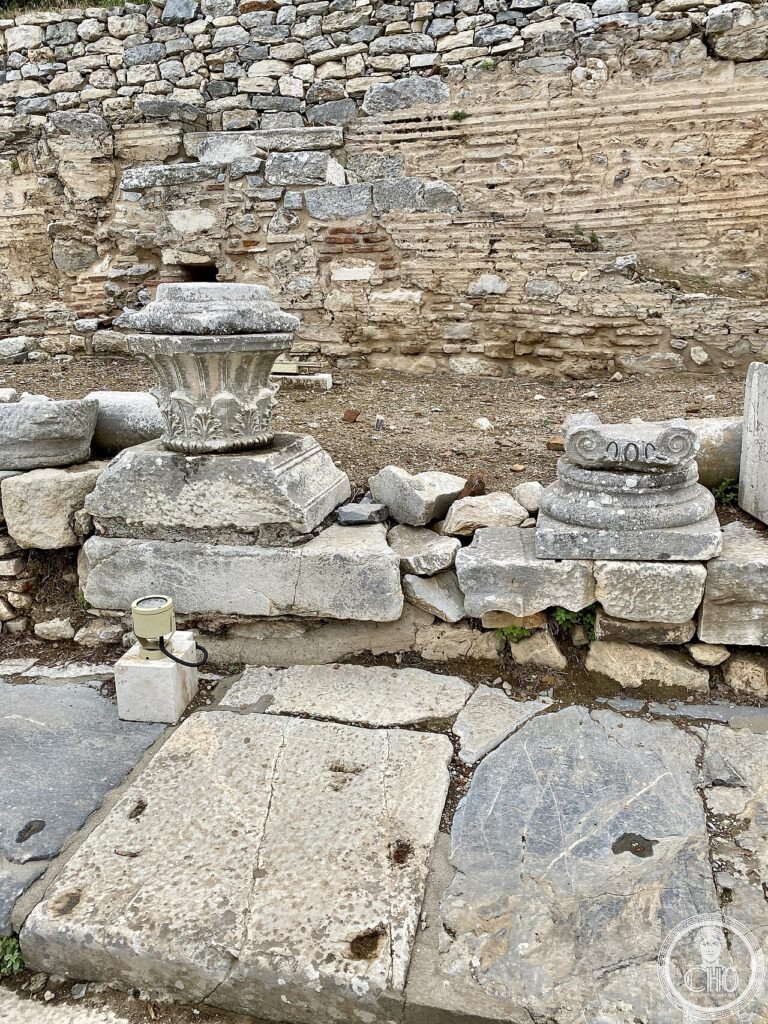
Ephesus preserves the marble heart of a Roman metropolis: a library facade, a theatre that once held tens of thousands, and streets that lead down to a harbour the sea long ago abandoned. Few ancient cities in the eastern Mediterranean survive in such continuous, walkable detail.
At a glance
Ephesus lies in Selçuk District, İzmir Province, on the western coast of Turkey. Founded by Ionian Greeks, it grew through the Hellenistic and Roman periods into one of the great cities of the ancient world, with a population that at its Roman-era peak is put at somewhere between 100,000 and 300,000 inhabitants. Its wealth came from trade through a harbour that later silted up as the Cayster and Küçük Menderes rivers deposited sediment, leaving the ancient port now several kilometres inland.
The site is inscribed as a UNESCO World Heritage Site, recognised in 2015. It is best known for the Library of Celsus, the Great Theatre, and its connection to the Apostle Paul and to the Council of Ephesus of 431 CE.
Key facts
- Location: Selçuk District, İzmir Province, Turkey
- Founded: by Ionian Greeks, with the classical city taking shape from around the 5th–4th century BCE
- Roman-period population: estimated at between 100,000 and 300,000
- Library of Celsus: built 114–117 CE as a mausoleum for Tiberius Julius Celsus Polemaeanus, a former governor of Asia Province
- Great Theatre: capacity of roughly 24,000–25,000, the best-preserved ancient theatre in Turkey
- Status: UNESCO World Heritage Site, inscribed 2015
History
Ephesus began as an Ionian Greek settlement and by the classical period had grown into a major city on the Aegean coast. The Temple of Artemis, the Artemision, was built here in the 7th century BCE and was, in its time, the largest temple in the Greek world; it burned down in 356 BCE, an act attributed to a man named Herostratus who confessed he wanted his name remembered forever. A grander Artemision was rebuilt between 350 and 300 BCE, with 127 columns standing 20 metres high, again the largest building in the Greek world and counted among the Seven Wonders of the Ancient World. Alexander the Great later offered to fund its restoration; the Ephesians declined. Around 294 BCE the general Lysimachus moved the city to higher ground and refortified it, and control later passed to the Attalid kings of Pergamon and then, from 133 BCE, to Rome, with Ephesus serving as capital of the Roman province of Asia.
The city sided with Mithridates VI of Pontus against Rome in 88 BCE, an episode remembered for the massacre of Romans that followed, before Sulla recaptured Ephesus in 84 BCE. Under Augustus the city became the largest in Asia Minor, and the emperor Hadrian oversaw a building boom in the 2nd century CE that gave Ephesus much of the fabric visible today, including the Library of Celsus, the Gate of Augustus and the Arcadian Way. The Apostle Paul spent time in Ephesus around 52–55 CE; his preaching provoked a riot led by the silversmith Demetrius, whose trade in miniature shrines to Artemis was threatened by conversions to Christianity, and the affair is recorded in the Acts of the Apostles. In 431 CE Ephesus hosted the Council of Ephesus, the third ecumenical council of the Christian church, called to settle the Nestorian controversy and which declared the Virgin Mary to be Theotokos, Mother of God; the Nestorians who rejected this split off and formed the Church of the East, which carried Christianity as far as China.
The city’s decline followed the silting of its harbour, which cut it off from the sea. Ephesus shrank through the 5th and 6th centuries, was sacked by the Persians in 614 CE and raided by Arab forces in 654 CE, and by around 700 CE its population had fallen drastically. The city was eventually abandoned. The site of the Temple of Artemis was rediscovered by the British engineer John Wood in 1863, and systematic excavation of Ephesus by the Austrian Archaeological Institute began in 1895 and continues today.
What you see
Visitors typically enter from the upper, southern gate and walk downhill through the site. The upper Agora complex includes the Prytaneion, the civic hearth where the sacred fire of Hestia was kept burning; several statues of Artemis were found here, with some now displayed in the Ephesus Museum in Selçuk and others in Vienna. Curetes Street, the main marble-paved artery of Roman Ephesus running about a kilometre down to the lower city, passes the Temple of Hadrian, built in 118 CE with an ornate four-column Corinthian facade and a Medusa-head keystone, and the Scholastica Baths, a 4th-century complex with heated floors, changing rooms and latrines.
The street ends at the Library of Celsus, built in 114–117 CE as a mausoleum for Tiberius Julius Celsus Polemaeanus and among the most photographed ancient buildings in Turkey. Its two-storey, 21-metre facade was restored between 1966 and 1978 by the Austrian Archaeological Institute; the four niches hold replica statues personifying Wisdom, Virtue, Thought and Knowledge, their originals kept in Vienna. The library once held a large collection of scrolls, ranking it among the largest libraries of antiquity, and Celsus’s sarcophagus survives in a vaulted chamber beneath the reading room. Nearby stand the Gate of Mazaeus and Mithridates and the lower Tetragonos Agora. From here the Arcadian Way, a colonnaded marble avenue over 500 metres long, once ran to the harbour, and the Great Theatre, cut into the hillside with a capacity of up to 25,000, offers views back along this route; it was here that the crowd gathered during the riot recorded in the Acts of the Apostles.
Practical information
- Coordinates: 37.9397° N, 27.3416° E
- Opening times and admission: subject to change; check the official Ephesus site or Turkey’s Ministry of Culture and Tourism channels before visiting
- Excavation: ongoing, led by the Austrian Archaeological Institute since 1895
- Scale: the site is extensive and largely uncovered, with a long walk from the upper to the lower entrance
Getting there
Ephesus lies within Selçuk District in İzmir Province, on Turkey’s Aegean coast. Selçuk is the nearest town to the archaeological site.
Nearby
- Temple of Artemis (Artemision) — a few kilometres north of the main site; only a single re-erected column remains of what was once one of the Seven Wonders of the Ancient World
- Ephesus Museum, Selçuk — holds original statues and finds excavated from the site, including images of Artemis
Sources
- Austrian Archaeological Institute
- UNESCO
- Acts of the Apostles
Find it on the map
See this place and what’s around it →📷 Become a Cultural Heritage Online photographer
Share your photos of places: they stay published under your name as the author. The more they're seen, the more you get noticed — and soon a contest will reward the most appreciated photos.
Log in or sign up free to add a photoIs this page about you?
This page is read by travellers and heritage enthusiasts who find it on Google. Tell us how you are connected to this place and we will take it from there.