

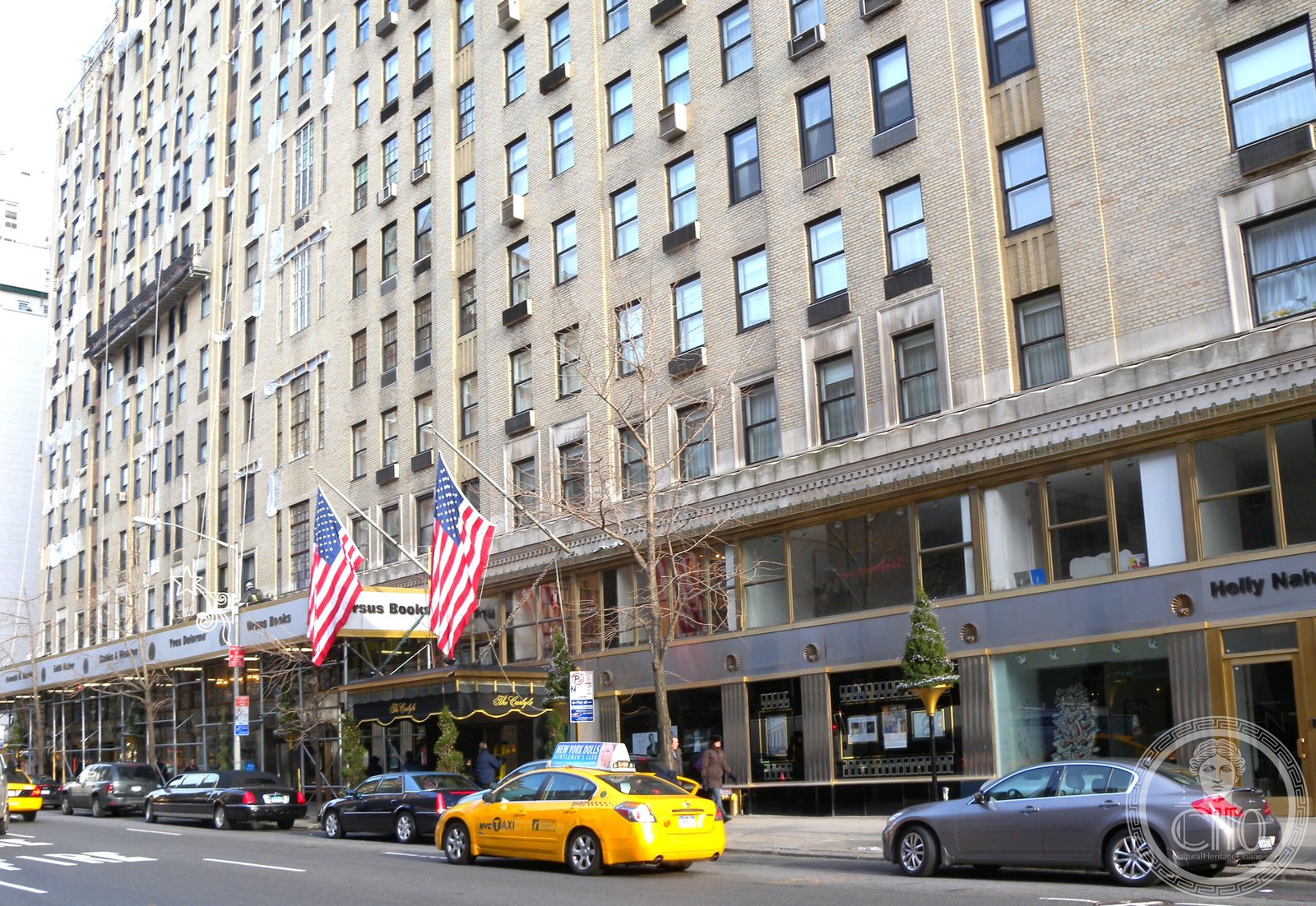
Since 1930, every American president from Truman to Obama has kept an apartment or suite at The Carlyle; the 35-story Art Deco tower on Madison Avenue at 76th Street has always been more than a hotel — it has been a stage for private power exercised in elegant rooms.
At a glance
The Carlyle Hotel opened in 1930 at 35 East 76th Street on the Upper East Side of Manhattan, designed by the architectural firm Bien & Prince in a style that balances Art Deco geometric restraint with the residential scale of the neighborhood. At 35 stories it is one of the taller buildings on the Upper East Side, its stepped limestone-and-brick mass rising above the surrounding townhouses and apartment buildings in a profile that reads as a confident vertical accent rather than a hulking commercial tower. Bemelmans Bar, whose walls are covered in Ludwig Bemelmans’s 1947 Central Park murals, and Café Carlyle, where Bobby Short performed for three decades, have given the building a cultural life well beyond its function as a luxury hotel. It is now part of the Rosewood Hotels & Resorts portfolio.
Key facts
- Opened: 1930
- Address: 35 East 76th Street at Madison Avenue, Upper East Side, Manhattan
- Architects: Bien & Prince (Sylvan Bien)
- Height: 35 stories
- Style: Art Deco — restrained limestone-and-brick, setback massing, geometric ornament
- Current use: The Carlyle, A Rosewood Hotel
- Designation: New York City Landmark; NRHP eligible
History
The Carlyle was developed by Moses Ginsberg, who named it after Thomas Carlyle — the Scottish essayist and historian whose Victorian moral seriousness suited the aspirations of an Upper East Side address. It opened in October 1930 in the early months of the Depression, a moment when several ambitious New York luxury hotel projects were finishing construction regardless of the economic climate that had already begun to damage occupancy rates across the city. Like the Essex House to the south and the Waldorf Astoria to the south-west, both completed in 1931, The Carlyle benefited from having been designed in the boom years and was built through by investors unwilling to abandon the project mid-construction.
The hotel’s presidential connection began in the Truman administration and deepened under Kennedy: John F. Kennedy maintained a suite at The Carlyle and used it as his New York base both before and after becoming president, arriving by helicopter on the roof terrace from time to time according to accounts of the period. The pattern continued through successive administrations, consolidating The Carlyle’s reputation as the preferred private address for American political power visiting New York rather than staying at more central Midtown hotels. The Royal Family of the United Kingdom, various heads of state, and a roster of entertainment figures — Judy Garland, Princess Diana, among others — made it the most socially documented hotel of the American Century’s second half.
Bemelmans Bar opened in 1947 following a commission to Ludwig Bemelmans — the Austrian-American illustrator best known for the Madeline children’s books — to paint the walls of the ground-floor bar. He produced a panoramic set of Central Park scenes with animals, ice skaters, and horse-drawn carriages rendered in a loose, warm, illustrative style that became one of the most photographed interiors in New York.
What you see
The Carlyle’s facade on Madison Avenue presents a composition of buff brick and limestone in which the Art Deco shows through the geometric incisions at the setbacks, the abstracted floral and geometric low-relief panels at the entrance level, and the way the building’s mass steps back four times as it rises toward its flat top. Unlike the more exuberant Deco towers of Midtown, the design defers to the Upper East Side residential character of its block: windows are large and regularly spaced, the entrance canopy is modest, and the overall effect is of luxury held at a conversational register rather than declared in exclamation marks.
The interior public rooms are the primary draw for non-guests. Bemelmans Bar retains its original 1947 decoration almost intact — the animal-and-skater murals cover three walls, the bar is lit with the amber light of banquette lamps, and the effect is of a private Central Park pavilion compressed into a single elegant room. Café Carlyle next door is a small supper club where Woody Allen performs a Monday-night jazz set in the winter months, a tradition that gives the room a continued association with a specific kind of serious-playful New York cultural life.
Practical information
- Bemelmans Bar: open daily from 5:30 p.m.; no reservation needed but crowded after 7 p.m.; jacket preferred in the evening
- Café Carlyle: ticketed performances several evenings per week; Woody Allen’s Eddy Davis New Orleans Jazz Band performs Mondays (winter season only); book well in advance
- Gallery: rotating art exhibitions visible from the lobby without hotel-guest status
- Time needed: Allow 45 minutes for the bar; 2–3 hours for a dinner or performance at Café Carlyle
- Dress: Smart-casual for the bar, jacket preferred for the evening; performances at Café Carlyle call for formal dress
Getting there
The Carlyle is at 35 East 76th Street at the corner of Madison Avenue on the Upper East Side. The nearest subway station is 77th Street on the Lexington Avenue 6 train, about two minutes’ walk east on 76th Street. The 86th Street station (4/5/6) is ten minutes’ walk north. From Grand Central Terminal, take the 6 train four stops uptown to 77th Street — approximately eight minutes. The hotel is about a fifteen-minute walk from the Metropolitan Museum of Art’s main entrance at Fifth Avenue and 82nd Street, and five minutes’ walk from the Neue Galerie on Fifth at 86th Street.
Nearby
- Metropolitan Museum of Art — the largest art museum in the United States at 1000 Fifth Avenue; about twelve minutes’ walk west and north, with collections spanning 5,000 years
- Neue Galerie — German and Austrian decorative arts and fine arts at 1048 Fifth Avenue (86th & 5th), ten minutes’ walk north; the Café Sabarsky serves Viennese pastries
- Frick Collection — the mansion collection of the steel industrialist at 1 East 70th Street, about eight minutes’ walk south, with Vermeers, Rembrandts, and a superb Fragonard room sequence
- Whitney Museum of American Art (former building at 945 Madison Ave) — the Marcel Breuer-designed Brutalist landmark at 945 Madison Avenue, six minutes’ walk south, now the Met Breuer (partial use) and later the Frick expansion
Sources
- Silber, Eve. The Carlyle: A New York Story. Historical documentation of the hotel, various editions.
- Stern, Robert A.M., Gregory Gilmartin, and Thomas Mellins. New York 1930: Architecture and Urbanism Between the Two World Wars. Rizzoli, 1994.
- Landmarks Preservation Commission of New York City, Upper East Side Historic District designation report.
- Wechsberg, Joseph. Profiles of The Carlyle Hotel guests and cultural life, The New Yorker, 1950s–1970s.
Find it on the map
See this place and what’s around it →📷 Become a Cultural Heritage Online photographer
Share your photos of places: they stay published under your name as the author. The more they're seen, the more you get noticed — and soon a contest will reward the most appreciated photos.
Log in or sign up free to add a photoIs this page about you?
This page is read by travellers and heritage enthusiasts who find it on Google. Tell us how you are connected to this place and we will take it from there.