
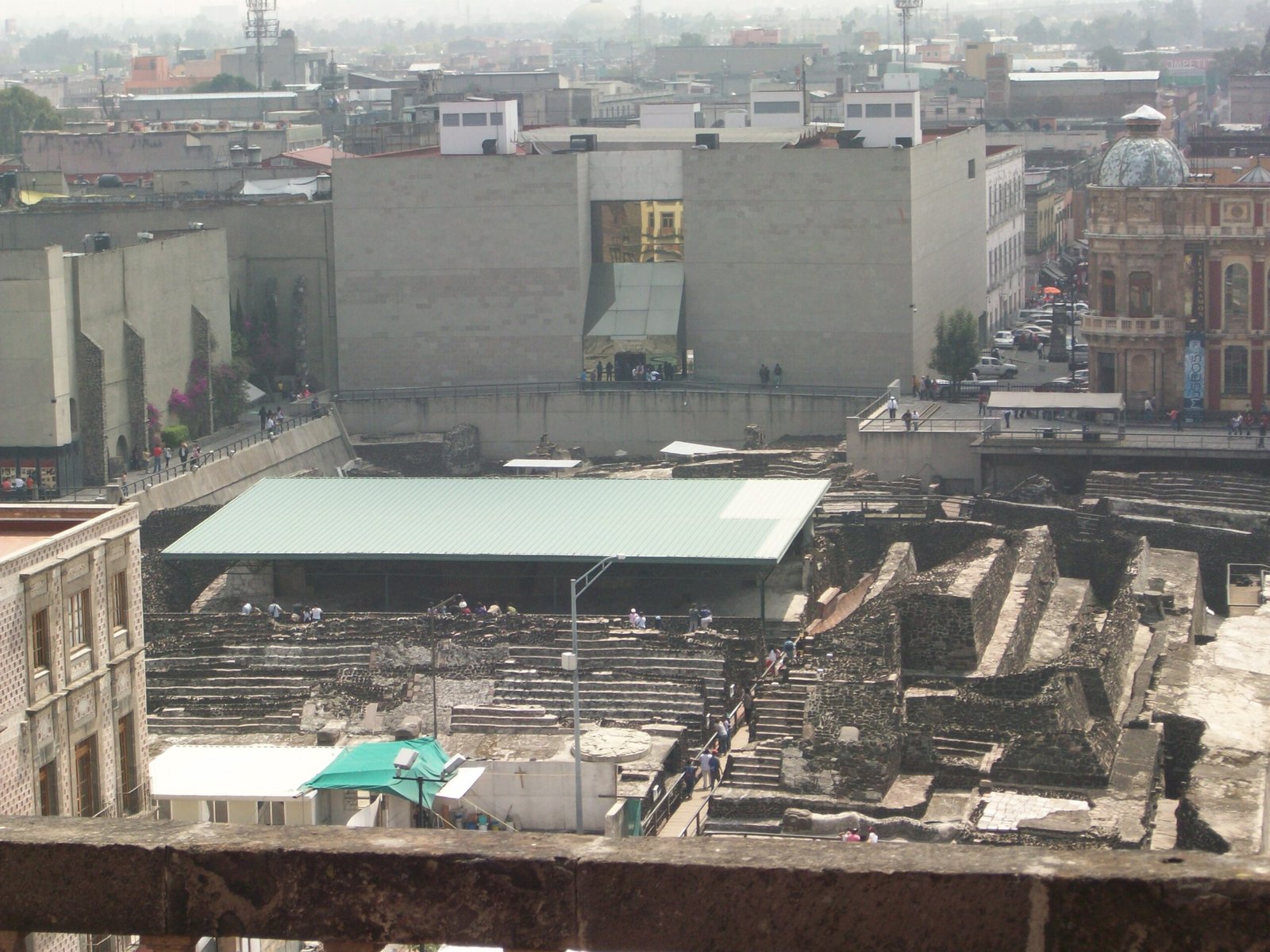
The great double pyramid at the heart of Tenochtitlan, demolished by the Spanish and hidden under Mexico City for four centuries — until an electric company’s drill struck the edge of the Coyolxauhqui disc in 1978.
At a glance
The Templo Mayor — the Great Temple — was the religious and political centre of Tenochtitlan, the Aztec capital founded around 1325 AD on an island in Lake Texcoco. At its final expansion, before the Spanish conquest of 1521, it rose approximately 45 metres and dominated a ceremonial precinct of some 40 interlocking structures. Hernán Cortés ordered the temple demolished, its stones used to build the Metropolitan Cathedral that still stands 200 metres away. The accidental discovery of a colossal stone disc by electric workers in February 1978 triggered an excavation led by archaeologist Eduardo Matos Moctezuma, which began clearing the buried pyramid that year and has not stopped since. The adjacent Museo del Templo Mayor holds the 3.25-metre Coyolxauhqui disc and over 13,000 recovered objects.
Key facts
- Location: Centro Histórico, Mexico City, Mexico — 19.4345° N, 99.1320° W (Google Maps)
- Period: c. 1325–1521 AD; 7 construction phases, each encasing the previous
- Height at conquest: c. 45 metres; twin shrines atop dedicated to Huitzilopochtli (war) and Tlaloc (rain)
- Coyolxauhqui disc: Monolithic basalt disc 3.25 m in diameter depicting the dismembered moon goddess; discovered 1978, now in the adjacent museum
- Offerings: Over 180 sacrificial deposits containing human remains (180+ individuals), jaguar skeletons, eagle warrior costumes, obsidian blades, and marine fauna from both coasts
- Excavation: Eduardo Matos Moctezuma, 1978–present; one of the longest continuous urban excavations in the Americas
- Visibility: Ruins viewable through glass floor panels in the surrounding streets of the Zócalo
History
Tenochtitlan was founded by the Mexica (Aztec) people around 1325 AD on a marshy island in Lake Texcoco, guided — according to their founding myth — by the sight of an eagle devouring a serpent on a cactus. The Templo Mayor was built at the precise centre of this new city, its twin shrines positioned to face the rising sun at the spring equinox. Over the following two centuries, the temple was enlarged seven times, each new construction encasing the previous pyramid like a series of nested shells. The four visible phases currently open to visitors date from the reigns of Moctezuma I (c. 1440–1469) through Ahuitzotl (1486–1502).
In 1519 Hernán Cortés arrived from Cuba with 550 men and a network of indigenous alliances; by August 1521 the city had fallen after a siege of seventy-five days. The destruction that followed was systematic: the Templo Mayor was dismantled stone by stone, its carved surfaces shattered, and its platform buried under rubble from which the colonial city was constructed. The Metropolitan Cathedral, begun in 1573, was built partly over the temple’s ceremonial precinct and sank unevenly into the ancient foundations for the next four centuries — a subsidence that is still being corrected today.
On 25 February 1978, workers from the Compañía de Luz laying electrical cable in the street struck the curved edge of the Coyolxauhqui disc at a depth of two metres. The disc — showing the dismembered body of the moon goddess defeated by her brother Huitzilopochtli — was the mythological centrepiece of the temple’s ritual life. Eduardo Matos Moctezuma, appointed by Mexico’s National Institute of Anthropology and History to direct the subsequent excavation, has directed work continuously since, uncovering offerings deposited in 180 sealed caches, the remains of more than 180 human sacrificial victims, and structural sequences that revised scholarly understanding of Aztec construction chronology.
What you see
The excavation site occupies a city block immediately north-east of the Zócalo, the main square of Mexico City. The exposed ruins represent roughly a third of the original temple’s footprint; the rest lies beneath streets and protected colonial-era buildings that cannot be demolished. What is visible shows the nested construction phases clearly: each expansion is visible in cross-section at the site’s edges, the later stone courses sitting directly against the earlier pyramid’s face. The twin staircases that led to the Huitzilopochtli and Tlaloc shrines are intact to approximately one-third of their original height, flanked by carved serpent heads whose paint has largely survived under the protective soil.
The surrounding Zócalo streets have glass viewing panels at several points, allowing pedestrians to see the tops of buried walls and platforms at street level — a dissonance that is Mexico City’s characteristic condition, where the colonial and the pre-Columbian coexist within centimetres. The Museo del Templo Mayor, whose entrance is at the site’s north end, holds the Coyolxauhqui disc in a dedicated circular gallery where it can be viewed from above — the angle from which it was always meant to be seen, having fallen at the foot of Huitzilopochtli’s staircase.
Practical information
- Opening hours: Tuesday–Sunday 9:00–17:00; closed Monday and major public holidays
- Tickets: Single ticket covers excavation site and Museo del Templo Mayor; free on Sundays for Mexican nationals
- Best season: Year-round; Mexico City’s altitude (2,240 m) keeps temperatures moderate; November–April is dry season
- What to wear: Comfortable shoes; the outdoor excavation areas are exposed to sun; jacket for the air-conditioned museum
- Time needed: 2–3 hours for the site and museum together; the museum’s 8 rooms repay a full morning
- Photography: Permitted throughout, including the Coyolxauhqui gallery
Getting there
The Templo Mayor occupies the eastern edge of the Zócalo (Plaza de la Constitución) in Mexico City’s Centro Histórico. Metro Line 2 stops at Zócalo, one block from the site entrance. The site is equally accessible by Metro Line 1 (Pino Suárez) or by taxi from any central hotel. Mexico City’s Benito Juárez International Airport is 6 kilometres east; express bus and metro connections reach the Zócalo in 30–45 minutes depending on traffic.
Nearby
- Metropolitan Cathedral — 100 m west: the largest cathedral in the Americas, built over the Aztec ceremonial precinct on foundations that include recycled Templo Mayor stones
- Palacio Nacional — 150 m south: Diego Rivera’s monumental murals of Mexican history, including the fall of Tenochtitlan, cover the stairwell walls
- Teotihuacan — 50 km north-east: the Pyramid of the Sun and Pyramid of the Moon, a pre-Aztec city that was already a pilgrimage site when the Mexica arrived
- Museo Nacional de Antropología — 5 km west (Chapultepec): the Aztec Sun Stone, Olmec heads, and the full sweep of pre-Columbian cultures in a single building
Sources
- Matos Moctezuma, Eduardo. The Great Temple of the Aztecs. Thames & Hudson, 1988.
- Wikipedia — Templo Mayor: en.wikipedia.org/wiki/Templo_Mayor
- INAH (Instituto Nacional de Antropología e Historia) — Templo Mayor official site: templomayor.inah.gob.mx
- Umberger, Emily. “Art and Imperial Strategy in Tenochtitlan.” In Aztec Imperial Strategies. Dumbarton Oaks, 1996.
Find it on the map
See this place and what’s around it →📷 Become a Cultural Heritage Online photographer
Share your photos of places: they stay published under your name as the author. The more they're seen, the more you get noticed — and soon a contest will reward the most appreciated photos.
Log in or sign up free to add a photoIs this page about you?
This page is read by travellers and heritage enthusiasts who find it on Google. Tell us how you are connected to this place and we will take it from there.