

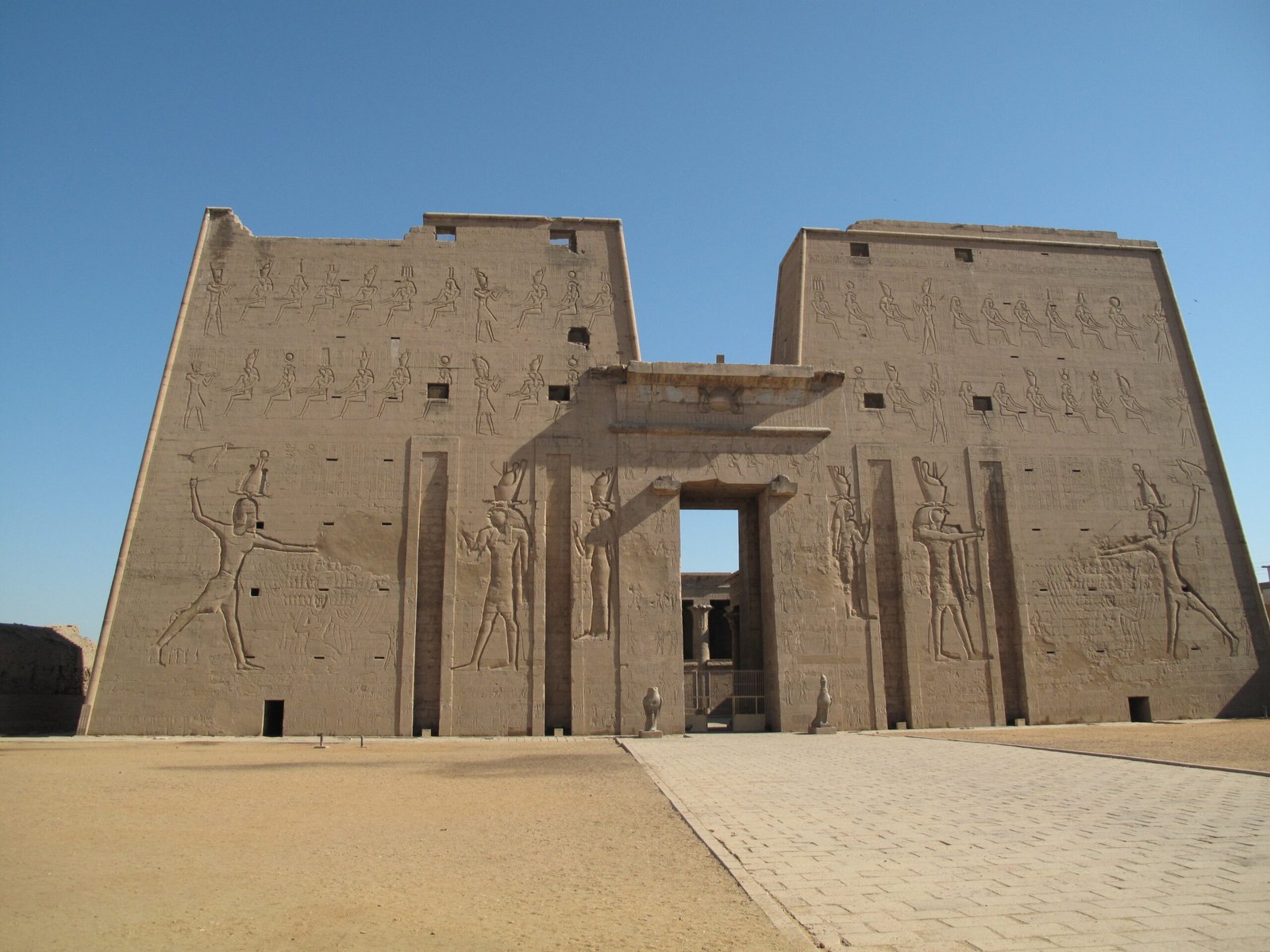
The best-preserved ancient Egyptian temple on earth — a Ptolemaic colossus built over 180 years whose walls hold the most complete collection of religious texts ever found in Egypt.
At a glance
The Temple of Horus at Edfu stands in the town of the same name on the west bank of the Nile, 105 kilometres south of Luxor. Begun in 237 BC under Ptolemy III and completed in 57 BC under Ptolemy XII, it was built on the site of a much earlier New Kingdom temple whose foundations archaeologists have traced beneath the current floor. Its survival owes an unlikely debt to the desert: sand and Nile silt buried the complex to its roof cornice over fifteen centuries, sealing it from Christian iconoclasm and stone robbers alike. The French Egyptologist Auguste Mariette cleared it beginning in 1860, revealing a structure that has barely aged.
Key facts
- Location: Edfu, Aswan Governorate, Egypt — 24.9782° N, 32.8731° E (Google Maps)
- Period: 237–57 BC (Ptolemaic); built on New Kingdom predecessor c. 1380 BC
- Pylon: 36 metres high, the largest surviving pylon in Egypt
- Hieroglyphic texts: 3,000 sq m of inscriptions covering exterior and interior walls — the most extensive religious text corpus in the country
- Granite naos: The inner shrine (naos) of black granite from the reign of Nectanebo I (c. 360 BC) remains intact and in situ
- Horus statue: The 2.5-metre granite falcon at the first pylon entrance is the most photographed object in Upper Egypt after Luxor Temple
- Excavation: Auguste Mariette, 1860, after centuries of burial under sand and silt
History
Edfu was one of the oldest sacred sites in Egypt, associated with a mythological battle between Horus and Set that the temple’s own texts recount in elaborate liturgical form. A New Kingdom temple stood here from at least the reign of Thutmose III (c. 1479–1425 BC); its remains lie buried under the current building’s floor, discovered by ground-penetrating surveys in the twentieth century. When Ptolemy III Euergetes laid the foundation stone in 237 BC, he was making a deliberate statement of legitimacy: the Greek-speaking Macedonian rulers who governed Egypt after Alexander’s conquest needed to present themselves as successors to the pharaonic tradition, and temple building on an Egyptian religious site was the clearest available signal.
Construction lasted 180 years across six reigns, a span that explains the slight stylistic inconsistencies between the inner sanctuary (oldest) and the great hypostyle hall and pylon (youngest, completed 57 BC). Throughout, the builders inscribed the walls in archaic hieroglyphics — a deliberately conservative register, not the spoken language of Ptolemaic Egypt, which was a form of Demotic — as a further claim to continuity with the ancient tradition. The resulting corpus of texts covers cult rituals, the mythological drama of Horus and Set, astronomical calendars, and lists of temple property; scholars have been publishing annotated translations since the 1930s and have not exhausted the material.
The temple’s burial was both its ruin and its salvation. As Christian communities settled in the area after the 4th century AD, they chiselled out the faces of the gods on the lower wall registers — the part they could reach — but could not access the upper reliefs buried in silt. Mariette’s 1860 clearance revealed 14 metres of accumulated debris above the sanctuary floor; the reliefs he exposed at the top of the pylon were in the condition of new work.
What you see
The approach from the town is abrupt and total: the pylon rises thirty-six metres from flat ground with almost no transition, its face carved with a 6-metre image of Ptolemy XII smiting his enemies before Horus. The two towers flank a doorway only two and a half metres wide — a deliberate narrowing designed to channel ritual processions rather than crowds. Beyond it, the forecourt opens onto 36 columns with composite floral capitals, each capital different, the ceilings between them painted midnight blue with gold stars. The polychrome is mostly gone from the walls, but the raised relief carving — cut into the stone rather than painted over plaster — survives at full sharpness.
Inside the hypostyle hall, the columns press close enough that the spaces between them feel like carved corridors. The inner sanctuary holds the black granite naos — a monolithic shrine box 180 centimetres tall that once enclosed the gilded cult statue of Horus — and a wooden replica of the divine barque (the ceremonial boat) used during the annual Feast of the Beautiful Meeting, when Horus’s statue was carried south to Dendera to “visit” Hathor. That journey, its route, and its rituals are inscribed in full on the temple walls; this is not secondary scholarship but primary liturgical record.
Practical information
- Opening hours: Daily 7:00–17:00 (summer until 18:00)
- Tickets: Single entrance fee covering the full complex; included in most Nile cruise itineraries
- Best season: October–March; summer temperatures in Edfu regularly exceed 42°C
- What to wear: Comfortable flat shoes (uneven stone floors); light, breathable clothing; head covering in exposed areas
- Time needed: 1.5–2 hours to cover pylon, forecourt, hypostyle hall, inner sanctuary, and ambulatory corridor
- Photography: Permitted throughout; interior requires flash-off mode to protect remaining pigment
Getting there
Edfu lies on the west bank of the Nile between Luxor (105 km north) and Aswan (115 km south), and appears on virtually every Nile cruise itinerary between the two cities. Independent travellers can reach Edfu by train or microbus from Luxor or Aswan, then cross the Nile by local ferry. A calèche (horse-drawn carriage) covers the two kilometres between the ferry landing and the temple entrance; the ride takes ten minutes. Driving from Luxor takes roughly 90 minutes via the west bank road.
Nearby
- Kom Ombo Temple — 65 km south: unusual double temple dedicated to Sobek and Horus the Elder, dramatically sited on a Nile bend
- Esna Temple — 55 km north: Khnum temple still largely unexcavated beneath the modern town, with some of the finest Ptolemaic astronomical ceilings in Egypt
- Luxor and Karnak — 105 km north: the largest temple complex in the ancient world and the Valley of the Kings
- Aswan and Philae — 115 km south: the Temple of Isis on Agilkia Island, relocated by UNESCO 1972–1980
Sources
- Cauville, Sylvie. Le Temple de Dendara (comparative Ptolemaic temple scholarship). IFAO, 1997.
- Wikipedia — Temple of Edfu: en.wikipedia.org/wiki/Temple_of_Edfu
- Finnestad, R.B. “The Pharaoh and the ‘Democratization’ of Post-Mortem Life.” Göttinger Miszellen, 1985.
- Egypt Exploration Society — Edfu Project field reports: ees.ac.uk
Find it on the map
See this place and what’s around it →📷 Become a Cultural Heritage Online photographer
Share your photos of places: they stay published under your name as the author. The more they're seen, the more you get noticed — and soon a contest will reward the most appreciated photos.
Log in or sign up free to add a photoIs this page about you?
This page is read by travellers and heritage enthusiasts who find it on Google. Tell us how you are connected to this place and we will take it from there.