
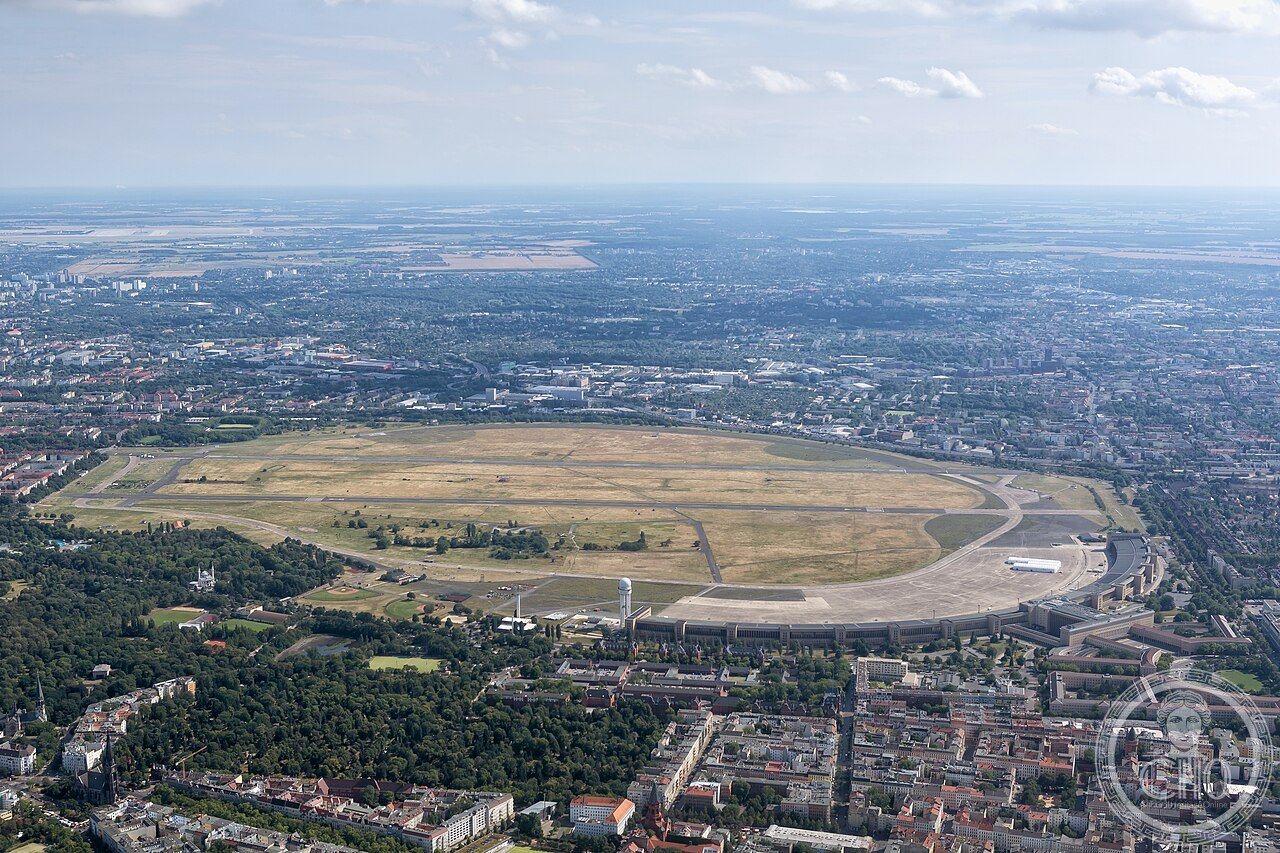
When Tempelhof Airport was completed in 1941 it was the largest building by floor area on earth — a single sweeping concrete arc nearly 1.2 kilometres long, its curved terminal building sheltering beneath a vast eagle-wing roof. Norman Foster called it “the mother of all airports.” Architect Ernst Sagebiel’s design was intended as a monument to Nazi aeronautical power: a building so enormous that it would make passengers feel the grandeur of the state the moment they arrived in the capital of the Reich. Yet Tempelhof’s defining hour came not under the swastika but in the name of freedom: between June 1948 and May 1949 American and British aircraft landed here every ninety seconds during the Berlin Airlift, delivering food and coal to a city of two million people blockaded by the Soviet Union. For 328 days the roar of transport planes kept West Berlin alive. The airport closed in 2008; today the building is a listed monument and its former airfield the largest urban park in Europe.
At a glance
- Type
- Airport terminal / Monument
- Period
- 1936–1941 (Nazi-era building); operational 1923–2008
- Style
- Nazi Stripped Classicism / Modernist
- Location
- Platz der Luftbrücke 5, 12101 Berlin, Germany
- Coordinates
- 52.4730° N, 13.4019° E
- Architect(s)
- Ernst Sagebiel
Overview
Berlin Tempelhof was one of the earliest airports in the world, operating in various forms from 1923. The monumental building completed under the Nazi regime between 1936 and 1941 — designed by Ernst Sagebiel, who also designed the Reich Air Ministry — covered approximately 300,000 square metres of floor area, making it the world’s largest building at completion. The curved terminal arc spans nearly 1.2 kilometres, with a cantilevered roof that sheltered aircraft directly alongside the passenger hall. After the airport’s closure in 2008, the building was listed as a protected monument. The former airfield — Tempelhofer Feld — opened as a public park in 2010 and has become one of the most remarkable urban spaces in Europe: a vast, flat expanse of former runway used daily by cyclists, kite-flyers, skaters, and community gardeners in the heart of the city.
History
Civil aviation began at Tempelhof in 1923, and the site quickly became one of Europe’s busiest airports. In 1934 Albert Speer’s office commissioned a master plan for the Nazi capital Germania, and Tempelhof was redesigned as its aerial gateway. Ernst Sagebiel’s enormous building was under construction from 1936; it was operational but unfinished when the war ended. The Berlin Airlift of 1948–49 transformed Tempelhof from a symbol of Nazi hubris into a monument of Allied resolve: a capacity of one plane every ninety seconds made it the linchpin of Operation Vittles, the largest sustained airlift in history. The Airlift Memorial — three curved arches representing the air corridors — stands at the airport entrance. Post-war Tempelhof served as a US military airfield until 1993, then as a civilian airport until its contested closure in 2008 following a Berlin referendum.
Architecture & Design
Sagebiel’s design is a textbook example of Nazi monumental architecture: stripped of classical ornament, vast in scale, relentlessly symmetrical, intended to overwhelm the individual. The main facade — 1.2 kilometres of curved concrete and stone — presents a continuous horizontal colonnade broken only by the central entrance tower. The cantilevered departure roof projects 40 metres over the apron, providing covered aircraft parking without columns. Inside, the passenger halls are surprisingly refined, with Art Deco details in the metalwork and tilework that reflect Sagebiel’s pre-Nazi modernist formation. The building’s combination of technological ambition and political theatricality makes it one of the most architecturally complex monuments of the 20th century — simultaneously a masterpiece of engineering and a building made for a criminal regime.
Cultural significance
Tempelhof occupies a unique position in modern European memory. The same building served as a site of Nazi spectacle, a witness to Soviet aggression, and a monument to Allied solidarity. The Berlin Airlift of 1948–49 was among the Cold War’s first and most dramatic confrontations, and Tempelhof was its stage. The Airlift Memorial at the airport entrance — erected in 1951 — remains one of the most visited monuments in Berlin. The decision to preserve the airport building as a monument rather than redevelop the site was itself a significant cultural statement: that architecture, even when built for evil ends, can accumulate meanings that transcend its origins.
Visiting today
The Tempelhofer Feld park is open daily from dawn to dusk and free of charge — one of the great urban experiences in Europe. Guided tours of the historic terminal building are available regularly through the Tempelhof Projekt, covering the Nazi-era construction, wartime history, Airlift operations, and the building’s remarkable interiors. The hangar spaces host trade fairs and cultural events. The Airlift Memorial stands at the Platz der Luftbrücke entrance and is freely accessible at all times.
Getting there
U-Bahn station Platz der Luftbrücke (U6 line) is directly at the main entrance. Tempelhof S-Bahn station (S41, S42, S45, S46) is a ten-minute walk to the east. Multiple bus lines serve the area. The park has multiple entry points around its perimeter, accessible from several U-Bahn and S-Bahn stations including Paradestrasse and Boddinstrasse.
Sources & resources
Find it on the map
See this place and what’s around it →📷 Become a Cultural Heritage Online photographer
Share your photos of places: they stay published under your name as the author. The more they're seen, the more you get noticed — and soon a contest will reward the most appreciated photos.
Log in or sign up free to add a photoIs this page about you?
This page is read by travellers and heritage enthusiasts who find it on Google. Tell us how you are connected to this place and we will take it from there.