
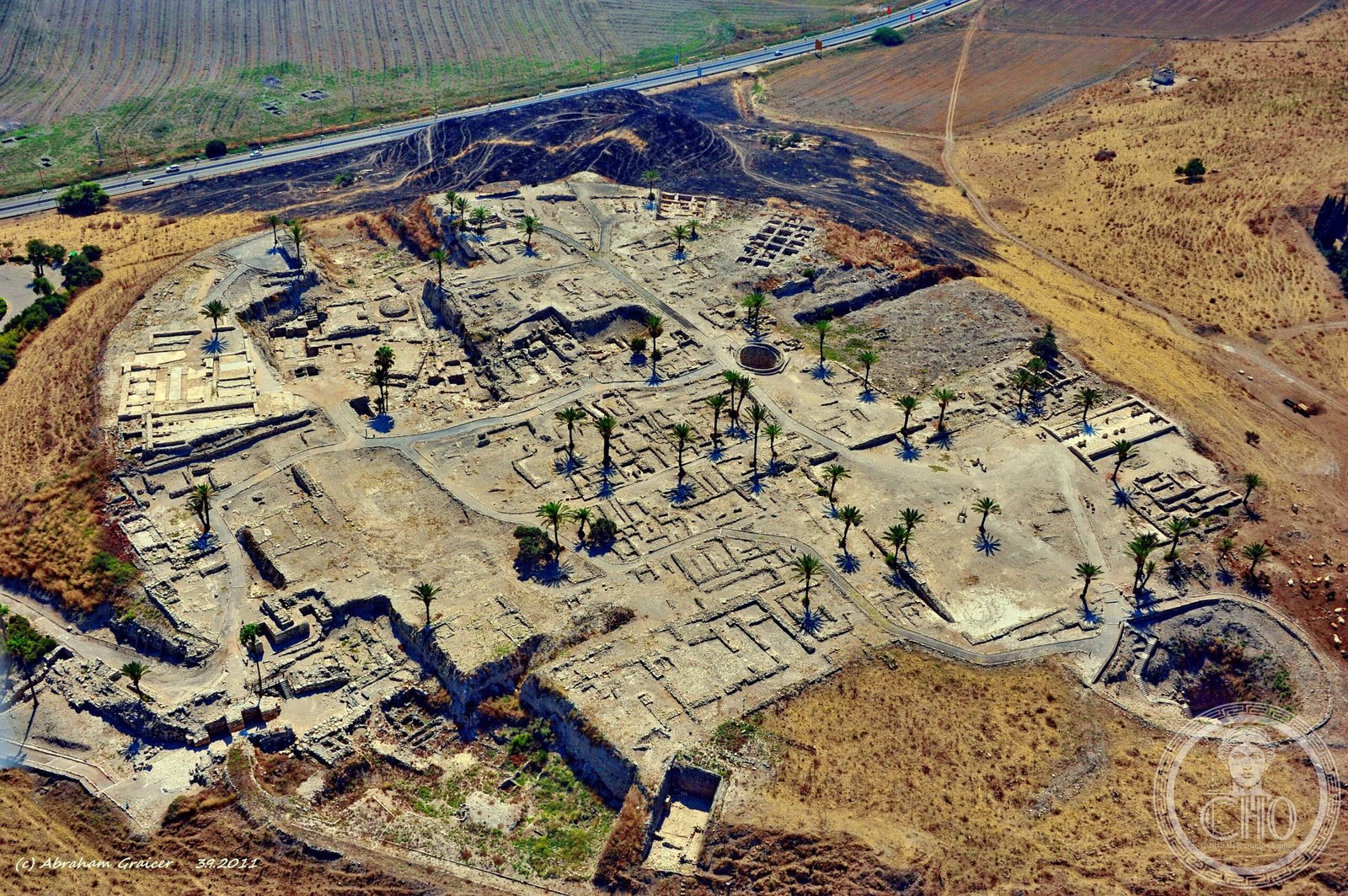
The ruins of an ancient city that dominated trade routes and warfare across the Levant, whose Greek name, Armageddon, resonates through religious texts as a symbol of ultimate conflict.
At a glance
Tel Megiddo rises from the western edge of the Jezreel Valley as a tell—an archaeological mound built up over millennia of successive settlements. Twenty distinct strata reveal continuous habitation from the Neolithic period through the Persian era. The site’s position at the crossroads of major ancient trade routes made it a focal point for commerce, diplomacy, and military strategy across the Bronze and Iron Ages.
History
Occupation began in the early Bronze Age around 3000 BCE and persisted until roughly 332 BCE. During the Bronze Age, Megiddo flourished as an important Canaanite city-state. In the Iron Age, it evolved into a royal city within the Kingdom of Israel, commanding one of antiquity’s most strategically vital junctions.
The site’s name lives on in Christian eschatology through Armageddon—the Greek transliteration appearing once in the New Testament book of Revelation as a symbol of apocalyptic warfare.
What you see
Excavations have revealed the physical infrastructure of a sophisticated ancient metropolis. Massive city walls and monumental gates speak to defensive engineering and administrative authority. Palace complexes and temples indicate both civic governance and religious life. Residential quarters show how inhabitants organized their domestic spaces.
A particularly notable discovery is the site’s advanced water system—engineering that ensured survival during siege or drought, demonstrating the city’s strategic planning and technical capability.
Cultural significance
Megiddo’s historical importance stems from its role as a nexus of ancient Mediterranean and Near Eastern power. Its continuous occupation across three millennia provides an unbroken archaeological record of cultural, military, and economic transformation. The site’s association with the biblical name Armageddon has made it a focal point in religious and cultural imagination, embedding it in Western consciousness far beyond its archaeological value.
Key facts
- Country: Israel
- Coordinates: 32.58527778° N, 35.18444444° E
- UNESCO World Heritage Site
- Protected as Megiddo National Park
- 20 archaeological strata spanning Neolithic to Persian periods
Practical information & getting there
Tel Megiddo operates as a national park with visitor facilities. The site is located in northern Israel’s Jezreel Valley, accessible by road from major population centers. Hours, admission fees, and guided tours are available through Megiddo National Park services. Consult official park resources for current access information and seasonal hours.
Sources & resources
Find it on the map
See this place and what’s around it →📷 Become a Cultural Heritage Online photographer
Share your photos of places: they stay published under your name as the author. The more they're seen, the more you get noticed — and soon a contest will reward the most appreciated photos.
Log in or sign up free to add a photoIs this page about you?
This page is read by travellers and heritage enthusiasts who find it on Google. Tell us how you are connected to this place and we will take it from there.