

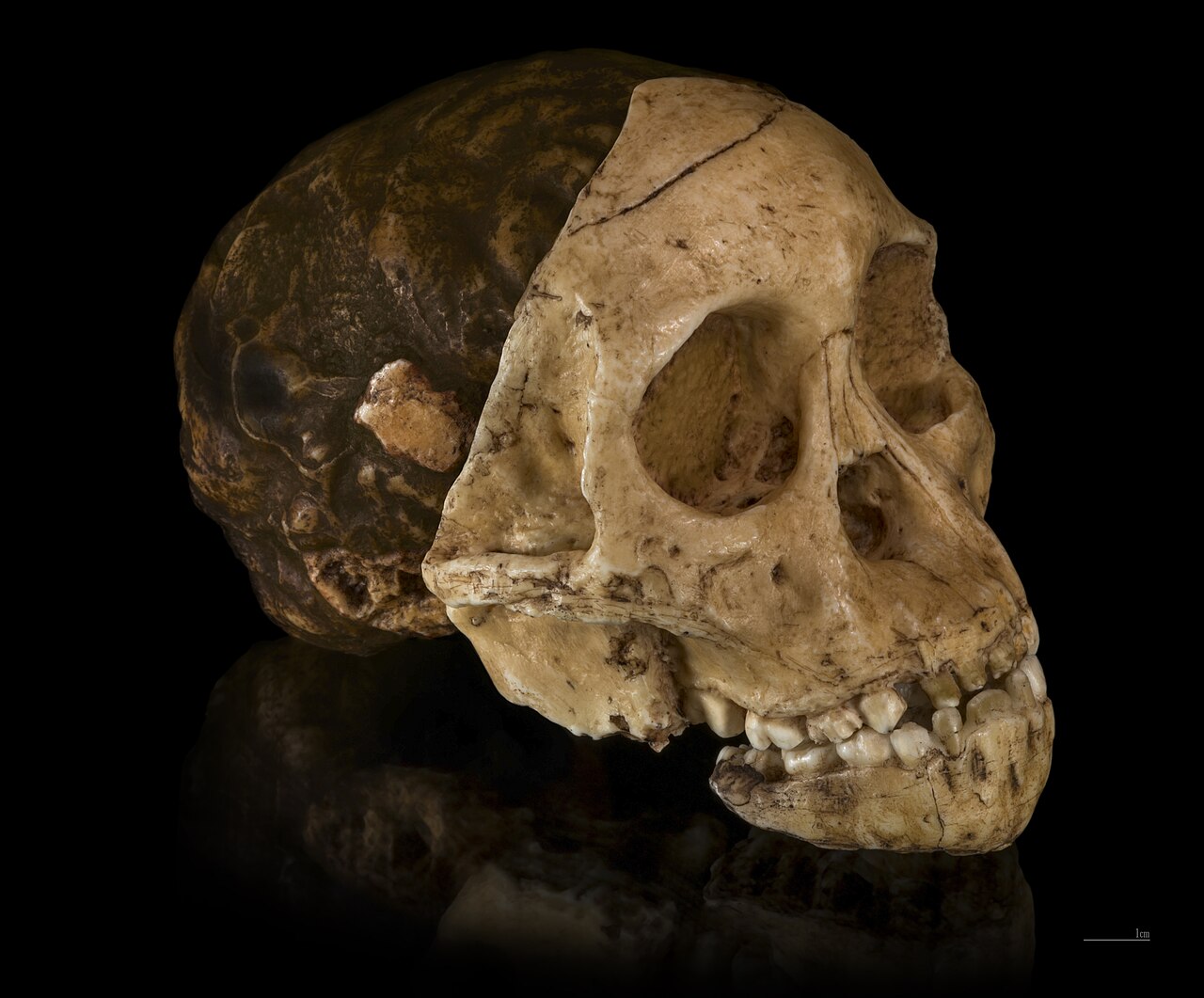
The limestone quarry in South Africa’s North West Province where a student delivered a small fossilised skull to anatomist Raymond Dart in 1924 — the skull that changed everything we thought we knew about where and how humans evolved.
At a glance
Near the town of Taung in what is now South Africa’s North West Province, a limestone quarry yielded, in November 1924, the fossilised skull and brain cast of a child who lived approximately 2.8 million years ago. Raymond Dart, professor of anatomy at the University of the Witwatersrand, identified the fossil as a new primate species — Australopithecus africanus, the southern ape of Africa — and argued that it represented an intermediate form between apes and humans, and that human evolution had therefore begun in Africa, not Asia. The scientific establishment of the time almost unanimously rejected Dart’s interpretation. He was proved right over the following three decades. The Taung Child is now recognised as one of the most important fossil finds in the history of science. The site is part of the UNESCO World Heritage property Fossil Hominid Sites of South Africa, inscribed in 1999 as part of the broader Cradle of Humankind cluster.
Key facts
- Fossil: Australopithecus africanus, specimen Taung Child — skull, mandible, and natural endocast of a child approximately 3 years old at death
- Age: Approximately 2.8 million years (Pliocene epoch)
- Discovery: November 1924; described by Raymond Dart, University of the Witwatersrand; published in Nature, 7 February 1925
- Significance: First evidence that humans evolved in Africa; demonstrated bipedalism and human-like dentition predated large brains
- UNESCO status: Part of Fossil Hominid Sites of South Africa World Heritage Site, inscribed 1999 (expanded 2005 and 2023)
- Location: Buxton Limeworks quarry, near Taung town, North West Province, South Africa (GPS: 27.5433°S, 24.7736°E)
- Access: The original skull is held at the University of the Witwatersrand; the site itself is accessible by road from Johannesburg (approx. 4 hours)
The discovery that rewrote human origins
In November 1924, a crate of fossils arrived at the desk of Raymond Dart, professor of anatomy at the University of the Witwatersrand in Johannesburg. The crate had been assembled by a student, Josephine Salmons, who had received a fossilised baboon skull from a colleague employed at the Buxton Limeworks quarry near Taung. Among the fossils in the crate, Dart recognised something extraordinary: a natural endocast — a perfect stone mould of a brain — and, embedded in a block of limestone, the facial bones of a juvenile primate unlike anything previously described. Working with a knitting needle borrowed from his fiancée to chip away the surrounding rock, Dart spent 73 days excavating the skull, which gradually revealed human-like teeth, eye sockets oriented forwards like those of humans rather than outwards like those of apes, and a brain larger than that of any known ape relative to body size.
Dart published his identification in Nature on 7 February 1925, naming the fossil Australopithecus africanus and arguing that it was a connecting link between apes and humans — and therefore that Africa, not Asia, was the cradle of humanity. The response from the British scientific establishment was immediate and almost uniformly hostile. The leading paleoanthropologists of the era, including Arthur Keith, Elliot Smith, and Arthur Smith Woodward (who had championed the fraudulent Piltdown Man as evidence of Asian origins), dismissed the Taung Child as a juvenile ape — specifically, they argued, a young chimpanzee or gorilla, whose juvenile skull bones would naturally appear more human-like. The controversy persisted for two decades. It was only through the work of Robert Broom, who from the late 1930s discovered additional adult Australopithecus specimens at Sterkfontein, Kromdraai, and Swartkrans, that the scientific community gradually accepted Dart’s original interpretation. The full vindication came with molecular genetics in the 1980s–1990s, which confirmed Africa as the point of origin of the human lineage.
The Taung Child fossil itself was also the subject of a separate discovery decades later: in 2006, paleoanthropologist Lee Berger (who would later direct the discovery of Homo naledi at Rising Star Cave) identified marks on the Taung Child skull consistent with predation by a large eagle — suggesting the child was killed and partially eaten by an eagle, whose talons and beak left characteristic damage patterns on the eye sockets and the back of the skull. The evidence supports the idea that hominins of 2.8 million years ago were prey animals as much as hunters.
What you see at the site today
The Buxton Limeworks quarry where the Taung Child was discovered is in a semi-arid landscape of the North West Province, approximately 4 kilometres from the town of Taung. The quarry itself — a series of exposed limestone formations in a valley — is still partially active as a working quarry; the specific location of the 1924 find is marked but embedded within a working industrial site. The surrounding landscape of dolomite and tufa limestone formations is typical of the Cradle of Humankind geological province: ancient freshwater springs deposited calcified sediments over millions of years, preserving the bones of animals and hominins that fell into cave systems or were dragged there by predators.
The most significant paleoanthropological collection from Taung is not at the site itself but at the Evolutionary Studies Institute at the University of the Witwatersrand in Johannesburg, where the original Taung Child skull — along with thousands of other hominin fossils from southern Africa — is held. High-quality casts of the Taung Child are displayed at the Ditsong Museum (formerly Transvaal Museum) in Pretoria and at the Maropeng Visitor Centre, the official visitor centre for the Cradle of Humankind UNESCO World Heritage Site, which provides the most comprehensive and accessible introduction to the paleoanthropological significance of the entire Fossil Hominid Sites cluster.
Practical information
- The original Taung Child fossil: Evolutionary Studies Institute, University of the Witwatersrand, Johannesburg — not permanently on public display; research access by appointment
- Best visitor destination: Maropeng Visitor Centre, Cradle of Humankind UNESCO WHS — comprehensive exhibition on all Fossil Hominid Sites including Taung; open daily 09:00–17:00
- Taung Heritage Site: the quarry site itself is accessible; contact North West Province Tourism for guided access
- The site is a working quarry: independent access is limited; guided visits are strongly recommended
- Entry fees: Maropeng Visitor Centre: approx. ZAR 200 adult (2026)
Getting there
The Taung Skull Site is located approximately 4 km from the town of Taung, North West Province, on the R504 road approximately 180 km southwest of Johannesburg. By road from Johannesburg: approximately 3.5–4 hours via the N14 highway west, then south via Ventersdorp toward Taung. There is no public transport to the quarry site itself; a rental car or organised tour from Johannesburg is recommended. The Maropeng Visitor Centre for the Cradle of Humankind UNESCO WHS is located much closer to Johannesburg (approximately 1 hour northwest via the R563 near Hekpoort) and is the more practical destination for most visitors wishing to understand the broader paleoanthropological context of the Fossil Hominid Sites of South Africa.
Nearby
- Sterkfontein Caves — UNESCO WHS site where Robert Broom discovered adult Australopithecus fossils from the 1930s; guided cave tours available; 180 km northeast of Taung
- Maropeng Visitor Centre — official Cradle of Humankind visitor attraction with world-class paleoanthropology exhibition; approximately 200 km northeast
- Rising Star Cave / Dinaledi Chamber — discovery site of Homo naledi (2013–2015); part of the same UNESCO WHS cluster; near Maropeng
Sources
- Dart, R.A. (1925). Australopithecus africanus: the man-ape of South Africa. Nature, 115(2884), 195–199.
- Berger, L.R. & Clarke, R.J. (1995). Eagle involvement in accumulation of the Taung child fauna. Journal of Human Evolution, 29(3), 275–299.
- UNESCO World Heritage Centre: Fossil Hominid Sites of South Africa. whc.unesco.org/en/list/915
- Tattersall, I. (2012). Masters of the Planet: The Search for Our Human Origins. Palgrave Macmillan.
- Maropeng Official Visitor Centre: maropeng.co.za
Find it on the map
See this place and what’s around it →📷 Become a Cultural Heritage Online photographer
Share your photos of places: they stay published under your name as the author. The more they're seen, the more you get noticed — and soon a contest will reward the most appreciated photos.
Log in or sign up free to add a photo