

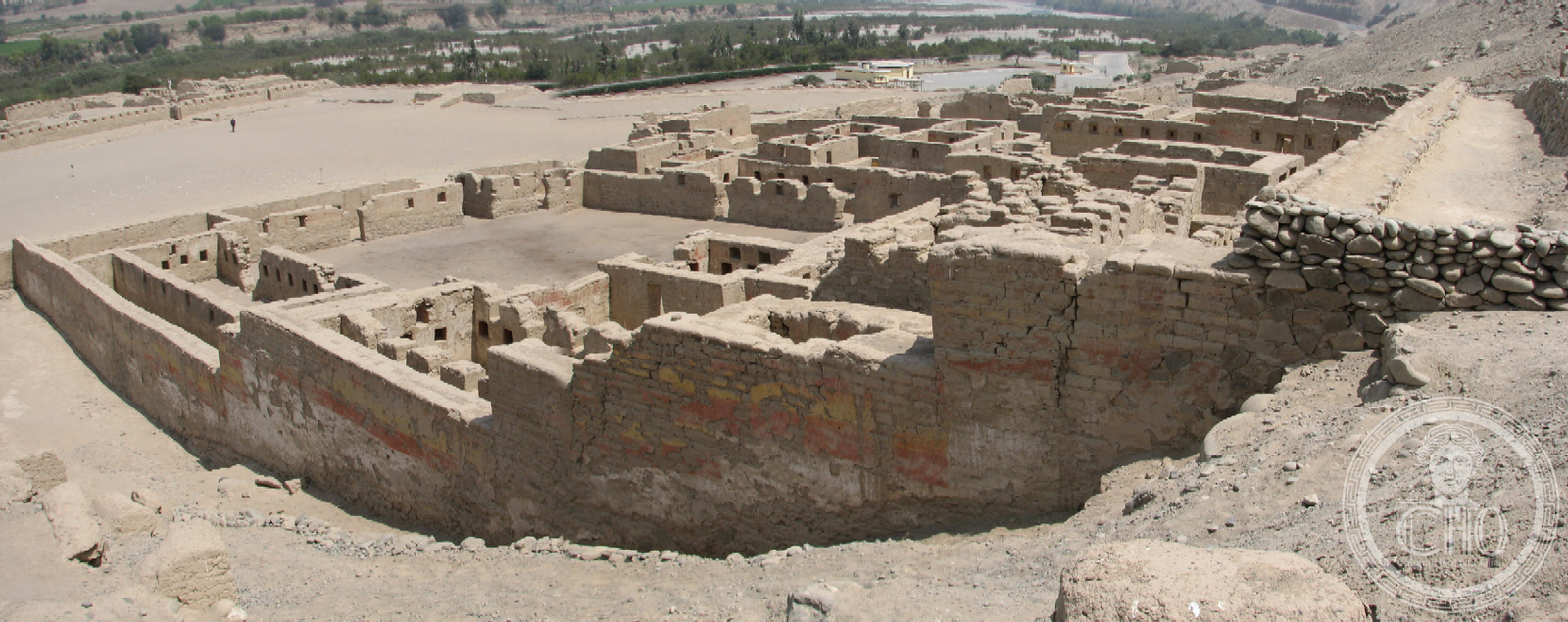
The best-preserved Inca coastal palace in Peru — and nearly unique in the Inca world for retaining its original polychrome decoration in red, yellow, white, and black, revealing what Inca buildings actually looked like before centuries of weathering stripped their surfaces.
At a glance
In the Pisco Valley of the Ica department of southern Peru, approximately 50 km northeast of the city of Pisco at an altitude of approximately 700 metres, Tambo Colorado preserves the most intact example of Inca coastal architecture in Peru. Its adobe walls retain their original polychrome paintings in red, yellow, white, and black — the same colours seen on Inca textiles and ceramics but almost never preserved on architecture — giving the site an almost unique status as direct evidence for what Inca buildings originally looked like. Built approximately 1470 AD as an administrative centre on the Inca coastal highway, it receives approximately 20,000 visitors per year, lying directly adjacent to the Panamericana highway.
Key facts
- Period: c. 1470–1532 AD (Inca Empire, Late Horizon).
- Altitude: approximately 700 metres — a coastal valley site, unusually low for Inca monuments.
- Unique feature: original Inca polychrome wall paintings in red, yellow, white, and black — extremely rare survival.
- Name origin: Spanish Tambo Colorado (Coloured Tambo) — named by early colonial observers for the painted walls.
- Function: tampu (Inca roadside administrative post) on the coastal branch of the Qhapaq Ñan.
- Structures: governor’s compound, kancha (central plaza), qollqa, usnu, aqllawasi sector.
- Visitors: approximately 20,000 per year; visible from the Panamericana highway.
History
Tambo Colorado was built approximately 1470 AD, likely during the reign of Topa Inca Yupanqui, as part of the systematic Inca programme of constructing administrative centres (tampu) at regular intervals along the Qhapaq Ñan — the imperial road network that stitched together the empire from present-day Colombia to central Chile. Its location in the Pisco Valley placed it on the coastal branch of the road, connecting Cusco and the highlands with the densely populated agricultural valleys of the south Peruvian coast.
The site served a dual function: as a way-station for Inca state travellers, messengers (chaski), armies, and officials moving along the coast, and as an administrative hub for managing the mit’a labour obligations and agricultural production of the Pisco and Ica valley populations. After the Spanish conquest in 1532, Tambo Colorado was abandoned as an administrative centre but survived in a condition of gradual decay rather than deliberate demolition. The dry coastal climate — among the driest on earth — has been responsible for the extraordinary preservation of the painted adobe surfaces.
What you see
The complex is dominated by the residential compound for the local Inca governor (kuraka or tukrikuq), organised around a large central plaza (kancha) with trapezoidal doorways — the canonical Inca form — opening between sectors. The walls rise to considerable height and preserve, in the better-sheltered sections, their original decoration: bands and geometric patterns in red ochre, yellow, white, and black applied to the adobe surface. These are the best-preserved examples of Inca exterior wall painting known, and their survival transforms the experience of visiting Tambo Colorado compared to the typically undecorated grey stone ruins of highland Inca sites.
On the hillside above the main compound, the qollqa storehouses stand in rows, their rectangular form typical of coastal storage requirements. The usnu (ceremonial platform for libation offerings and state rituals) occupies a prominent position within the plaza. A separate architectural sector, apparently reserved for the aqllakuna (the chosen women who produced fine textiles and chicha for the state), is identifiable by its distinctive spatial arrangement. The site sits immediately adjacent to the Panamericana highway, making it visible from passing vehicles — one of the few major Inca sites with such direct road access.
Practical information
- Location: km 209 of the Panamericana Sur, approximately 50 km northeast of Pisco; clearly signed.
- Opening hours: daily; check current hours with Peru’s Ministry of Culture (cultura.gob.pe).
- Tickets: entry fee payable at the site.
- On site: small visitor area at entrance; no café; bring water (hot, dry valley).
- Combination: typically paired with the Paracas National Reserve (30 km southwest) and the Nazca Lines (3 hours south).
Getting there
Tambo Colorado is at km 209 of the Panamericana Sur, approximately 50 km northeast of the city of Pisco and 240 km south of Lima. By car or bus from Pisco, take the inland road up the Pisco Valley toward Huaytará; the site is clearly signposted and lies directly on the road. From Lima, the journey to Pisco takes approximately 3–3.5 hours by car or intercity bus (frequent departures from Lima’s terminal). The nearest accommodation hub is Pisco/Paracas, which also provides access to the Paracas Reserve and the Ballestas Islands.
Nearby
- Paracas National Reserve: 30 km southwest — dramatic desert coastal reserve with flamingos and sea lions.
- Ballestas Islands: offshore from Paracas — boat excursions to penguin and sea lion colonies.
- Nazca Lines: 3 hours south — the famous geoglyphs on the Nazca plateau (UNESCO World Heritage).
- Ica: 65 km south — oasis city with wine bodegas and the Huacachina sand dune lagoon.
Sources
- Menzel, D. Style and Time in the Middle Horizon. Ñawpa Pacha 2, 1964.
- D’Altroy, T.N. The Incas. Blackwell, 2002.
- Hyslop, J. Inka Settlement Planning. University of Texas Press, 1990.
- Wikipedia: Tambo Colorado.
- Peru Ministry of Culture: cultura.gob.pe.
Find it on the map
See this place and what’s around it →📷 Become a Cultural Heritage Online photographer
Share your photos of places: they stay published under your name as the author. The more they're seen, the more you get noticed — and soon a contest will reward the most appreciated photos.
Log in or sign up free to add a photo