
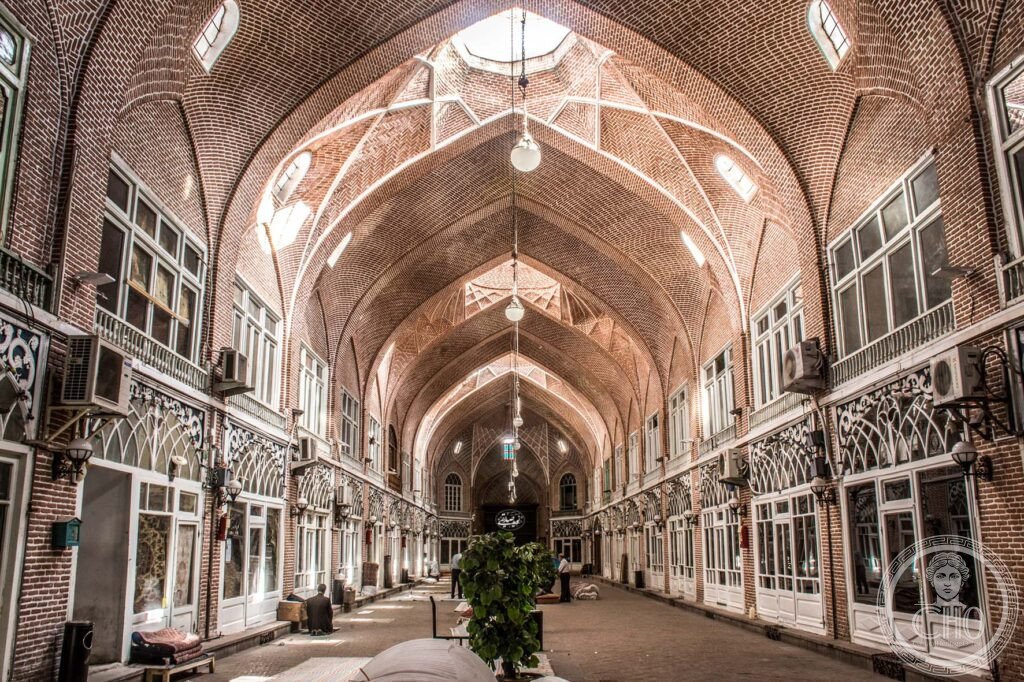
A crossroads between East and West, Tabriz was for centuries one of the great emporia of the Silk Road. Its bazaar is a covered labyrinth of brick-vaulted lanes, caravanserais, mosques and schools: one of the most extensive historic commercial complexes in the world, still alive and bustling.
At a glance
Tabriz, in north-western Iran, stood at a great crossroads of trade between East and West, and for centuries was one of the most important commercial cities on the Silk Road. Its historic bazaar is one of the largest covered marketplaces in the world: a vast labyrinth of brick-vaulted lanes, caravanserais, courtyards, mosques and schools, each trade with its own section. A complete and still-thriving example of a historic commercial and social complex, it was inscribed by UNESCO in 2010.
Key facts
- UNESCO: World Heritage since 2010 (Tabriz Historic Bazaar Complex)
- One of the largest: among the biggest covered bazaars in the world
- Silk Road: a great trading hub between East and West
- Brick vaults: a labyrinth of vaulted lanes and domed halls
- More than a market: caravanserais, mosques, schools and baths
- Living complex: still a working bazaar at the heart of the city
History
Tabriz prospered from its position on the routes linking Anatolia, the Caucasus and Central Asia, and at times served as a capital of empires. By the late Middle Ages its bazaar was famous across the known world; travellers such as Marco Polo and later European envoys remarked on its wealth. Earthquakes destroyed and rebuilt the city more than once, the present bazaar dating largely from the rebuilding after a great quake in the 18th century.
Organised by trade and by interconnected halls, courtyards and caravanserais, the bazaar was not only a marketplace but the economic, social and religious heart of the city, with its mosques and schools. It remains a living institution, one of the most complete historic bazaars anywhere.
What you see
The bazaar is a covered world of brick: long vaulted lanes lit by openings in the domes, opening into grand halls and courtyards. Each section has its trade — carpets, gold, spices, leather — and between them lie caravanserais where goods were stored, mosques and old schools, all under the patterned brick vaults.
The Mozaffariyeh hall, with its elegant arcade, is among the most beautiful spaces in the complex.
Practical information
- Bazaar: a living market, freely open during trading hours
- Time needed: 2–3 hours to wander the halls
- Note: Tabriz is famous for its carpets
- Setting: in the centre of Tabriz, north-western Iran
Getting there
Tabriz is the capital of East Azerbaijan province in north-western Iran, with an airport and rail and road links. The bazaar is in the city centre. GPS: 38.0805° N, 46.2919° E.
Nearby
- Blue Mosque — the tiled 15th-century mosque of Tabriz
- Kandovan — a village of cave houses nearby
- Lake Urmia — the great salt lake to the south
Sources
- UNESCO World Heritage Centre — “Tabriz Historic Bazaar Complex” (ref. 1346)
- Iranian Cultural Heritage Organisation — official body
- Encyclopaedia Britannica — Tabriz
Find it on the map
See this place and what’s around it →📷 Become a Cultural Heritage Online photographer
Share your photos of places: they stay published under your name as the author. The more they're seen, the more you get noticed — and soon a contest will reward the most appreciated photos.
Log in or sign up free to add a photoIs this page about you?
This page is read by travellers and heritage enthusiasts who find it on Google. Tell us how you are connected to this place and we will take it from there.