
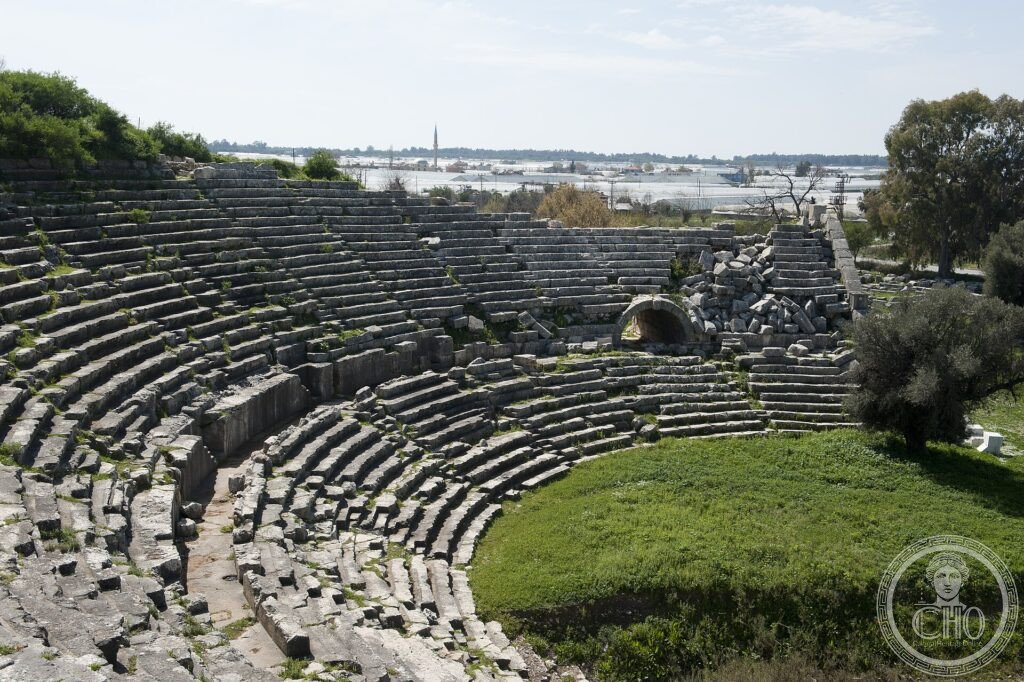
In the south-western corner of Anatolia flourished a people with a culture all their own, the Lycians. Their capital Xanthos and the nearby sanctuary of Letoon, dedicated to the goddess Leto, have left us unique carved tombs, inscriptions in the Lycian language, and monuments that fuse East and the Greek world.
At a glance
Xanthos and the nearby sanctuary of Letoon, in south-western Turkey, were the heart of ancient Lycia, a people with their own language and a distinctive culture at the meeting of Anatolian, Greek and Persian worlds. Xanthos was the chief city; Letoon, dedicated to the goddess Leto and her children Apollo and Artemis, was the federal sanctuary of the Lycians. Their carved pillar-tombs, inscriptions in the Lycian language, and temples make the site uniquely important. Xanthos-Letoon was inscribed by UNESCO in 1988.
Key facts
- UNESCO: World Heritage since 1988 (Xanthos-Letoon)
- Lycian capital: Xanthos was the leading city of ancient Lycia
- Letoon: the federal sanctuary of Leto, Apollo and Artemis
- Lycian tombs: distinctive carved pillar- and house-tombs
- Inscriptions: key texts in the little-known Lycian language
- Cultural crossroads: Anatolian, Greek and Persian influences
History
Lycia, in the mountainous south-west of Anatolia, kept a strong identity through the first millennium BC, its cities bound in a federation. Xanthos, the chief city, twice chose mass self-destruction rather than surrender — to the Persians and later to Rome — episodes recorded by ancient writers. Its rulers and citizens raised the carved pillar-tombs and monuments, inscribed in Lycian and Greek, that are the glory of the site; some sculptures, like the Nereid Monument, are now in museums abroad.
A short distance away, Letoon served as the religious centre of the Lycian League, with three temples by a sacred spring. Greek, then Roman and Byzantine layers were added, but the Lycian character endures in the ruins and inscriptions.
What you see
At Xanthos, the theatre and agora are overlooked by the famous pillar-tombs — tall monolithic shafts bearing burial chambers and reliefs — and inscribed monuments in the Lycian script. At Letoon, the foundations of three temples lie by the spring, with a Hellenistic theatre on the slope above and a long inscription that helped decipher the Lycian language.
The two sites, set among fields near the coast, together tell the story of a vanished civilisation.
Practical information
- Sites: Xanthos and Letoon are a few kilometres apart, both open to visitors
- Time needed: half a day for both
- Note: near the resort coast of Lycia; combine with the Lycian Way
- Setting: in Antalya/Muğla province, south-west Turkey
Getting there
Xanthos and Letoon are near the village of Kınık in south-western Turkey, inland from the coast between Fethiye and Kalkan. They are reached by road. GPS (Letoon): 36.3858° N, 29.3147° E.
Nearby
- Patara — an ancient Lycian port and beach nearby
- The Lycian Way — the long-distance coastal trail
- Fethiye and Kaş — coastal towns with more Lycian tombs
Sources
- UNESCO World Heritage Centre — “Xanthos-Letoon” (ref. 484)
- Republic of Türkiye Ministry of Culture and Tourism — official body
- Encyclopaedia Britannica — Lycia; Xanthus
Find it on the map
See this place and what’s around it →📷 Become a Cultural Heritage Online photographer
Share your photos of places: they stay published under your name as the author. The more they're seen, the more you get noticed — and soon a contest will reward the most appreciated photos.
Log in or sign up free to add a photo