

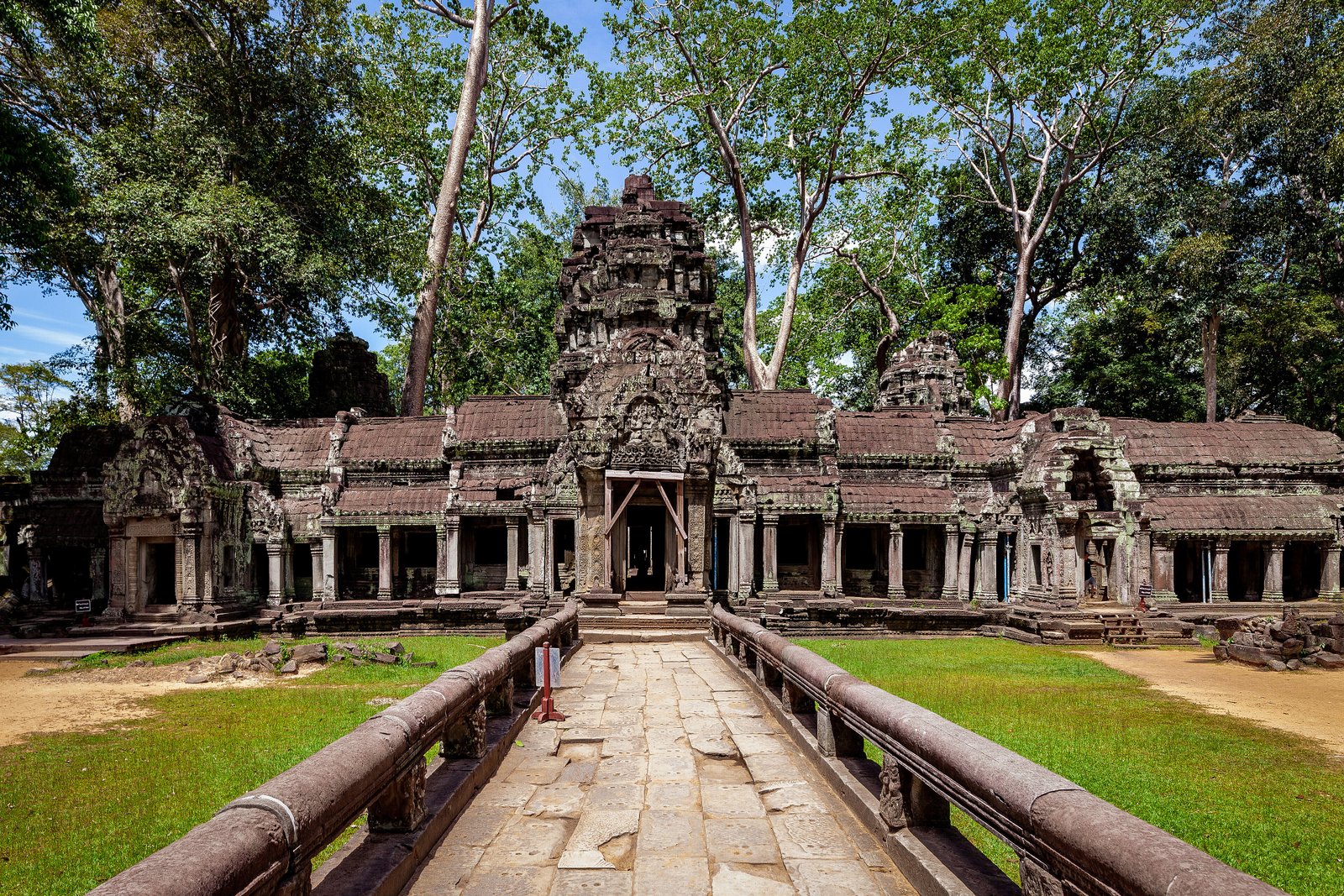
Built in 1186 by the Khmer king Jayavarman VII as a Buddhist monastery and university, Ta Prohm is the temple the jungle reclaimed — its stone galleries split and embraced by the roots of giant silk-cotton trees in one of the most visually striking sights in Southeast Asia.
At a glance
Ta Prohm sits within the Angkor complex near Siem Reap, Cambodia, approximately 2 km east of Angkor Wat. Unlike most Angkor temples, which have been cleared and partly restored, Ta Prohm has been deliberately left in a state of controlled overgrowth: strangler figs and silk-cotton trees have grown through and over the stone galleries, their roots spreading across walls and towers like enormous grey fingers. The APSARA National Authority, which manages the Angkor World Heritage Site, has maintained this “romantic ruin” aesthetic while undertaking structural stabilisation to prevent collapse. At the height of its activity in the late 12th century, the temple complex housed 12,640 people — including 2,740 officials and 615 dancers — according to a Sanskrit inscription discovered in 1186.
Key facts
- Built: 1186 AD by Jayavarman VII, Khmer Empire; Buddhist monastery and university (originally called Rajavihara)
- Population: 12,640 people at peak, per 1186 inscription, including 2,740 officials and 615 dancers
- UNESCO: Part of Angkor World Heritage Site (1992); managed by APSARA National Authority with French-led restoration teams
- Trees: Primarily strangler figs (Ficus gibbosa) and silk-cotton trees (Ceiba pentandra); some root systems span more than 10 m across stone walls
- Film location: Lara Croft: Tomb Raider (dir. Simon West, 2001), starring Angelina Jolie
- Management policy: Intentional partial overgrowth preserved; structural stabilisation ongoing since the 1990s
History
In 1186, the Khmer king Jayavarman VII commissioned Ta Prohm as a Buddhist monastery dedicated to his mother — the temple’s central image represented the Prajnaparamita, the personification of wisdom. At its foundation, according to a stele inscription, the complex supported 12,640 people across its grounds: administrators, priests, dancers, teachers, and workers, sustained by 3,140 villages and 66,625 labourers in the surrounding territory. This was not a solitary sacred ruin but a living institutional city.
After the fall of the Khmer Empire in the 15th century and the abandonment of Angkor, the jungle moved in quickly. The site was recorded by European explorers in the 19th century — the French naturalist Henri Mouhot wrote of it in 1860 — but the decision of the École française d’Extrême-Orient, which took custody of Angkor in the early 20th century, was to leave Ta Prohm largely as found, as a counterpoint to the cleared and restored temples nearby. That decision has defined the site’s identity ever since.
The APSARA National Authority, established in 1995, now manages the site jointly with international conservation teams. Work focuses on stabilising structures threatened by root pressure without removing the trees that have become the temple’s defining feature — a technically demanding balance between preservation and spectacle.
What you see
Ta Prohm is built on a flat plan in concentric rectangular enclosures, its gopuras (entrance towers) and galleries linked by cruciform corridors. Much of the stone facing has been displaced by root systems, and some galleries have partially collapsed; the current experience combines cleared pathways with ruined sections where tree and stone have become genuinely inseparable. The silk-cotton trees are the dominant visual presence: their buttressed roots spill across doorways and along wall faces, their trunks rising from the stone like the bodies of enormous sleeping animals. Where roots have lifted stone blocks, the displacement is measured in metres.
The central sanctuary, though damaged, preserves carved bas-reliefs and apsara figures — the graceful celestial dancers that appear throughout Angkor. The Hall of Dancers near the eastern entrance contains especially fine carvings. The so-called “Tomb Raider tree” — a particularly photogenic silk-cotton growing over a stone gateway near the south entrance — is the most visited single feature in the complex.
Film location: Lara Croft: Tomb Raider (2001)
Ta Prohm became internationally famous when Simon West’s Lara Croft: Tomb Raider (2001), starring Angelina Jolie as Lara Croft, used its overgrown galleries as a primary filming location. The scene in which Lara discovers an ancient clock hidden beneath the roots of a massive tree — using it to open a portal to a hidden chamber — was shot on location within Ta Prohm’s root-covered corridors. No digital enhancement was needed: the roots, the scale, and the atmosphere of controlled ruin were exactly what the production required.
The film brought a global audience to Angkor and was directly credited with a surge in tourism to Cambodia in the early 2000s. Ta Prohm has since been used in numerous other productions and advertising campaigns, and the “Jungle Temple” aesthetic — stone ruins reclaimed by tropical vegetation — has become one of the most recognisable tropes in adventure film and television worldwide.
Practical information
- Opening hours: Daily 07:30–17:30 (part of the general Angkor Archaeological Park)
- Access: Included in the Angkor Archaeological Park pass (1-day, 3-day, or 7-day). Purchase at the official APSARA ticket centre; passes are checked strictly
- Best time: Early morning (before 09:00) for soft light and fewer visitors; the root-draped facades photograph best in morning side-light
- Duration: 1–2 hours on site; allow longer if combining with the eastern Angkor circuit
- Notes: Some pathways require ducking under root formations; the site can be very crowded by mid-morning. Mosquito repellent recommended.
Getting there
Ta Prohm is approximately 2 km east of Angkor Wat and 7 km north of Siem Reap city centre. Most visitors travel within the Angkor complex by tuk-tuk (arranged through accommodation) or bicycle along the well-signposted temple circuit roads. Siem Reap International Airport (REP) has direct connections to Bangkok, Singapore, Kuala Lumpur, Ho Chi Minh City, and other regional hubs, as well as some international routes. The temple is reached via the eastern gate of Angkor Thom or directly via the road running east from Angkor Thom toward Banteay Kdei.
Nearby
- Angkor Wat — 2 km west; the world’s largest religious monument, the symbolic heart of the Khmer Empire and Cambodia’s national emblem
- Angkor Thom — 1.5 km northwest; the last great capital of the Khmer Empire, with the Bayon temple at its centre
- Banteay Kdei — 500 m southeast; another Buddhist temple of similar period, less visited and partly overgrown
- Srah Srang — 600 m southeast; a royal bathing pool with stone terraces, still used today by local communities
- Preah Khan — 4 km north; a large temple-monastery also commissioned by Jayavarman VII, with similar root-overgrowth features
Frequently asked questions
Was Tomb Raider filmed at Ta Prohm?
Yes. Ta Prohm is the temple used in Lara Croft: Tomb Raider (2001), starring Angelina Jolie, and is widely known as the "Tomb Raider temple".
Where is the Tomb Raider temple?
Ta Prohm is part of the Angkor complex in Cambodia, famous for the giant tree roots growing over its stone galleries.
Can you visit Ta Prohm?
Yes. It is included in the standard Angkor Archaeological Park ticket, close to Angkor Wat and Angkor Thom.
Why is Ta Prohm covered in trees?
It was deliberately left in its jungle-reclaimed state during restoration, with silk-cotton and strangler-fig roots wrapping the galleries built in 1186.
Who built Ta Prohm?
The Khmer king Jayavarman VII built it in 1186 as a Buddhist monastery and university.
See this location in context: Set-Jetting: Six Famous Film & TV Locations You Can Actually Visit.
Sources
- Wikipedia — Ta Prohm
- UNESCO World Heritage — Angkor
- Dagens, B. (1995). Angkor: Heart of an Asian Empire. Thames & Hudson.
Find it on the map
See this place and what’s around it →
Historical events at this place (2)
📷 Become a Cultural Heritage Online photographer
Share your photos of places: they stay published under your name as the author. The more they're seen, the more you get noticed — and soon a contest will reward the most appreciated photos.
Log in or sign up free to add a photo