
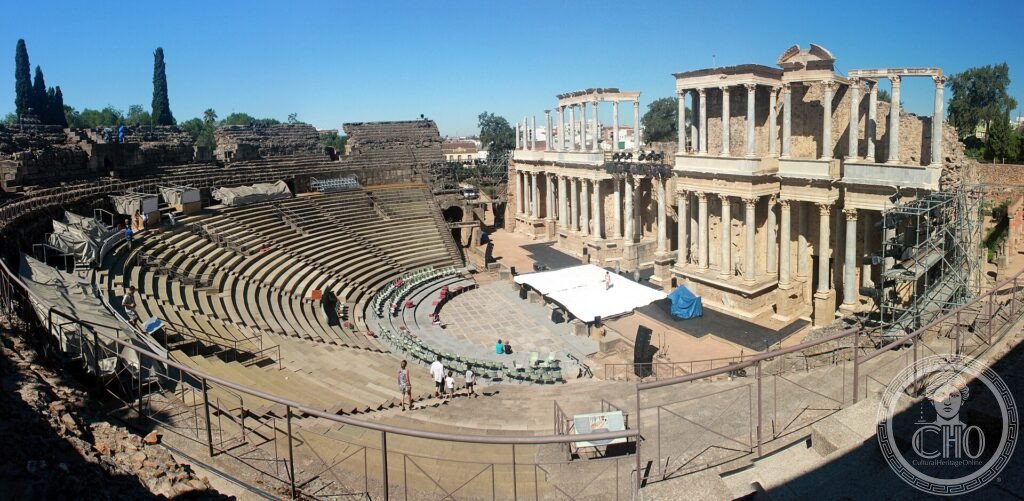
Founded by Augustus in 25 BC for his veterans, Augusta Emerita was the capital of Lusitania and one of the richest cities of the Empire in Hispania. Mérida preserves one of Spain’s most complete Roman ensembles: theatre, amphitheatre, bridge, aqueducts, temples — the life of a Roman city frozen in stone.
At a glance
Mérida, founded by the emperor Augustus in 25 BC as Augusta Emerita, a colony for his veterans, became the wealthy capital of the Roman province of Lusitania. It preserves one of the most extensive and best-preserved groups of Roman monuments in Spain: a magnificent theatre and amphitheatre, a long bridge over the Guadiana, aqueducts, the Temple of Diana, a circus and more. Together they evoke a complete Roman provincial capital. The archaeological ensemble was inscribed by UNESCO in 1993.
Key facts
- UNESCO: World Heritage since 1993 (Archaeological Ensemble of Mérida)
- Founded: 25 BC by Augustus as Augusta Emerita
- Capital: of the Roman province of Lusitania
- Roman Theatre: built around 15 BC, still used for performances
- Amphitheatre and circus: for gladiatorial games and chariot races
- Engineering: a long bridge, aqueducts and the Temple of Diana survive
History
Augustus founded Augusta Emerita in 25 BC to settle veterans (emeriti) of his legions at a strategic crossing of the river Guadiana. Richly endowed, it grew into the capital of Lusitania and one of the greatest cities of Roman Hispania, with theatre, amphitheatre, circus, temples, baths and a vast road and water network.
After Rome the city remained important under the Visigoths and the Moors, but never outgrew its Roman bones. Centuries of excavation have uncovered an exceptional ensemble of monuments, making modern Mérida an open-air museum of Roman urban life, with the great theatre as its centrepiece.
What you see
The Roman Theatre is the jewel: its tiered seating curves before a two-storey colonnaded stage front of marble columns, restored and still hosting a summer drama festival. Beside it the amphitheatre recalls the games. Across the city stand the long Roman bridge over the Guadiana, the arches of aqueducts, the columns of the Temple of Diana and the remains of the circus.
The National Museum of Roman Art displays mosaics, statues and finds that bring the ancient capital to life.
Practical information
- Monuments: a combined ticket covers the theatre, amphitheatre and other sites
- Festival: the Mérida Classical Theatre Festival fills the theatre each summer
- Time needed: a full day for the monuments and museum
- Note: the National Museum of Roman Art is a highlight
Getting there
Mérida is the capital of the Extremadura region in western Spain, near the Portuguese border. It has rail and road links from Madrid, Seville and Lisbon. The monuments are in and around the city centre. GPS: 38.9156° N, 6.3389° W.
Nearby
- National Museum of Roman Art — beside the theatre
- Cáceres — a UNESCO old town to the north
- Alentejo and Elvas — the Portuguese border country to the west
Sources
- UNESCO World Heritage Centre — “Archaeological Ensemble of Mérida” (ref. 664)
- Consorcio Ciudad Monumental de Mérida — official body
- Encyclopaedia Britannica — Mérida, Spain
Find it on the map
See this place and what’s around it →📷 Become a Cultural Heritage Online photographer
Share your photos of places: they stay published under your name as the author. The more they're seen, the more you get noticed — and soon a contest will reward the most appreciated photos.
Log in or sign up free to add a photo