
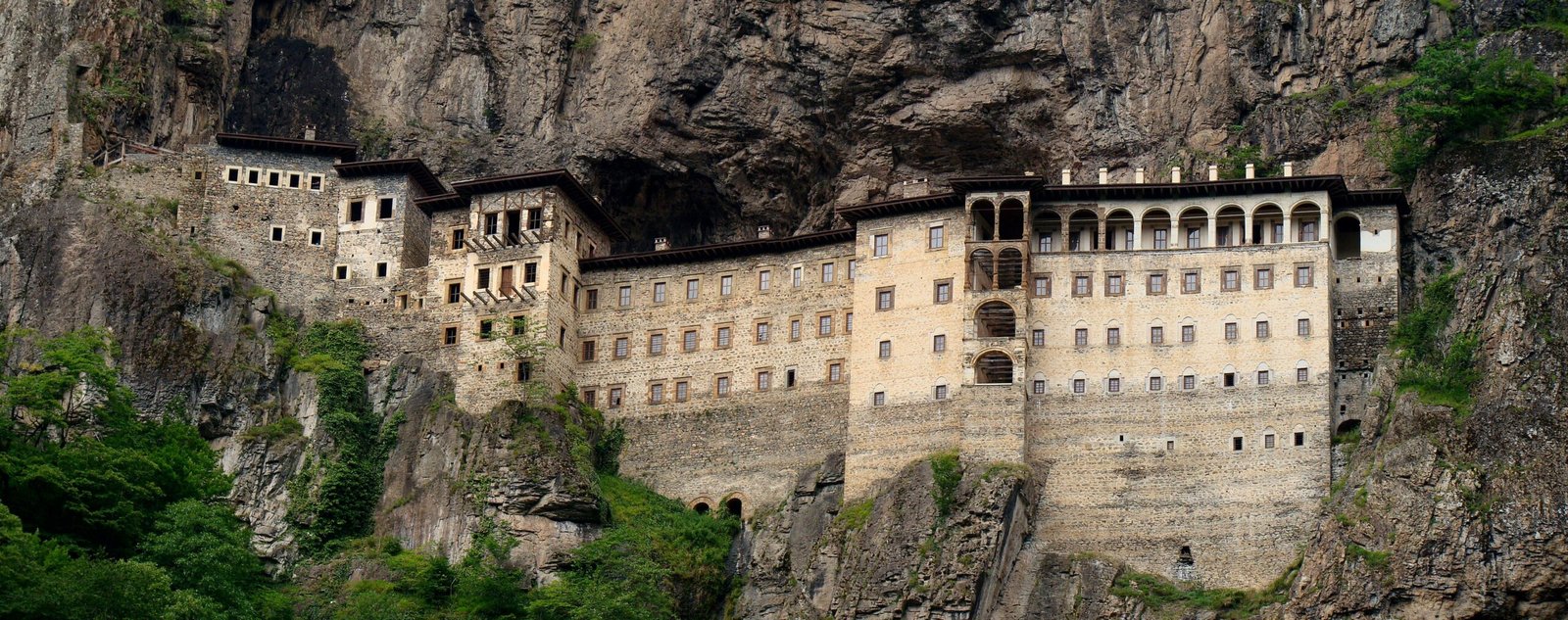
A Byzantine cliff monastery built into a sheer rock face at 1,200 metres altitude in the Pontic Mountains — one of the most dramatically sited monastic complexes in the Christian world, founded according to tradition in 386 AD and continuously occupied for 1,500 years.
At a glance
In the Altindere National Park in the Pontic Mountains above the Black Sea coast of Turkey, approximately 46 km south of Trabzon (ancient Trebizond), the Sumela Monastery clings to a near-vertical cliff face at approximately 1,200 metres above sea level. Built into a natural cave in the rock and extending outward on wooden and stone platforms over the densely forested Altindere Valley 300 metres below, it is one of the most dramatically sited and historically significant monastic complexes in the Byzantine and post-Byzantine Christian world. The monastery was abandoned in 1923 during the Greek-Turkish population exchange and partially reopened for annual religious pilgrimages from 2010.
Key facts
- Altitude: Approximately 1,200 metres above sea level; valley floor approximately 300 metres below
- Founded: According to tradition, 386 AD by two Athenian monks, Barnabas and Sophronios
- Peak era: Empire of Trebizond (1204–1461 AD) — principal spiritual centre of the Pontic Greek Komnenian dynasty
- Central object: The Panagia Soumela — an icon of the Virgin Mary believed painted by St. Luke, held since ancient times
- Abandoned: 1923, following the Greek-Turkish population exchange; icon removed to Greece
- Annual pilgrimage: 15 August (Feast of the Assumption); Greek Orthodox services resumed 2010
- Restoration: Ongoing since 2000s; restoration work continues on the cliff-face frescoes
History
According to the monastic foundation legend, Sumela was established in 386 AD by two Athenian monks, Barnabas and Sophronios, who discovered a miraculous icon of the Virgin Mary (believed to have been painted by St. Luke) in a cave on the cliff face. Whether or not the founding date is accurate, the site was certainly occupied by Byzantine monks from an early period, and by the 9th century it had become one of the most revered pilgrimage destinations in the Pontic region. The monastery received imperial patronage from successive Byzantine emperors and from the rulers of the Empire of Trebizond — the Pontic Greek successor state established in 1204 AD by the Komnenian dynasty after the sack of Constantinople by the Fourth Crusade.
Under the Empire of Trebizond (1204–1461 AD), Sumela reached its greatest architectural elaboration. The Komnenian rulers made it their principal spiritual centre, covering the rock-face church and surrounding buildings with Byzantine frescoes depicting Gospel scenes, the life of the Virgin, and the saints. After the Ottoman conquest of Trebizond in 1461, Sumela continued to function as a Greek Orthodox monastery under Ottoman rule, receiving new imperial firman protections and building extensions through the 18th and 19th centuries. The monastery was finally abandoned in 1923 as a consequence of the compulsory Greek-Turkish population exchange that followed the Greco-Turkish War, which required all Orthodox Christians in Turkey to relocate to Greece. The monks departed, taking the Panagia Soumela icon to Thessaloniki, where it remains at the Veria Monastery.
The site was opened to tourists in the late 20th century and since 2010 has been the setting for an annual Greek Orthodox liturgy on 15 August, the Feast of the Assumption — attended by thousands of pilgrims from Greece, Turkey, and the wider Orthodox diaspora. Restoration work on the frescoes and structure has been ongoing, though vandalism of the frescoes during the decades of abandonment caused irreversible damage.
What you see
The monastery complex is built in multiple layers directly onto and into the cliff face. The lower levels are accessible via a path winding up through forest from the car park at the valley floor (approximately 40 minutes on foot) or via a new cable car. The complex consists of the main rock church (the central cave church dedicated to the Panagia), a library, student rooms, a guest house, a kitchen, and a series of chapels — all stacked vertically on the cliff and connected by internal staircases and walkways. The outer facade presents a dramatic silhouette of white-plastered walls, wooden balconies, and bell towers against the dark vertical rock face and the forested green valley below.
The interior of the main church preserves the Byzantine frescoes that represent the artistic peak of the Trebizond-period patronage. Despite significant damage from vandalism and water infiltration during the decades of abandonment, large sections of the frescoes survive, depicting scenes from the Gospels and the life of the Virgin in a style distinctive to the Trebizond school of Byzantine painting. Ongoing restoration work aims to stabilise and document what remains.
Practical information
- Opening hours: Approximately 9:00 am – 6:00 pm daily (seasonal variation; check locally); access is via cable car (new) or a 40-minute forest path from the valley car park
- Admission: Entrance fee payable at the site; price subject to change
- Best time to visit: May to October; the mountain road is snowbound in winter
- Pilgrimage crowds: Extraordinarily busy on 15 August (Feast of the Assumption); visit in the days before or after for a less crowded experience
- Dress code: Modest dress required; shoulders and knees covered inside the church
- Facilities: Car park and basic food stalls at valley floor; no facilities at the monastery itself
Getting there
Sumela Monastery is approximately 46 km south of Trabzon city centre, reached via the D885 road through the Altindere valley. From Trabzon, dolmus (shared minibuses) serve the Sumela road during the summer season; taxis and rental cars are also widely available. Trabzon is served by Trabzon Airport, with domestic flights from Istanbul, Ankara, and other Turkish cities, as well as some international connections. From Trabzon city centre the drive takes approximately 45–60 minutes.
Nearby
- Trabzon (ancient Trebizond) — the Black Sea city 46 km north, whose Hagia Sophia (13th century) and Atataturk Villa are additional historic highlights; served by international airport
- Altindere National Park — the forested valley surrounding the monastery, with hiking trails and picnic areas; the park is a destination in its own right
- Vazelon Monastery — another ruined Byzantine cliff monastery approximately 20 km from Sumela, less restored but equally dramatic in setting
Sources
- Bryer, Anthony, and David Winfield. The Byzantine Monuments and Topography of the Pontos. Washington DC: Dumbarton Oaks, 1985.
- Turkish Ministry of Culture and Tourism. Sumela Monastery official documentation. kulturportali.gov.tr
- Eastmond, Antony. Art and Identity in Thirteenth-Century Byzantium: Hagia Sophia and the Empire of Trebizond. Aldershot: Ashgate, 2004.
- Metropolitan Museum of Art. “The Empire of Trebizond.” metmuseum.org
- Wikipedia, “Sumela Monastery.” en.wikipedia.org/wiki/Sumela_Monastery
Find it on the map
See this place and what’s around it →📷 Become a Cultural Heritage Online photographer
Share your photos of places: they stay published under your name as the author. The more they're seen, the more you get noticed — and soon a contest will reward the most appreciated photos.
Log in or sign up free to add a photo