
A 15th-century Hindu pyramid temple on the slopes of Mount Lawu whose truncated stone form, explicit fertility iconography, and flat sculptural style have no parallel in Javanese temple architecture — and have generated more debate about ancient trans-oceanic contact than almost any site outside the Americas.
At a glance
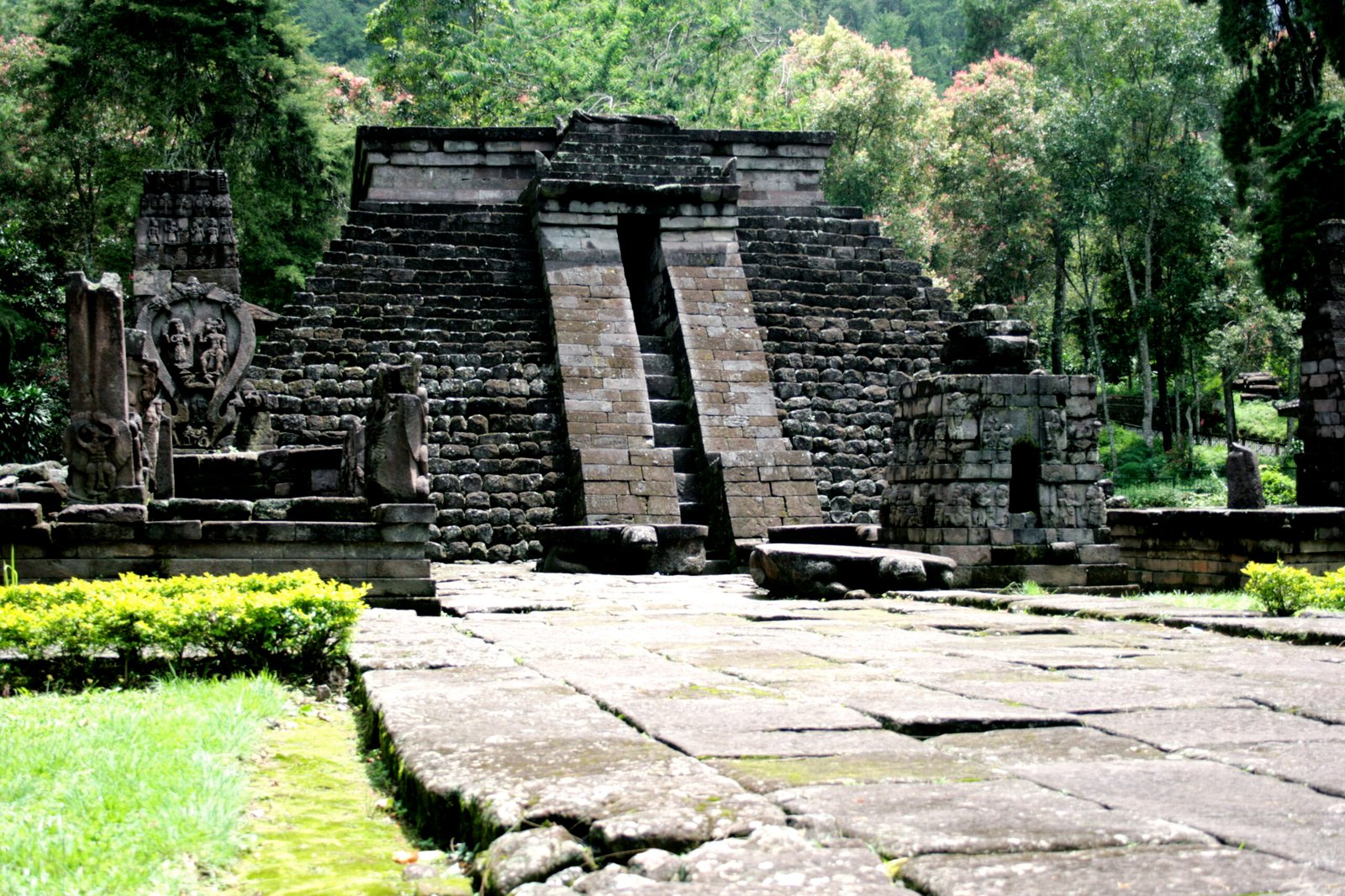
Candi Sukuh stands at approximately 1,186 metres on the western slope of Mount Lawu. Built around 1437 AD in the final decades of the Majapahit Empire, the temple is a truncated stone pyramid roughly 12 metres high with stepped terraces and a broad flat summit platform. Approached through ceremonial gates and preceded by a forecourt decorated with explicitly erotic fertility imagery and Sudamala narrative reliefs rendered in a flat, frontal style that appears to recover a pre-Hindu Austronesian visual tradition, the summit commands panoramic views of Mount Merapi, Lawu, and Merbabu.
Key facts
- Built: c. 1437 AD, late Majapahit period
- Altitude: approximately 1,186 m above sea level, western slope of Mount Lawu
- Pyramid height: approximately 12 metres, truncated stepped form
- Iconography: explicit fertility sculpture as threshold guardians; smith-god mythology; Sudamala narrative reliefs
- Sculpture style: flat, frontal, conceptual — interpreted as a resurfacing pre-Hindu Austronesian aesthetic
- Religious context: syncretic late Shivaite, Tantric Buddhist, and vernacular Javanese
- Status: Indonesian cultural heritage monument; entrance fee applies
History
Candi Sukuh was constructed around 1437 AD during the political and religious turbulence of the Majapahit Empire’s final century. As the Majapahit fragmented under civil war and the gradual spread of Islam, temple builders here moved away from the orthodox Sanskrit-derived Hindu-Buddhist forms that had dominated Javanese sacred architecture since the 8th century. The result was a syncretic experiment fusing Shivaite, Tantric Buddhist, and vernacular Austronesian elements with no close parallel anywhere else in Java.
The relief cycle is unlike anything at Borobudur or Prambanan. The Sudamala narrative — the story of Sadewa’s exorcism of the goddess Durga’s curse — is rendered not in the fluent Indo-classical style of 9th-century Central Javanese art but in a rigidly flat, hieratic mode closely resembling the wayang kulit shadow-puppet aesthetic. This has been interpreted as evidence of an indigenous Javanese visual vocabulary re-emerging as the Indianising overlay thinned. The explicit fertility imagery at the entrance is theologically coherent within Tantric traditions; nowhere else in Java does it appear in such direct sculptural form.
Dutch colonial archaeologists noted and partially restored the temple in the late 19th century. Its apparent formal resemblance to Mesoamerican pyramids — a coincidence of function and proportion, not evidence of contact — became a touchstone for fringe trans-oceanic contact theories from the 1960s onward, consistently rejected by mainstream scholarship but persistent in popular literature.
What you see
The approach follows a processional axis through three successive gates (gapura), each marking a transition to higher sacred ground. The forecourt contains the temple’s most discussed sculptures: a stone tortoise with a phallic protrusion used as a threshold marker, and reliefs depicting the kris-making process — smith Bima forging a blade under the guidance of the forge-god Wisnu Siwaraja, a scene unique to Sukuh and connected to the mystical importance of the kris in Javanese culture.
The pyramid has three stepped terraces climbed by a central staircase to the summit platform, where a large lingam-yoni sculpture once stood (now partially in the National Museum Jakarta). The summit view on a clear morning — Merapi’s cone to the west, Lawu and Merbabu flanking it — is one of the most theatrically composed sacred landscapes in Java. Approximately ten Sudamala relief scenes are distributed across the forecourt and terrace levels.
Practical information
- Opening hours: daily approximately 07:00–17:00
- Best time: early morning for clear volcano views; dry season (May–October) reduces cloud cover
- Guides: local guides available at entrance; recommended for iconographic context
- Photography: permitted; low-angle morning light suits the flat relief surfaces
- Combined itinerary: pair with Candi Cetho (6 km north) for a full day from Solo
Getting there
Candi Sukuh is approximately 36 km east of Solo (Surakarta). The most practical approach is by hired car or motorbike; the mountain road from Karanganyar is steep and public transport does not reach the temple gate. The nearest airport is Solo’s Adi Soemarmo (SOC), approximately 50 km distant; Yogyakarta (YIA) is also accessible for travellers combining sites.
Nearby
- Candi Cetho — 15th-century Shaivite terrace temple on Mount Lawu, 6 km north
- Solo (Surakarta) — 36 km west; Kraton Kasunanan palace, Mangkunegaran palace, batik markets
- Sangiran Early Man Site — UNESCO World Heritage fossil site north of Solo with major Homo erectus assemblages
- Trowulan — Majapahit Empire capital site, approximately 3 hours east in East Java
Sources
- Kinney, Klokke, Kieven. Worshipping Siva and Buddha: The Temple Art of East Java. University of Hawaii Press, 2003.
- Fontein, Jan. The Sculpture of Indonesia. National Gallery of Art, Washington, 1990.
- Wikipedia contributors. Candi Sukuh. Accessed June 2026.
- Indonesian Ministry of Education and Culture. Monument records, Central Java.
Find it on the map
See this place and what’s around it →📷 Become a Cultural Heritage Online photographer
Share your photos of places: they stay published under your name as the author. The more they're seen, the more you get noticed — and soon a contest will reward the most appreciated photos.
Log in or sign up free to add a photoIs this page about you?
This page is read by travellers and heritage enthusiasts who find it on Google. Tell us how you are connected to this place and we will take it from there.