
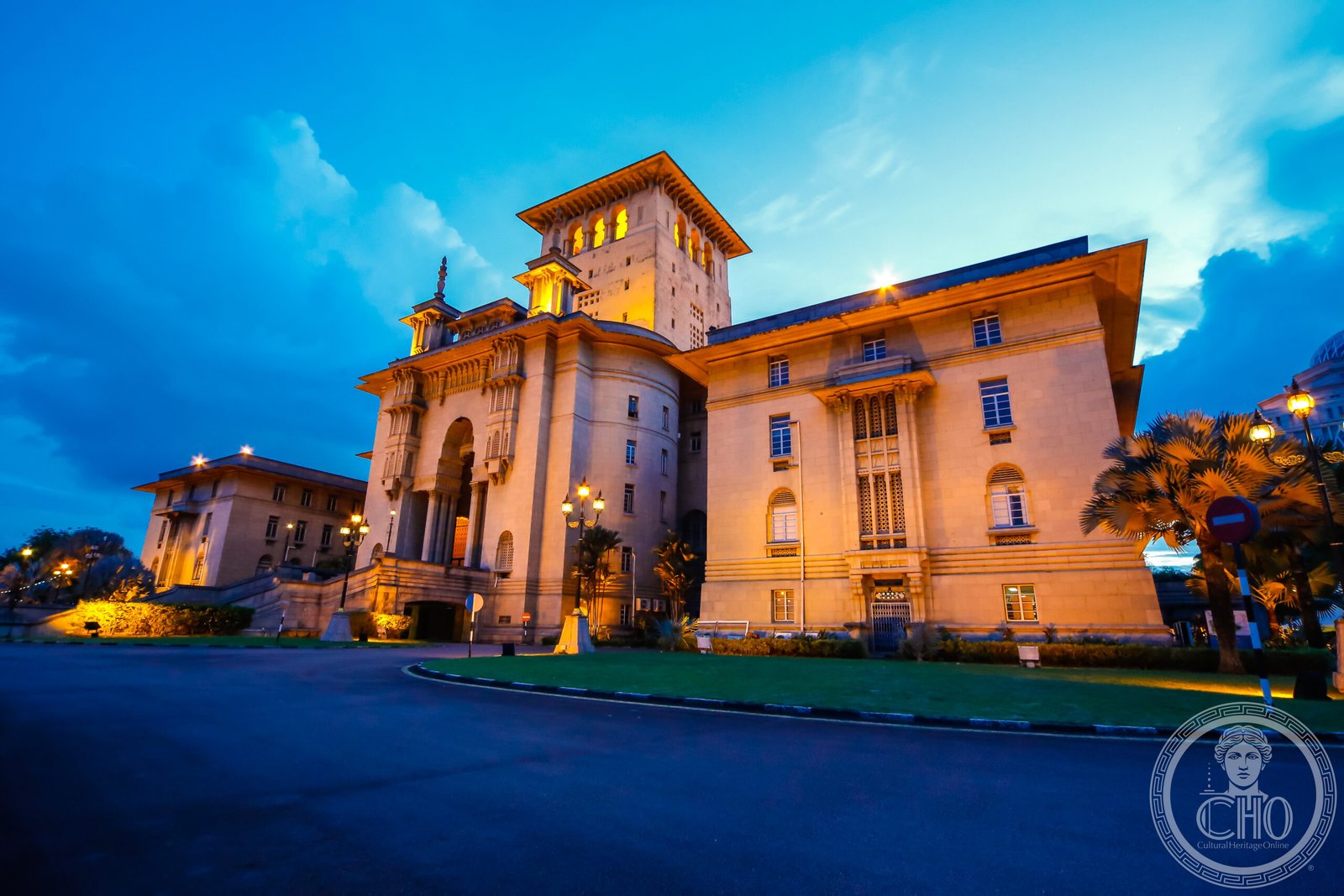
Rising sixty metres above the southern tip of the Malay Peninsula, the Sultan Ibrahim Building is one of Southeast Asia’s most arresting exercises in architectural hybridism. Its streamlined Art Deco body — white rendered concrete, ribbon windows, and horizontal banding — culminates in a battlemented Gothic tower whose arched openings carry clear Mughal inflections. Commissioned by Sultan Ibrahim ibni Abu Bakar of Johor to house his state secretariat, the building was completed in 1940 to designs by the Public Works Department under J.B. Cowrie. It overlooks the Strait of Johor and remains clearly visible from Singapore’s northern shore. The tower dominated the Johor Bahru skyline for decades and continues to define the civic waterfront today. Gazetted as a Malaysian National Heritage site, the building embodies Sultan Ibrahim’s programme of confident modernisation: a ruler who built a private airstrip, cultivated Western alliances, and insisted that his capital project power through architecture of international ambition tempered by local symbolism.
At a glance
- Type
- State secretariat building
- Period
- Completed 1940
- Style
- Art Deco Gothic with Mughal detail
- Location
- Bukit Timbalan, Johor Bahru, Johor, Malaysia
- Coordinates
- 1.4655° N, 103.7578° E
- Architect(s)
- J.B. Cowrie, Public Works Department of Johor
Overview
The Sultan Ibrahim Building stands on a hill above Johor Bahru’s historic core, its silhouette a composite of three architectural traditions fused without apology. The main block follows late Art Deco conventions: flat roof, symmetrical facade, grouped vertical windows relieved by projecting string courses. Above this rises the clock tower, where battlemented parapets and pointed Mughal arches replace Deco restraint with deliberate grandeur. The effect reads simultaneously as a Malaysian raja’s assertion of sovereignty and a colonial-era civic monument. Inside, original teak flooring and ornamental ironwork survive in many rooms. The building housed the Johor State Secretariat for over eight decades and continues in administrative use, restricting public access to the exterior and ground-floor lobby.
History
Sultan Ibrahim ibni Abu Bakar ruled Johor from 1895 to 1959 — a reign spanning colonial accommodation, Japanese occupation, and the birth of independent Malaya. He was a moderniser by temperament: he introduced the motor car to Johor, built a private aerodrome at Senai, and maintained close personal ties with the British aristocracy. By the late 1930s his existing secretariat was inadequate for a state whose tin and rubber revenues had made it one of the wealthiest on the peninsula. Work on the new building began in 1938, continued through the tense pre-war years, and was completed in 1940. During the Japanese occupation from 1942 to 1945, the building served Japanese military administration. After Malayan independence in 1957 and the formation of Malaysia in 1963, it reverted to state government use. It was gazetted under the National Heritage Act 2005.
Architecture & Design
The building sits on a podium accessed by a formal staircase that emphasises civic ceremony. The main block is five storeys of reinforced concrete rendered in cream, its facade organised by pilasters that rise without interruption to the roofline — a Deco device that implies soaring height even on a relatively compact footprint. The tower breaks the skyline at approximately 60 metres; its upper stages set back twice before arriving at the battlemented crown. Each battlement is punctuated by a pointed arch whose proportions owe more to Mughal Rajput gateways than to any European Gothic precedent. Horizontal banding, streamlined window surrounds, and a central projecting bay at first-floor level complete the Deco vocabulary of the lower body. The synthesis of Deco efficiency with Islamic-feudal ornament was characteristic of Malay royalty’s architectural patronage in the interwar decades.
Cultural significance
As a gazetted National Heritage site, the Sultan Ibrahim Building occupies a central place in Malaysian architectural history. It represents the moment when pre-independence Malay rulers commissioned buildings that were neither purely colonial nor purely vernacular, but a deliberate third thing: modern structures inflected with Islamic-feudal symbolism to assert cultural continuity amid rapid change. The building is also a visual anchor for Johor Bahru’s historic waterfront, an important counter-narrative to the city’s image as a transit point between Malaysia and Singapore. DOCOMOMO Southeast Asia has cited it as a significant example of regional interwar modernism.
Visiting today
The Sultan Ibrahim Building is an active government office and the interior is generally not open to casual visitors. The exterior and hill gardens are freely accessible during daylight hours and offer excellent views across the Strait of Johor toward Singapore. The building is best photographed in the late afternoon when the western sun illuminates the cream facade. Johor Bahru’s historic quarter — including the Royal Abu Bakar Museum and the Grand Palace — lies within easy walking distance, making the hill a natural anchor for a heritage half-day.
Getting there
From Singapore, take the MRT North-South Line to Woodlands station, then a taxi or Grab to the Johor–Singapore Causeway crossing; the building is a short taxi ride from the Johor Bahru CIQ complex. From Johor Bahru Sentral station, served by KTM intercity trains, the hill is approximately 10 minutes by taxi. City buses connect the town centre to the Bukit Timbalan area. Parking is available on the hill access road for private vehicles.
Sources & resources
Find it on the map
See this place and what’s around it →📷 Become a Cultural Heritage Online photographer
Share your photos of places: they stay published under your name as the author. The more they're seen, the more you get noticed — and soon a contest will reward the most appreciated photos.
Log in or sign up free to add a photoDo you manage this place?
This page is read by travellers and heritage enthusiasts who find it on Google. Keep it accurate — and make it work for you. Free for non-profit heritage institutions.