
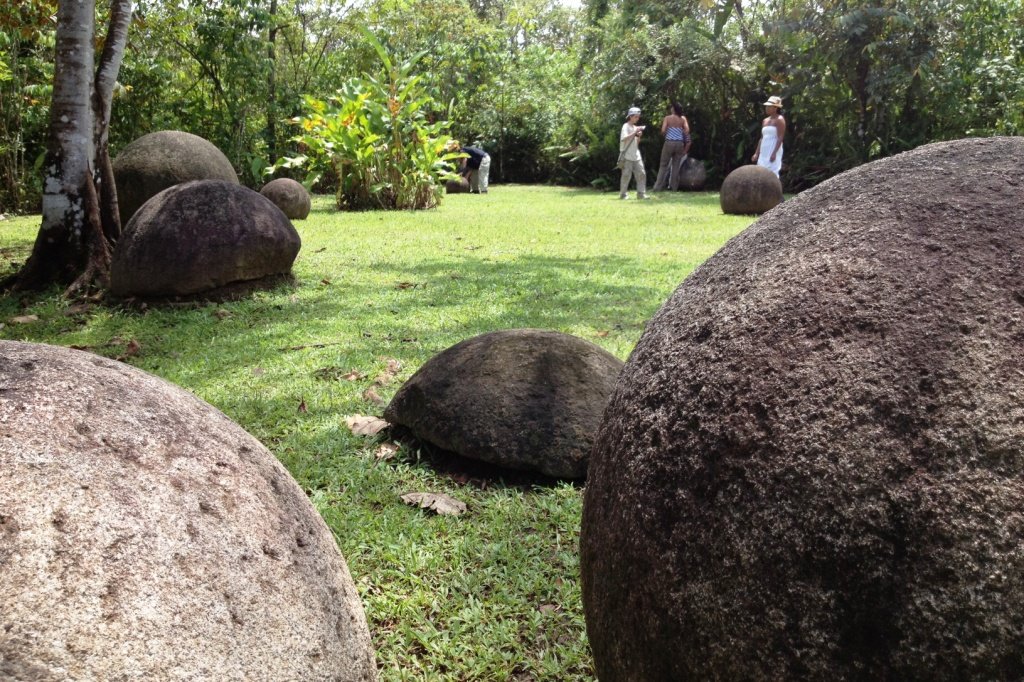
In the Diquís Delta of southern Costa Rica, a Chibchan people left behind one of prehistory’s most enigmatic achievements: hundreds of nearly perfect stone spheres, some weighing 15 tonnes, arranged in geometric patterns whose meaning remains unknown.
At a glance
The Pre-Columbian Chiefdom Settlements with Stone Spheres of the Diquís is a UNESCO World Heritage Site (2014) comprising four archaeological sites in the Diquís Delta and Isla del Caño on Costa Rica’s Pacific coast. Over 300 spheres have been documented, ranging from a few centimetres to 2.57 metres in diameter, carved by the Diquís culture between approximately 600 and 1500 CE. The site holds the world’s most important concentration of these petaloid stone spheres.
Key facts
- UNESCO inscription: 2014 — serial site of four archaeological zones
- Culture: Diquís (part of the broader Chibchan cultural sphere)
- Period: c. 600–1500 CE
- Spheres documented: Over 300; largest is 2.57 m diameter, up to 15 tonnes
- Material: Gabbro — a hard igneous rock not available locally; boulders transported from river beds
- Precision: The largest spheres are nearly perfectly round, within millimetres
- GPS: 8.9167° N, 83.5833° W
History
The Diquís people inhabited the alluvial delta of the Térraba and Sierpe rivers in what is now southern Costa Rica, part of the Chibchan cultural sphere — a network of interconnected societies stretching from Honduras to Colombia. Between roughly 600 and 1500 CE they carved spheres from gabbro boulders transported from mountain river beds using wooden rollers, ropes, and organised communal labour. The shaping involved pecking and grinding with harder stone tools, then polishing to achieve near-perfect spherical form.
Once placed, the spheres were arranged in precise geometric patterns — lines, triangles, and parallelograms — in front of the houses of high-ranking chiefs, possibly aligned with astronomical events. No contemporary written records explain their purpose. The oral traditions of the descendant Brunca (Boruca) people say only that the spheres were made by divine intervention and that the ancestors knew the secret. The knowledge was lost after the Spanish conquest dismantled the chiefdom society.
The site suffered severe looting during banana-plantation expansion in the 1930s–40s, when United Fruit Company workers moved spheres and attempted to dynamite some open, believing gold was hidden inside. Many spheres now stand in gardens and public spaces across Costa Rica.
What you see
The four UNESCO component sites are Finca 6, Batambal, El Silencio, and Grijalba-2, plus the Isla del Caño biological reserve. Finca 6 near Palmar Sur is the most accessible, with spheres in or near their original positions alongside the remains of earthen chieftains’ platforms. The spheres emerge as grey-green gabbro orbs — the largest approaching the height of a standing adult — with a polished surface that catches the light with an almost unnatural smoothness in the surrounding tropical lowland.
The Museo Nacional de Costa Rica in San José holds the largest indoor collection of spheres and is essential context before visiting the field sites.
Practical information
- Main site: Finca 6 Archaeological Site, near Palmar Sur, Puntarenas Province
- Opening hours: Tuesday–Sunday, 8:00–16:00; closed Mondays
- Admission: Charged; managed by the Museo Nacional de Costa Rica
- Best season: December–April (dry season); rainy season makes dirt roads difficult
- Photography: Permitted throughout the open sites
Getting there
Palmar Sur is approximately 300 km south of San José on the Pan-American Highway. By car: 4–5 hours; 4WD recommended for field sites. By air: scheduled flights from San José to Palmar Sur airstrip (~45 minutes). By bus: services from San José to Palmar Norte (~6 hours); local taxis cross the bridge to Palmar Sur.
Nearby
- Corcovado National Park — one of the most biodiverse places on Earth, ~100 km south on the Osa Peninsula
- Térraba-Sierpe National Wetlands — the largest mangrove system in Central America, adjacent to the Diquís Delta
- Isla del Caño — biological reserve and UNESCO component site, accessible by boat from Drake Bay
- Museo Nacional, San José — definitive collection of Diquís spheres and pre-Columbian gold work
Sources
- UNESCO World Heritage List: Pre-Columbian Chiefdom Settlements with Stone Spheres of the Diquís (2014)
- Hoopes, J. W. & Mora Marín, D. (2009). The Diquís Archaeological Zone. University of Kansas.
- Museo Nacional de Costa Rica — official site management authority
- Wikipedia: Stone spheres of Costa Rica (consulted 2026)
Find it on the map
See this place and what’s around it →📷 Become a Cultural Heritage Online photographer
Share your photos of places: they stay published under your name as the author. The more they're seen, the more you get noticed — and soon a contest will reward the most appreciated photos.
Log in or sign up free to add a photo