

The oldest monastery in Slovenia held for centuries a library of almost two thousand volumes, among them illuminated Latin manuscripts of the twelfth and thirteenth centuries. But its most significant treasure is the Stična Manuscript of 1428: one of the very first texts ever written in Slovene, produced in the same scriptorium that centuries earlier had copied Latin codices for the whole region of Carniola.
About Stična Abbey
Stična Abbey is the oldest monastery in Slovenia. Monastic life began there in 1135, and its formal foundation charter was issued in 1136 by Pellegrinus I, Patriarch of Aquileia; the first monks had arrived in 1132 from Burgundy, accompanied by the architect Michael, who oversaw construction of the monastery complex. Its mother house was Rein Abbey in Austria, and Stična remains today the only Cistercian monastery still active in Slovenia — the country’s other Cistercian house, Kostanjevica Abbey, did not survive into the modern era. The monastery quickly grew into an important religious, cultural, and economic centre for the wider Carniola region, operating both a school and a music academy; the Renaissance composer Jacobus Gallus is thought to have received early musical training there. Its scriptorium was producing illuminated Latin manuscripts as early as the 12th century, and in 1428 it produced the Stična Manuscript, containing one of the earliest known texts written in the Slovenian language. The monastery suffered repeated Ottoman raids, being burned and looted on at least two occasions. Its long institutional life was interrupted in 1784, when Emperor Joseph II abolished the abbey as part of his sweeping Josephine Reforms dissolving contemplative monasteries across the Habsburg lands. The community was revived in 1898, when Cistercian monks from Mehrerau Abbey on the shore of Lake Constance resettled the site. During the Second World War, Partisan forces used the monastery to imprison captured priests. Today Stična remains Slovenia’s only active Cistercian monastery and houses the Slovene Museum of Christianity.
Key facts
- 1132: first monks arrive from Burgundy with the architect Michael
- 1135-1136: monastic life begins; foundation charter issued by Patriarch Pellegrinus I of Aquileia
- Mother house: Rein Abbey, Austria
- 12th-13th century: scriptorium produces illuminated Latin manuscripts
- 1428: the Stična Manuscript, one of the earliest known texts in Slovenian, is produced
- 1784: abbey abolished under Emperor Joseph II’s Josephine Reforms
- 1898: monks from Mehrerau Abbey resettle the site
- Today: the only active Cistercian monastery in Slovenia; houses the Slovene Museum of Christianity
History
The 1428 Stična Manuscript’s status as one of the earliest surviving texts written in the Slovenian language gives this Cistercian scriptorium — otherwise devoted overwhelmingly to Latin religious manuscripts across the preceding three centuries — an outsized significance in the documented early history of Slovenian as a written vernacular, produced within an institutional context whose primary linguistic and liturgical medium remained firmly Latin. The monastery’s near-simultaneous roles as school, music academy, and manuscript-producing scriptorium reflect the broader Cistercian pattern of combining agricultural, educational, and cultural functions within a single monastic institution, extending Stična’s influence across Carniola well beyond its purely religious activities.
The 114-year gap between the abbey’s 1784 suppression under Joseph II’s Josephine Reforms and its 1898 revival by monks from Mehrerau Abbey on Lake Constance situates Stična within the broader pattern of Habsburg-era monastic dissolutions that swept Central Europe in the late 18th century, many of which — unlike Stična — never saw their communities return at all; the abbey’s eventual restoration and its continued status today as Slovenia’s sole surviving active Cistercian house makes its long-term institutional survival unusually complete.
What you see
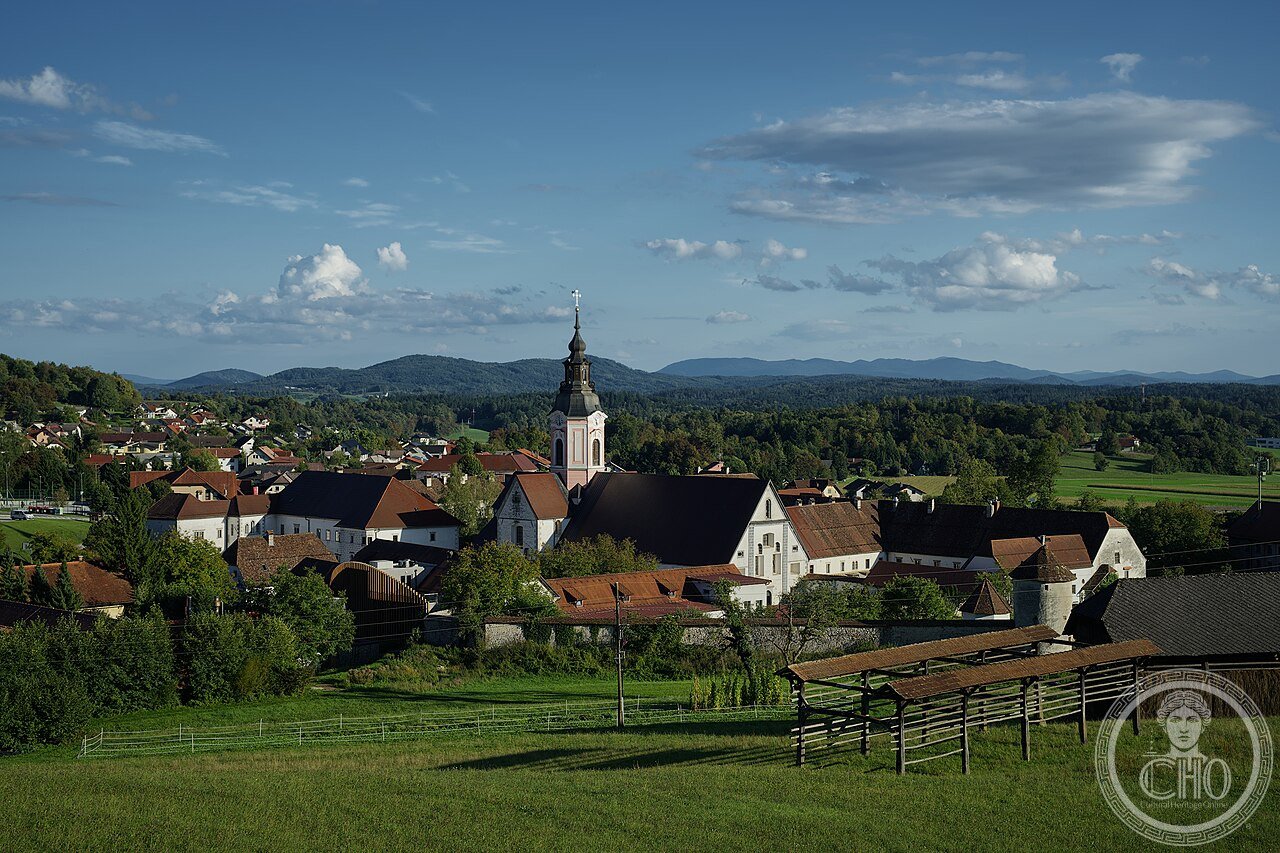
The abbey complex today houses the Basilica of Our Lady of Sorrows alongside the Slovene Museum of Christianity, which displays religious art, manuscripts, and artefacts documenting the monastery’s own long history and the wider history of Christianity in Slovenia. The monastery’s layout, shaped by centuries of construction beginning with the original 12th-century work overseen by the architect Michael, reflects the classical Cistercian combination of church, cloister, and working monastic buildings set within the surrounding countryside of Carniola.
Practical information
- Opening hours: the museum and basilica are generally open daily with seasonal variation; check current hours before visiting; admission fee applies to the museum
- Address: Stična 17, 1295 Ivančna Gorica, Slovenia
Getting there
Stična is reachable by car from Ljubljana (approximately 40 minutes) in the Ivančna Gorica municipality, central Slovenia. GPS: 45.9570° N, 14.8078° E.
Nearby
- Ivančna Gorica — the nearby municipal centre
- Ljubljana — approximately 40 minutes away; Slovenia’s capital
- Krka river valley — the surrounding landscape of central Slovenia
Sources
- Wikipedia — “Stična Abbey” (en.wikipedia.org)
- Culture.si — “Stična Cistercian Abbey” (culture.si)
- Luka Esenko — “Stična Abbey: Slovenia’s Oldest Monastery” (lukaesenko.com)
Find it on the map
See this place and what’s around it →📷 Become a Cultural Heritage Online photographer
Share your photos of places: they stay published under your name as the author. The more they're seen, the more you get noticed — and soon a contest will reward the most appreciated photos.
Log in or sign up free to add a photo