
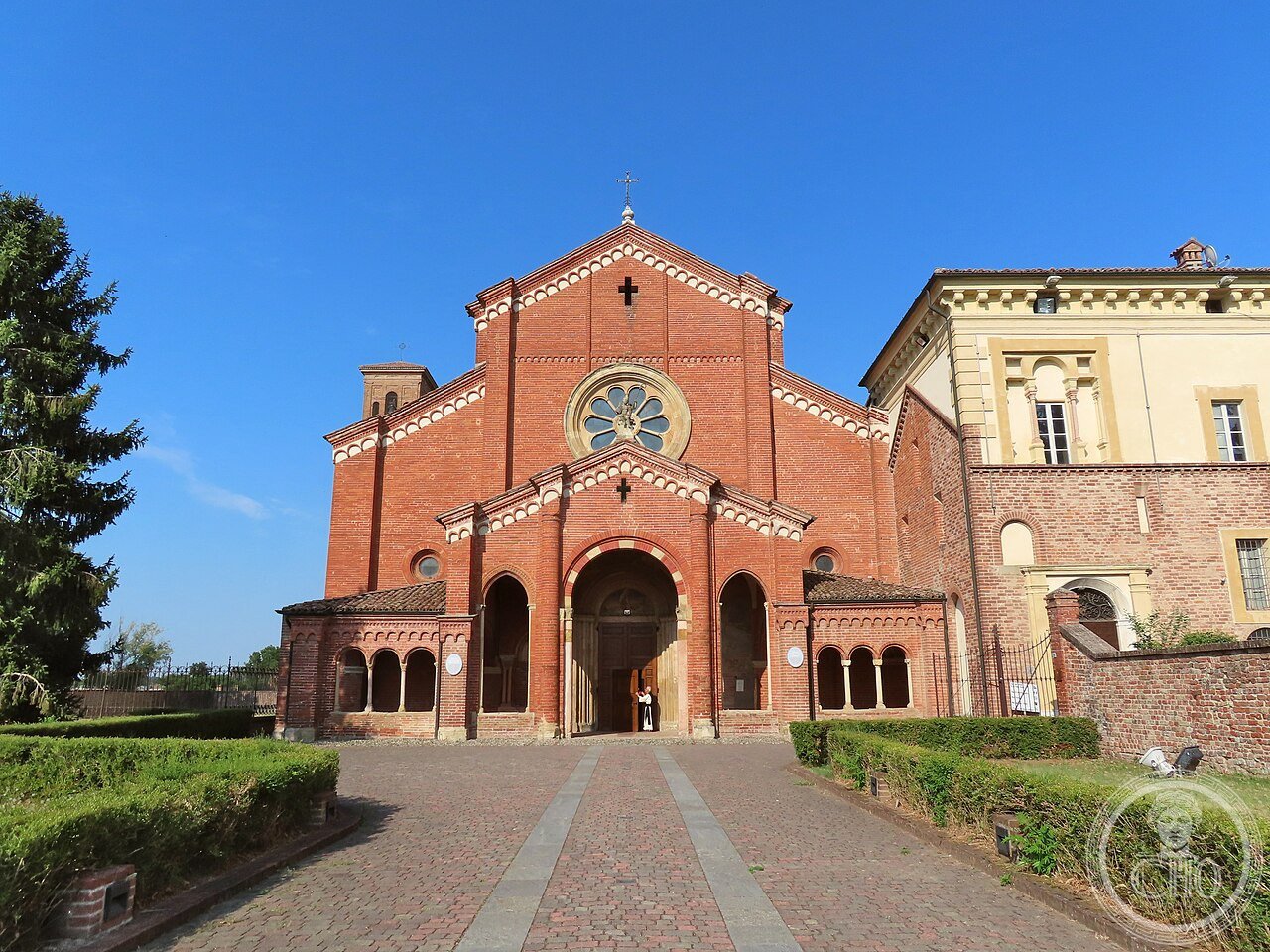
Tradition has it that while the first twelve monks were looking for the place to build the new abbey, a dove began to circle in front of them, gathering straws and carrying them some three hundred metres northwards, so marking the exact point where the church would rise. From that episode the abbey, founded by Saint Bernard of Clairvaux on 11 April 1136, took the name of Chiaravalle della Colomba — Clairvaux of the Dove.
About Chiaravalle della Colomba Abbey
Chiaravalle della Colomba Abbey was founded on 11 April 1136, when Arduino, Bishop of Piacenza, asked Bernard of Clairvaux for a group of monks to establish an abbey within his diocese; Bernard sent twelve monks led by John from Clairvaux Abbey in France. The canonical foundation took place in February 1136, and the church was consecrated on 5 May 1137, making the new house a direct daughter foundation of Clairvaux itself. According to tradition, the abbey’s distinctive name derives from a dove that flew before the founding monks as they searched for a building site, gathering straw and carrying it some three hundred metres north to mark the spot where the church should stand — though the name may equally reference the dove as a symbol of the Holy Spirit at the Annunciation, given the abbey’s Marian dedication. Like many Cistercian foundations of the period, the community was tasked with draining and cultivating the marshy plain surrounding the site, embodying the Cistercian motto “Ora et labora” (pray and work); in the following decades the abbey gained wide renown both for the sanctity of its abbots and monks and for its land reclamation, construction, and cultural activities. The complex today displays a Gothic-Romanesque basilica of the 12th-13th centuries, with a three-nave layout, alongside a cloister of particular beauty built between the 14th and 16th centuries, its walkways supported by more than a hundred columns in Verona marble. Napoleonic decrees of 1805 and 1810 suppressed the monastery and dispersed its collections; Cistercian monks returned in 1937 following agreements with diocesan authorities, and the complex passed into Italian state ownership in 1976, since undergoing ongoing restoration.
Key facts
- 11 April 1136: founded by Bernard of Clairvaux, with 12 monks led by John, at the request of Bishop Arduino of Piacenza
- 5 May 1137: church consecrated, a direct daughter house of Clairvaux Abbey
- Legend: a dove gathering straw is said to have indicated the building site, giving the abbey its name
- Mission: draining and cultivating the surrounding marshland, per the Cistercian tradition
- Architecture: Gothic-Romanesque basilica (12th-13th centuries); cloister (14th-16th centuries) with over 100 Verona-marble columns
- 1805-1810: suppressed under Napoleonic decrees, collections dispersed
- 1937: Cistercian monks return; 1976: complex becomes Italian state property, ongoing restoration since
History
The abbey’s direct filiation from Clairvaux itself, established within the same year — 1136 — as Bernard of Clairvaux’s own broader wave of Cistercian expansion across Northern Italy, situates Chiaravalle della Colomba among the earliest and most directly connected daughter houses of the order’s founding monastery, carrying Clairvaux’s own reformist monastic discipline into the Piacenza countryside almost immediately after its initial spread beyond France. The community’s assigned task of draining and cultivating the surrounding marshland reflects the broader Cistercian pattern of using disciplined monastic labour to reclaim otherwise unproductive land, a practice that gave many such foundations, including this one, an outsized economic and agricultural influence over their surrounding region well beyond their purely religious function.
The 1805-1810 Napoleonic suppression and subsequent dispersal of the abbey’s collections, followed only in 1937 by the Cistercians’ return and by full state ownership in 1976, traces a nearly century-and-a-half gap in the community’s continuous presence at the site — a disruption typical of the broader wave of monastic suppressions across Napoleonic-era Italy, from which many Cistercian houses never fully recovered their original communities.
What you see
The Gothic-Romanesque basilica, dating to the 12th-13th centuries, presents a three-nave layout typical of Cistercian architectural discipline. The cloister, built across the 14th to 16th centuries, is considered of particular beauty, its walkways supported by more than a hundred columns carved from Verona marble. The complex’s overall layout follows the classical Benedictine-Cistercian plan, combining monastic austerity with the refined decorative details visible in the cloister’s marble colonnade.
Practical information
- Opening hours: generally open daily with seasonal variation; check current hours before visiting; free admission
- Address: Strada del Guardà, Chiaravalle della Colomba, 29010 Alseno, Italy
Getting there
Chiaravalle della Colomba is reachable by car from Piacenza (approximately 30 minutes) in the Val d’Arda, Emilia-Romagna. GPS: 44.9264° N, 9.9739° E.
Nearby
- Alseno — the nearby town, in the province of Piacenza
- Via Francigena — the historic pilgrimage route passing through the area
- Val d’Arda — the surrounding valley, known for its wine production
Sources
- Wikipedia — “Abbazia di Chiaravalle della Colomba” (it.wikipedia.org)
- Cathopedia — “Abbazia di Santa Maria di Chiaravalle della Colomba (Alseno)” (it.cathopedia.org)
- Abbazie Cistercensi — “Abbazia di Chiaravalle della Colomba, Alseno (Piacenza)” (abbaziecistercensi.it)
Find it on the map
See this place and what’s around it →📷 Become a Cultural Heritage Online photographer
Share your photos of places: they stay published under your name as the author. The more they're seen, the more you get noticed — and soon a contest will reward the most appreciated photos.
Log in or sign up free to add a photo