

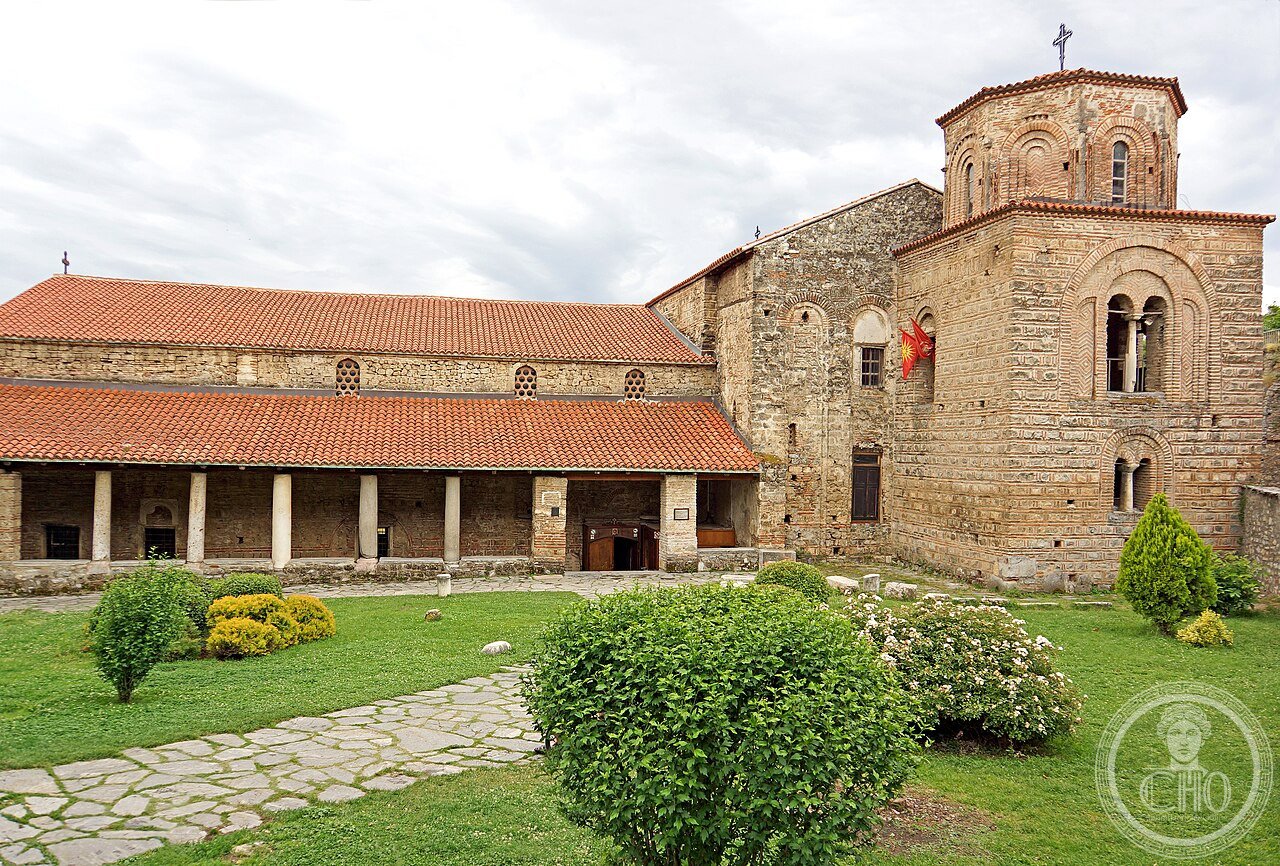
The present Church of St Sophia in Ohrid stands on the foundations of an earlier metropolitan cathedral, destroyed in the first decade of the 6th century amid the barbarian invasions that brought the early Slavic peoples into the region. The church was substantially rebuilt in the final decade of the 10th century as a patriarchal cathedral, in the form of a domed basilica, during a period when Ohrid served as the capital of the First Bulgarian Empire under Tsar Samuil, with the church functioning as the seat of the Bulgarian Patriarchate itself. That placed it at the very centre of medieval Balkan ecclesiastical authority. Following the Ottoman conquest of the Ohrid region, completed between 1385 and 1408, the church was converted into a mosque: its bell tower, central dome and interior galleries were demolished, and a minbar, the pulpit used for Islamic sermons, was installed within the building. In the process, the Ottoman occupiers whitewashed over the church’s extensive Byzantine frescoes. That act, entirely unintentionally, protected and preserved these medieval artworks from centuries of subsequent damage, deterioration and exposure. It was not until a dedicated restoration campaign between 1950 and 1957 that the frescoes of Ohrid’s cathedral master and several later painters were carefully uncovered and rediscovered beneath their Ottoman-era whitewash. These frescoes are today regarded as work of exceptional significance, not only for the regional history of art and the Ohrid archbishopric specifically, but for understanding the broader development of Byzantine and medieval European painting as a whole.
About St Sophia Cathedral, Ohrid
The present Church of St Sophia in Ohrid stands on the foundations of an earlier metropolitan cathedral, which was destroyed in the first decade of the 6th century amid the barbarian invasions that brought the early Slavic peoples into the region. The church was substantially rebuilt in the final decade of the 10th century as a patriarchal cathedral, constructed in the form of a domed basilica, during a period when Ohrid served as the capital of the First Bulgarian Empire under Tsar Samuil, with the church functioning as the seat of the Bulgarian Patriarchate itself — placing it at the very centre of medieval Balkan ecclesiastical authority. Following the Ottoman conquest of the Ohrid region, completed between 1385 and 1408, the church was converted into a mosque: its bell tower, central dome, and interior galleries were demolished, and a minbar, the pulpit used for Islamic sermons, was installed within the building. In the process, the Ottoman occupiers whitewashed over the church’s extensive Byzantine frescoes — an act that, entirely unintentionally, protected and preserved these medieval artworks from centuries of subsequent damage, deterioration, and exposure. It was not until a dedicated restoration campaign between 1950 and 1957 that the frescoes of Ohrid’s cathedral master and several later painters were carefully uncovered and rediscovered beneath their Ottoman-era whitewash. These frescoes are today regarded as work of exceptional significance, not only for the regional history of art and the Ohrid archbishopric specifically, but for understanding the broader development of Byzantine and medieval European painting as a whole.
Key facts
- Early 6th century: earlier metropolitan cathedral on the site destroyed by Slavic invasions.
- Late 10th century: church rebuilt as patriarchal cathedral under Tsar Samuil of Bulgaria.
- 1385-1408: Ottoman conquest of the Ohrid region.
- Post-conquest: church converted into a mosque, dome and bell tower demolished, frescoes whitewashed.
- 1950-1957: Byzantine frescoes rediscovered and restored beneath the whitewash.
- 14th century: exterior additions built by Archbishop Gregory II.
History
The cathedral’s status as seat of the Bulgarian Patriarchate under Tsar Samuil situates Ohrid, and this church specifically, at the very heart of medieval Balkan ecclesiastical and political power during the height of the First Bulgarian Empire, a role the building retained symbolically even as political control of the region shifted repeatedly over the following centuries. Its subsequent conversion into a mosque under Ottoman rule, involving the physical demolition of major structural elements alongside the whitewashing of its frescoes, exemplifies the broader pattern of religious architectural transformation that swept across formerly Christian Byzantine and Balkan territories following Ottoman conquest.
The accidental preservation of the frescoes through whitewashing, followed by their careful mid-20th-century rediscovery, gives St Sophia a rare double significance: both as a building whose physical fabric documents successive religious transformations across roughly a millennium, and as the unlikely custodian of one of medieval Europe’s most important surviving bodies of Byzantine wall painting, saved specifically by the same act that had been intended to erase it.
What you see
The church’s domed basilica form, dating to its late 10th-century reconstruction, incorporates 14th-century exterior additions commissioned by Archbishop Gregory II, along with visible traces of its Ottoman-era conversion into a mosque. Inside, the rediscovered Byzantine frescoes, uncovered in the 1950-1957 restoration, cover much of the interior surface, ranking among the most significant surviving cycles of medieval religious painting in the Balkans.
Practical information
- Opening hours: generally open daily with seasonal variation; admission fee applies; check current hours before visiting.
- Address: Ilindenska, Ohrid 6000, North Macedonia.
Getting there
The Church of St Sophia stands in the historic centre of Ohrid, on the shores of Lake Ohrid in southwestern North Macedonia, easily reachable on foot within the old town. GPS: 41.1121° N, 20.7942° E.
Nearby
- Church of St. John at Kaneo — cliffside 13th-century church overlooking the lake, nearby.
- Plaošnik (Church of St Clement) — early medieval monastic and educational site, nearby.
- Ohrid Old Town — UNESCO World Heritage historic centre, surrounding the church.
Sources
- Wikipedia — “Church of Saint Sophia, Ohrid” (en.wikipedia.org).
- The Byzantine Legacy — “Church of St. Sophia (Ohrid)” (thebyzantinelegacy.com).
- UNESCO — “Saint Sophia of Ochrida: preservation and restoration” (unesdoc.unesco.org).
Find it on the map
See this place and what’s around it →📷 Become a Cultural Heritage Online photographer
Share your photos of places: they stay published under your name as the author. The more they're seen, the more you get noticed — and soon a contest will reward the most appreciated photos.
Log in or sign up free to add a photo