

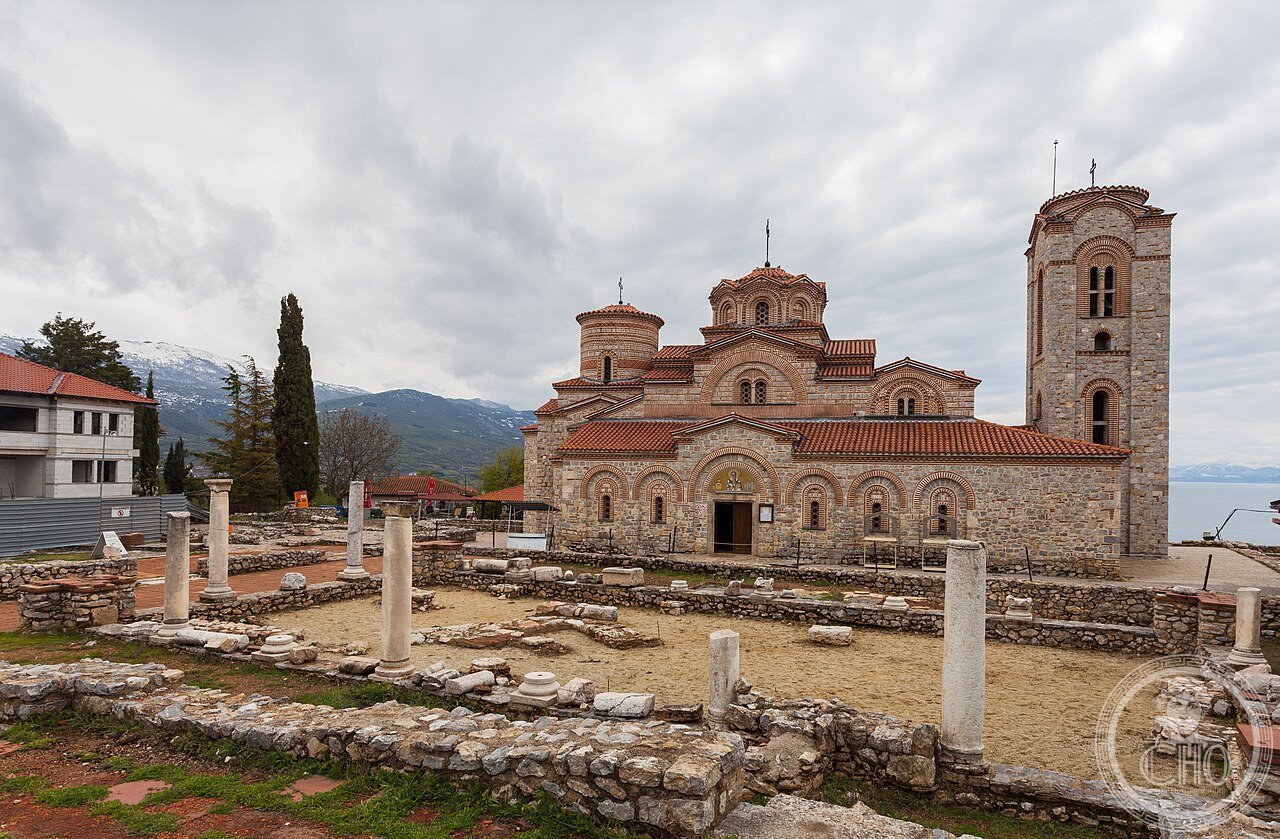
A disciple of Saints Cyril and Methodius, Clement of Ohrid built in 893 a church dedicated to Saint Pantaleon on the foundations of an older early Christian basilica, at Plaošnik: here, together with Saint Naum, he founded what is considered the first Slavic university, the Ohrid Literary School, where the Glagolitic and Cyrillic alphabets were first taught systematically to the newly Christianised Slavic peoples, making it the starting point of written Slavic culture. The Ottomans destroyed the church and built a mosque on the site; only between 1942 and 1943 did archaeologists, digging inside the remains of the Sultan Mehmed mosque, bring back to light the foundations of the original church and the tomb of Saint Clement himself. The later mosque, the Imaret, was demolished in 2000 and the church was rebuilt in full, consecrated in 2002.
About Plaošnik and the Church of St Clement
Plaošnik, an archaeological and religious site located roughly 250 metres south of Samuil’s Fortress in Ohrid, holds one of the most historically significant foundations in the entire history of Slavic culture. In 893 CE, Saint Clement of Ohrid — a leading disciple of Saints Cyril and Methodius — built a church dedicated to Saint Panteleimon on the site, incorporating the foundations of an even earlier Christian basilica. Clement, working alongside Saint Naum, used this site as the base for what is widely regarded as the first Slavic university: the Ohrid Literary School, where students were systematically taught the Glagolitic and, later, Cyrillic alphabets, from which Old Church Slavonic literacy, art, and culture spread outward across the Balkans and beyond. Following the Ottoman conquest, the original church was demolished and replaced first by one mosque and, after a period of ruin and restoration in the 16th century, by a second, the Imaret Mosque, built in the late 16th or early 17th century. The site’s full historical significance came back to light only through 20th-century archaeology: between October 1942 and May 1943, excavations conducted inside the remains of the Sultan Mehmed mosque structure, led by the Ohrid Department of Antiquities, uncovered the original foundations of Saint Clement’s church along with his own tomb. In 2000, the Imaret Mosque, by then included on a list of damaged religious buildings, was demolished, and a full physical reconstruction of Saint Clement’s church began that December; the rebuilt church was completed and consecrated by August 2002. The site today combines the reconstructed church with extensive exposed archaeological remains, including long-concealed Byzantine mosaics from the original basilica.
Key facts
- 893 CE: church built by Saint Clement of Ohrid, over an earlier basilica
- First Slavic university: Ohrid Literary School founded here by Clement and Naum
- Ottoman era: original church demolished, replaced by successive mosques
- 1942-1943: archaeologists rediscover the original church foundations and Clement’s tomb
- 2000: Imaret Mosque demolished; church reconstruction begins
- August 2002: reconstructed church completed and consecrated
History
Clement and Naum’s foundation of a systematic school for teaching the Glagolitic and Cyrillic alphabets at Plaošnik marks one of the true origin points of Slavic literary civilisation, a role that places this modest hilltop site in Ohrid among the most consequential locations in the entire cultural history of the Slavic-speaking world, comparable in significance to any major medieval European centre of learning. The site’s repeated religious transformation across roughly eleven centuries — Christian basilica, Clement’s church, successive Ottoman mosques, and finally a fully reconstructed Christian church — traces the same broader pattern of shifting religious and political control seen across much of the medieval and early modern Balkans.
The 2000 demolition of the Imaret Mosque to enable the church’s reconstruction remains, as with comparable cases elsewhere in the Balkans, a historically and politically sensitive episode, reflecting the layered and at times contested religious heritage of a region where Christian and Islamic architectural histories are frequently superimposed on the very same ground.
What you see
The fully reconstructed church, consecrated in 2002, follows the original medieval plan and construction technique, its exterior built in alternating courses of local limestone and mortar, with a restored bell tower rising above the narthex. Surrounding archaeological excavations expose the foundations of the earlier basilica and Clement’s original church, along with long-concealed Byzantine floor mosaics and a stone baptismal font traditionally associated with Clement’s own teaching activities.
Practical information
- Opening hours: generally open daily with seasonal variation; admission fee applies; check current hours before visiting
- Address: Plaošnik, Ohrid 6000, North Macedonia
Getting there
Plaošnik is located on a hilltop within Ohrid’s historic centre, roughly 250 metres south of Samuil’s Fortress, reachable on foot from the old town. GPS: 41.1128° N, 20.7906° E.
Nearby
- Samuil’s Fortress — medieval fortress overlooking Ohrid, a short walk north
- Church of St. John at Kaneo — cliffside 13th-century church, nearby along the lakeshore
- Church of St Sophia — former patriarchal cathedral, in Ohrid’s old town
Sources
- Wikipedia — “Church of Saints Clement and Panteleimon” (en.wikipedia.org)
- Wikipedia — “Plaošnik” (en.wikipedia.org)
- HAEMUS — “Plaoshnik – St. Clement church” (haemus.org.mk)
Find it on the map
See this place and what’s around it →📷 Become a Cultural Heritage Online photographer
Share your photos of places: they stay published under your name as the author. The more they're seen, the more you get noticed — and soon a contest will reward the most appreciated photos.
Log in or sign up free to add a photo