
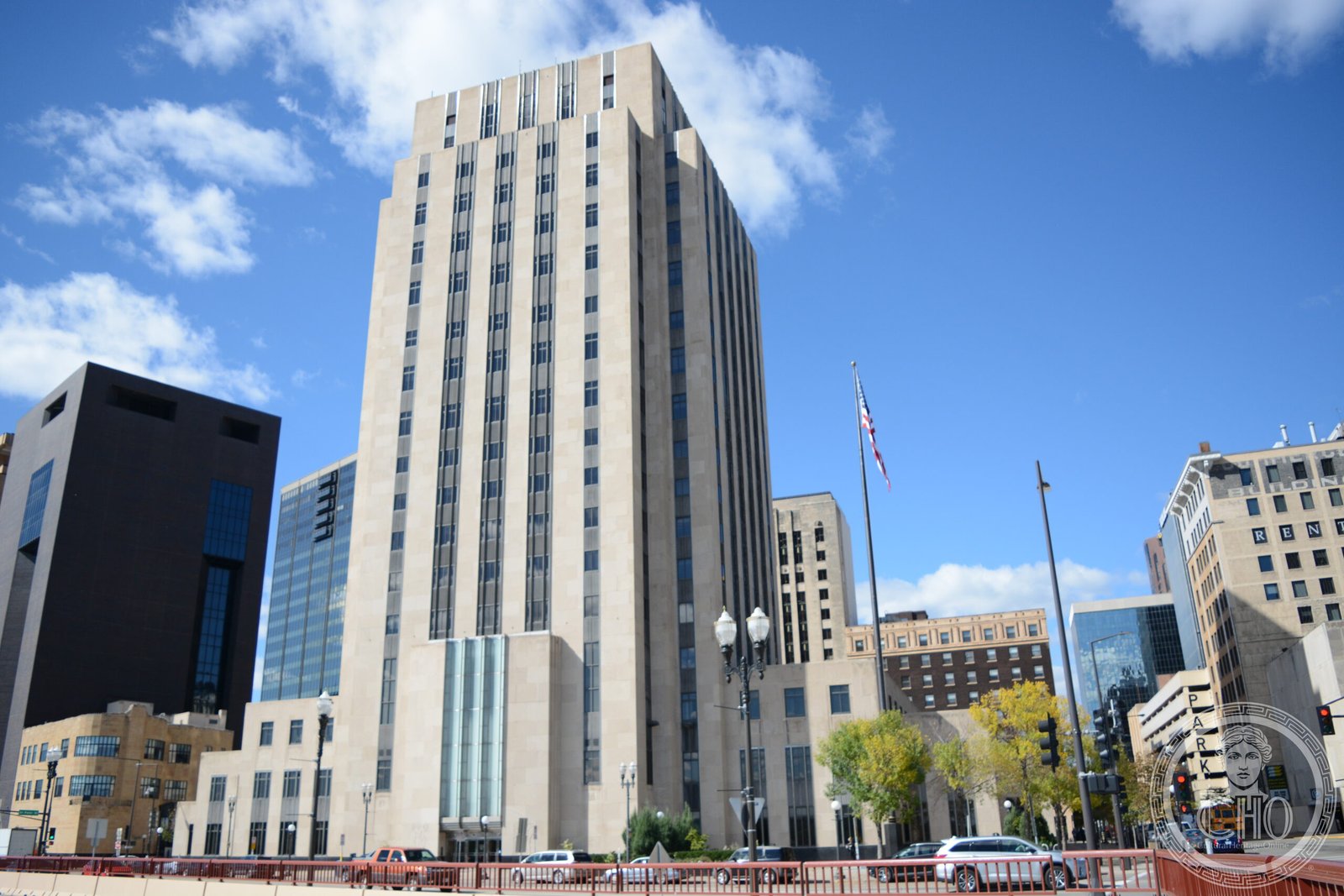
A joint civic complex where Depression-era economy produced monumental ambition. Inside its Memorial Hall rotunda, Paul Manship’s sixty-ton onyx “Vision of Peace” rotates slowly on its turntable — one of the most remarkable civic sculptures in the American interior.
At a glance
Completed in 1932 on the bluff above the Minnesota State Capitol approach, this limestone-clad tower houses both St. Paul city government and Ramsey County administration under one roof. Ellerbe & Company designed the exterior in restrained Art Deco; the interior Memorial Hall was conceived as a permanent civic monument, anchored by Paul Manship’s extraordinary onyx sculpture installed four years after the building opened.
Key facts
- Address: 15 W Kellogg Boulevard, St. Paul, MN 55102
- Year completed: 1932
- Architects: Ellerbe & Company (Charles Ellerbe); Holabird & Root, Chicago (associate architects)
- Height: 18 stories
- Style: Art Deco civic
- Sculpture: “Vision of Peace” by Paul Manship (1936), 36 ft / 11 m, Mexican jade onyx, approximately 60 tons
- Designation: National Register of Historic Places; St. Paul Heritage Preservation Site
History
The decision to house city and county government under one roof was a Depression-era economy measure that produced one of Minnesota’s most ambitious civic statements. Ground was broken in 1930; the complex opened in 1932 after a compressed construction schedule that mobilised local labor during the height of unemployment. Ellerbe & Company, the St. Paul firm, collaborated with Chicago’s Holabird & Root to manage both the practical program and the monumental scale required by the dual-government brief.
The building’s most celebrated element arrived four years after opening. Sculptor Paul Manship — best known internationally for the Prometheus at Rockefeller Center — carved the “Vision of Peace” from a single block of Mexican jade onyx weighing approximately 60 tons. The 36-foot figure, representing a Native American leader holding a peace pipe, was installed in 1936 in the Memorial Hall rotunda. A motorised turntable rotates the sculpture slowly, so the figure faces each compass point in sequence throughout the day.
What you see
The exterior presents Art Deco austerity: Minnesota limestone cladding, vertical pilasters that gather toward the crown, and entrance portals framed with stylised carved ornament. The massing follows stepped-setback logic — a clear progression from base to shaft to crown that reads as confidently monumental from Kellogg Boulevard below.
Inside, Memorial Hall makes the lasting impression. The rotunda is finished in dark Belgian black marble and Colorado yule marble; natural light enters through tall windows above the entry doors, and the green onyx of the “Vision of Peace” gleams against the darker surround. The surface quality of onyx is uniquely translucent: the figure seems to glow rather than merely reflect ambient light, especially at midday. The sculpture’s 36-foot scale is not apparent until you stand in the hall; most visitors expect something larger, then realise they are standing closer to it than expected.
Practical information
- Memorial Hall and public corridors open during government business hours, approximately Monday–Friday 8 AM–4:30 PM. Admission free.
- The “Vision of Peace” is visible from the ground-floor lobby at all open hours.
- Guided tours can be arranged through Ramsey County Heritage Programs; check availability in advance.
- The building is fully accessible; elevator access to all public floors.
- Minnesota winters are severe (November–March); interior attractions make this a worthwhile year-round visit.
Getting there
The building stands at the intersection of Kellogg Boulevard and Wabasha Street in downtown St. Paul. Metro Transit Green Line light rail stops at Central Station approximately 0.4 miles east; bus routes 3, 16, and 54 serve Kellogg Boulevard directly. Minneapolis–Saint Paul International Airport (MSP) is approximately 10 miles south via I-35E; by light rail, transfer at Target Field Station to the Green Line (approximately 35 minutes total from the airport). The Minnesota State Capitol is approximately 0.6 miles north along Cedar Street.
Nearby
- Minnesota State Capitol (1905) — Cass Gilbert Beaux-Arts dome, approximately 0.6 miles north on Cedar Street
- Landmark Center (1902) — Federal Building in Richardson Romanesque, 0.3 miles east fronting Rice Park
- Ordway Center for the Performing Arts (1985) — 0.4 miles east, fronting Rice Park
- First National Bank Building (1931) — Art Deco tower, approximately 0.3 miles southeast on Minnesota Street
Sources
- Ramsey County Heritage Programs, “City Hall–Courthouse History,” official documentation
- National Register of Historic Places nomination form, St. Paul City Hall and Ramsey County Courthouse
- Gebhard, David, and Tom Martinson. A Guide to the Architecture of Minnesota. University of Minnesota Press, 1977
- Ruzicka, Joseph. “Paul Manship’s Vision of Peace,” Minnesota History, Vol. 44 (1974)
- Holabird & Root project records, Chicago History Museum archives
Find it on the map
See this place and what’s around it →📷 Become a Cultural Heritage Online photographer
Share your photos of places: they stay published under your name as the author. The more they're seen, the more you get noticed — and soon a contest will reward the most appreciated photos.
Log in or sign up free to add a photoIs this page about you?
This page is read by travellers and heritage enthusiasts who find it on Google. Tell us how you are connected to this place and we will take it from there.