
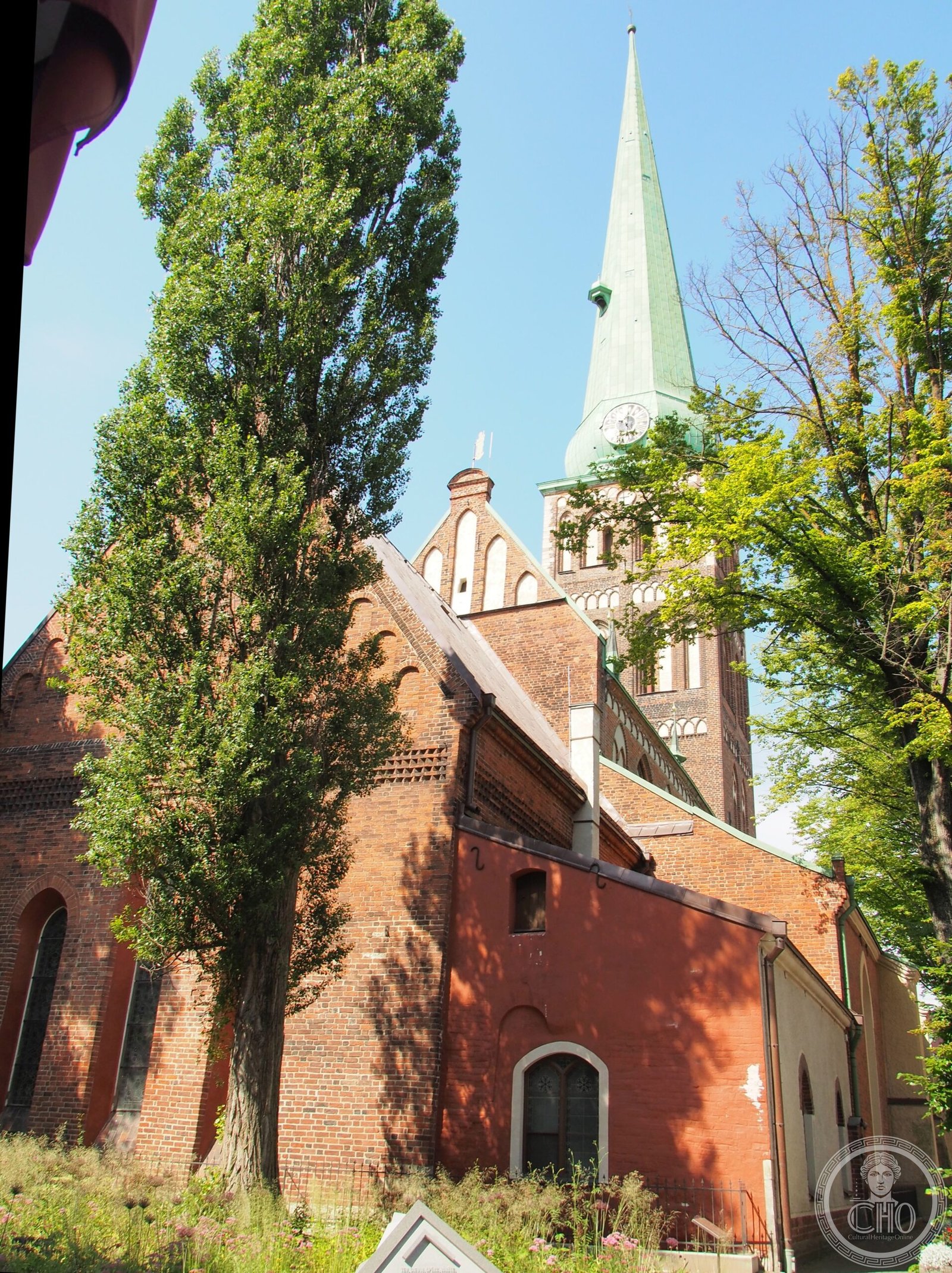
On Jēkaba iela, facing the Latvian parliament, the cathedral of St James is one of the three oldest churches in Riga. The sources differ on the exact year of foundation: Wikipedia gives 1212-1225, while the official site of the cathedral speaks of a first wooden church of 1203, burnt down in 1215. The stone church is first documented in 1225, and the main works ended around 1300. The building changed confession several times. A Catholic parish church from 1225, it became Lutheran in 1522 during the Reformation, was assigned to the Jesuits in 1582 under the Polish king Stefan Báthory as part of the Counter-Reformation, returned to the Lutherans in 1621 after the Swedish conquest of Riga, and then served as a Russian court church after the Russian occupation of 1710. In 1812 the troops of Napoleon used it as a store for flour and provisions, while the congregation moved temporarily to the nearby church of St Peter. Only in 1923, following a Latvian referendum on church property, did the building return for good to the Catholics. The first Catholic mass was celebrated there on 3 May 1924, and the official archiepiscopal entry took place the following day. The diocese of Riga, heir to the bishopric of Üxküll founded in 1186, raised to an archbishopric in 1255 and suppressed in 1561 with the Reformation, was re-established on 22 September 1918 and raised to an archdiocese on 25 October 1923, becoming a metropolitan see on 8 May 1937. Since 1923 the cathedral of St James has been its seat. Unlike the Lutheran dome church of Riga, turned by the Soviets into an organ concert hall, and the Orthodox cathedral of the Nativity, closed in the early Sixties and used as a planetarium, no closure of this cathedral under the Soviet regime is documented: the site of the cathedral claims a continuous priestly presence from 1945 to 1993, with the parish formally re-established in 1947, although this continuity has not been found in an independent source. The present archbishop is Zbigņevs Stankevičs, appointed in 2010 and installed in this cathedral on 21 August of that year. Pope John Paul II visited it on 8 September 1993, according to the site of the cathedral, during his Baltic journey centred on the mass at the shrine of Aglona before more than three hundred thousand pilgrims. Pope Francis came here on 24 September 2018, an event confirmed by the official Vatican transcript of his address.
About the Cathedral
St. James’s Cathedral, facing the Latvian parliament on Jēkaba iela, is one of Riga’s three oldest churches, first documented around 1225. It is the seat of the Archdiocese of Riga, a status it has held continuously since 1923.
Key facts
- 1225 (first documented): stone church recorded, one of Riga’s oldest churches.
- 1522: becomes Lutheran during the Reformation.
- 1582: handed to the Jesuits under Polish king Stefan Báthory; reverts to Lutheran control in 1621.
- 1812: used by Napoleon’s troops as a flour and supply storehouse.
- 1923: returned permanently to the Catholic Church following a Latvian church-property referendum; first Catholic Mass 3 May 1924.
- 8 September 1993 / 24 September 2018: visited by Pope John Paul II and Pope Francis respectively.
History
Among Riga’s three oldest churches, St. James’s changed religious hands repeatedly across four centuries — Catholic, then Lutheran from the 1522 Reformation, briefly Jesuit-run under Polish Counter-Reformation rule, Lutheran again after Sweden’s conquest, and even a wartime flour depot for Napoleon’s army in 1812 — before a 1923 referendum settled its status permanently as a Catholic cathedral. Unlike Riga’s Lutheran Dom Cathedral, converted into a Soviet concert hall, or its Orthodox cathedral, turned into a planetarium, no closure of St. James’s under Soviet rule is documented, and two popes, John Paul II and Francis, have each visited since Latvia regained independence.
What you see
A red-brick Gothic church, converted from a hall church to a basilica in the 15th century, rises to a single slender tower topped with a tall green copper needle spire added around 1596 after lightning damage, with a decorative brick-sculpted gable console unique among Latvia’s medieval architecture.
Practical information
- Opening hours: generally open daily outside services; check current hours before visiting.
- Address: Jēkaba iela 9, Vecrīga (Old Town), Riga, Latvia.
Getting there
The cathedral stands on Jēkaba iela in Riga’s Old Town, directly opposite the Saeima (Latvian Parliament) building. GPS: 56°57′03″N, 24°06′17″E.
Nearby
- Saeima (Latvian Parliament) — directly across the street from the cathedral.
Sources
- Wikipedia — “St. James’s Cathedral, Riga,” “Roman Catholic Archdiocese of Riga”
- jekabakatedrale.lv (official cathedral site) — construction, denominational, and Soviet-era history.
- medievalheritage.eu — architectural and construction detail.
- GCatholic.org — Archdiocese of Riga records.
- Vatican.va — transcript of Pope Francis’s 24 September 2018 visit to St. James’s Cathedral.
Find it on the map
See this place and what’s around it →📷 Become a Cultural Heritage Online photographer
Share your photos of places: they stay published under your name as the author. The more they're seen, the more you get noticed — and soon a contest will reward the most appreciated photos.
Log in or sign up free to add a photo