
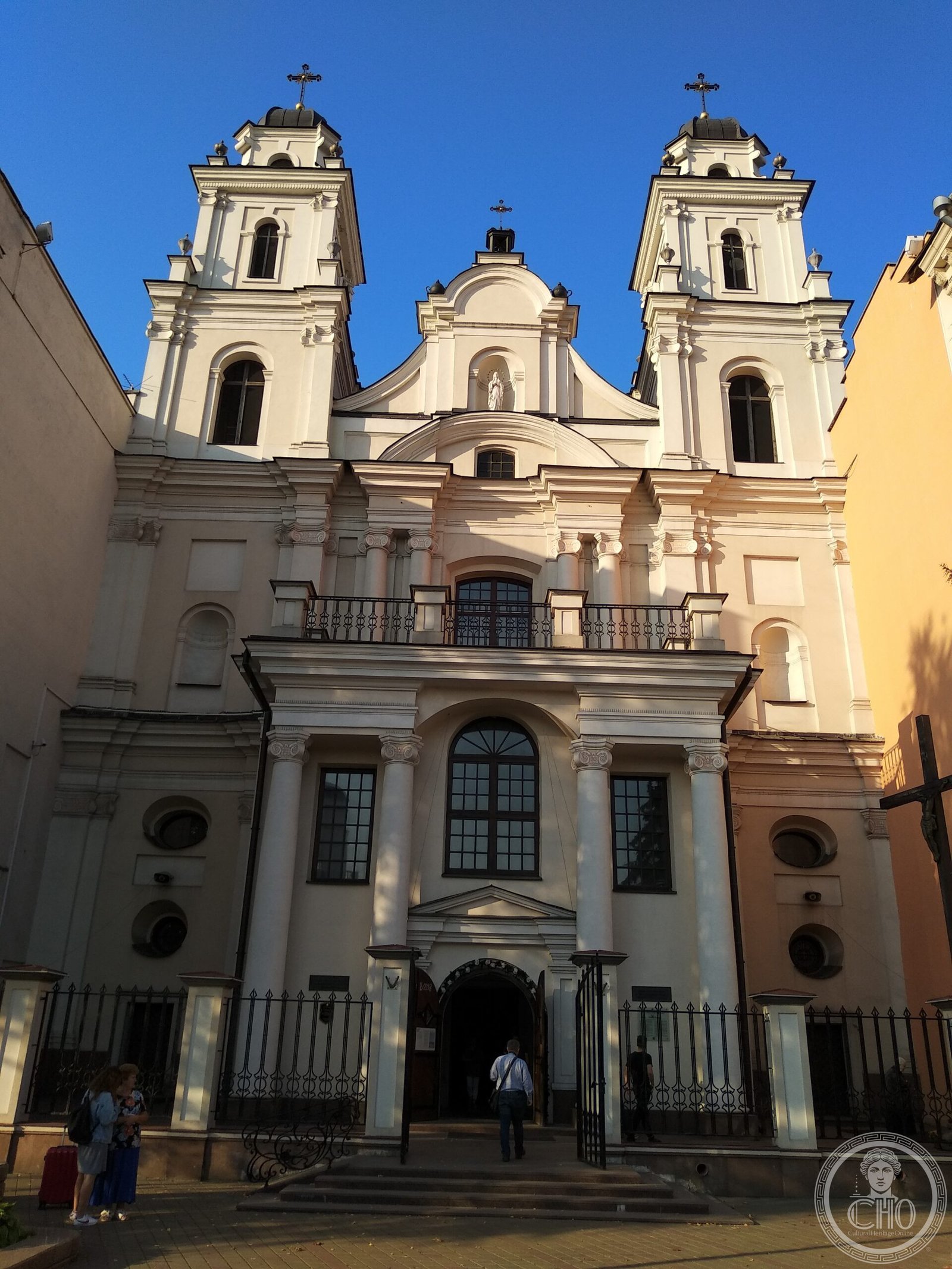
On Freedom Square, in the upper town of Minsk, the Cathedral of the Holy Name of the Blessed Virgin Mary is the main seat of the archdiocese of Minsk-Mohilev. It is not the co-cathedral, which stands at Mohilev, a different city. It was built between 1700 and 1710 as the church of the Jesuit college of Minsk, in the Vilnius Baroque style, with three naves. The two Baroque bell towers were finished in 1732 and fitted with four bells. When the Jesuit order was suppressed in 1773 the building became a parish church, and with the erection of the diocese of Minsk on 9 August 1798 it took the rank of cathedral, dedicated to the Holy Name of Mary. A fire damaged it in 1797, and it was rebuilt afterwards. The diocese was suppressed in 1869, a direct consequence of the Russian repression that followed the Polish-Lithuanian rising of 1863, and it stood effectively vacant from 1925 to 1991 under Soviet rule. The cathedral was closed in 1934, reopened briefly during the German occupation in the Second World War, and closed again after it. In 1951 the two Baroque towers were dismantled and the front was covered with an addition in Stalinist style. The building was handed to the «Spartak» sports society and used as a gym for boxing, weightlifting and gymnastics, with the frescoes painted over, until 1993, when it was returned to the Catholic Church. A restoration of the front, the interior and the eighteenth-century frescoes came before the official reconsecration in October 1997, under the then archbishop Tadeusz Kondrusiewicz. The archdiocese of Minsk-Mohilev was re-established as a metropolitan see on 13 April 1991. The present archbishop is Iosif Staneŭski, in office since 14 September 2021. He succeeded Kondrusiewicz, who in August 2020 was refused re-entry to Belarus after criticising the state’s repression of the post-election protests, a ban lifted only after Vatican diplomatic intervention around Christmas that year. Catholics are about ten per cent of the Belarusian population nationally, in a country with an Orthodox majority of around seventy-three per cent. Neither John Paul II nor Francis ever visited Belarus, although John Paul II repeatedly said he wished to.
About the Cathedral
The Cathedral of the Holy Name of the Blessed Virgin Mary, on Freedom Square in Minsk’s Upper Town, is the seat of the Archdiocese of Minsk-Mohilev. Built 1700–1710 as a Jesuit college church, it became a cathedral in 1798 following the Diocese of Minsk’s erection.
Key facts
- 1700–1710: built as the Jesuit college church of Minsk, Vilnian Baroque style.
- 9 August 1798: Diocese of Minsk erected; the building becomes a cathedral.
- 1951: Soviet authorities demolish the cathedral’s Baroque bell towers and hand the building to the “Spartak” sports society as a boxing and gymnastics hall.
- 1993: returned to the Catholic Church after decades of Soviet secular use.
- October 1997: formally reconsecrated by Archbishop Tadeusz Kondrusiewicz.
- Catholics number roughly 10% of Belarus’s population, in a country about 73% Orthodox.
History
Built as a Jesuit church in the early 1700s, the cathedral survived the Jesuit order’s 1773 suppression and the diocese’s own 1869 abolition under Russian imperial crackdowns following the 1863 uprising, only to be closed outright under Soviet rule in 1934. Its most striking transformation came in 1951, when Soviet authorities tore down its Baroque bell towers and converted the building into a boxing and gymnastics hall for the “Spartak” sports society — a use that lasted over four decades until the cathedral was returned to the Catholic Church in 1993 and formally reconsecrated in 1997.
What you see
A twin-tower Baroque facade, rebuilt after the Soviet-era demolition of its original towers, rises around a central niche holding a statue of the Virgin Mary, above an entrance gate and steps in Minsk’s historic Upper Town.
Practical information
- Opening hours: generally open daily outside services; check current hours before visiting.
- Address: Freedom Square 9, Minsk, Belarus.
Getting there
The cathedral stands on Freedom Square in Minsk’s historic Upper Town, near the city hall. GPS: 53°54′11″N, 27°33′16″E.
Nearby
- Cathedral of the Holy Spirit — Minsk’s Orthodox cathedral, standing on the same Freedom Square roughly 200 meters away.
Sources
- Wikipedia — “Cathedral of the Holy Name of Saint Virgin Mary,” “Roman Catholic Archdiocese of Minsk–Mohilev,” “Religion in Belarus”
- GCatholic.org and Catholic-Hierarchy.org — Archdiocese of Minsk-Mohilev records.
- Vatican.va — Pope John Paul II’s 1998 address to Belarusian pilgrims expressing hope to visit.
- Vatican News, RFE/RL, America Magazine, Crux — coverage of Archbishop Kondrusiewicz’s 2020 entry ban.
- planetabelarus.by and other Belarusian heritage sources — Soviet-era Spartak sports-hall history.
Find it on the map
See this place and what’s around it →📷 Become a Cultural Heritage Online photographer
Share your photos of places: they stay published under your name as the author. The more they're seen, the more you get noticed — and soon a contest will reward the most appreciated photos.
Log in or sign up free to add a photo