
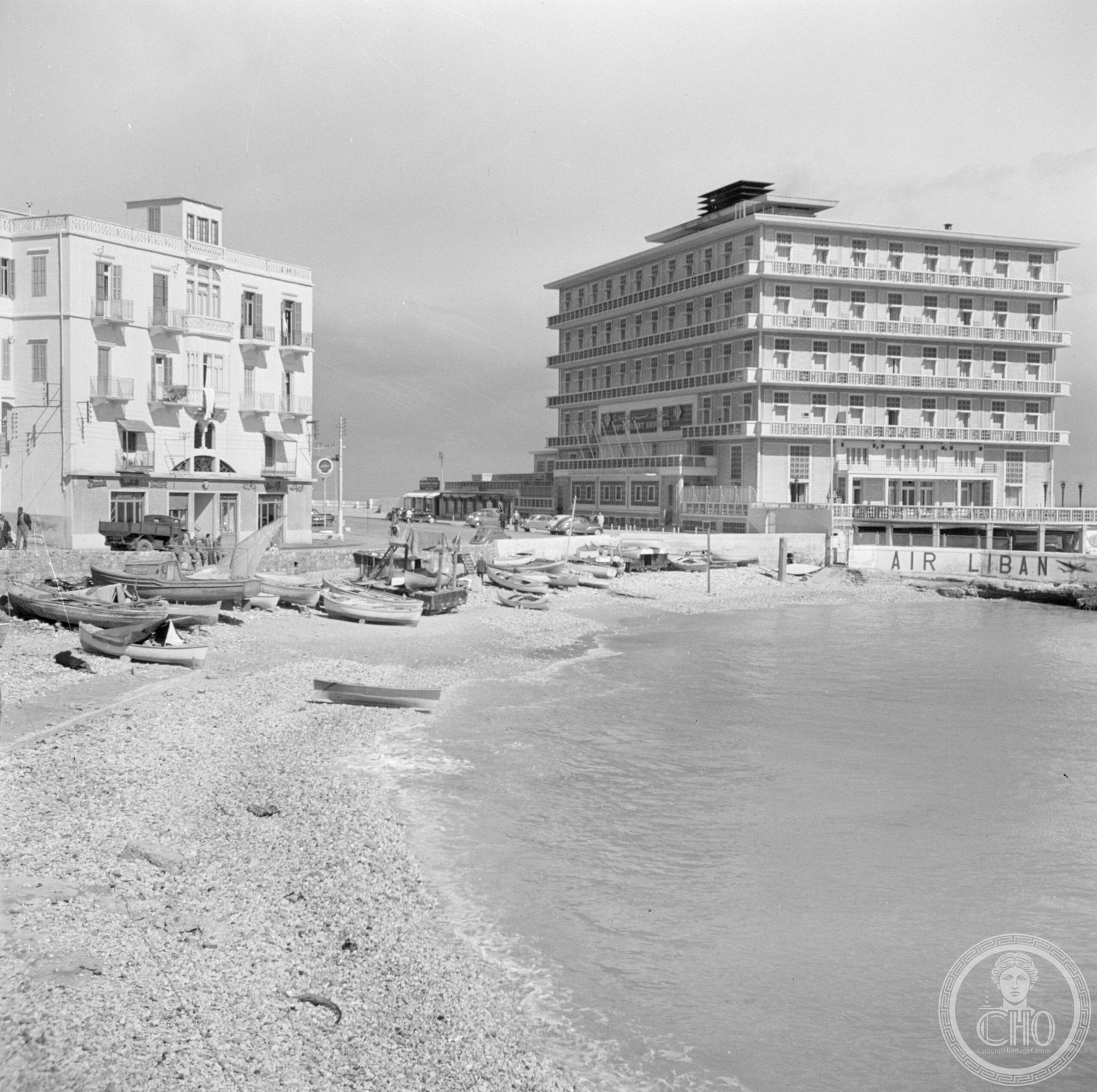
The St. Georges Hotel in Beirut is one of the most storied buildings in the Middle East — a place where glamour, espionage, and tragedy converged over six decades. Opened in 1934 on Saint George Bay, the Art Deco facade faced one of the Mediterranean’s most beautiful natural harbors. During Lebanon’s golden age in the 1950s and 1960s, the hotel was the nerve center of the Arab world’s most cosmopolitan city: intelligence officers, diplomats, journalists, and spies crossed paths in its bar and pool terrace. Kim Philby, the British double agent, reportedly drank here the night before he defected to Moscow in 1963. Graham Greene visited regularly. The Civil War of 1975–1990 forced the hotel’s closure and left it scarred. After a brief reopening, it was devastated again on 14 February 2005 when the car bomb that assassinated Prime Minister Rafik Hariri exploded meters away. Today the St. Georges stands as a ruin-shell on the Beirut waterfront, frozen at the center of a protracted legal battle over reconstruction rights — an involuntary monument to modern Lebanese history.
At a glance
- Type
- Luxury hotel
- Period
- 1930s
- Style
- Art Deco
- Location
- Minet el-Hosn, Beirut, Lebanon
- Coordinates
- 33.9023° N, 35.4946° E
- Architect(s)
- Antoine Tabet
Overview
Situated on the edge of Saint George Bay in central Beirut, the St. Georges Hotel was the most celebrated address in the Middle East for three decades. Its Art Deco architecture — curving balconies, horizontal banding, and a waterfront pool terrace — made it synonymous with Lebanese sophistication. The hotel was founded in 1934 by a French investment group, the Société Des Grands Hôtels, and quickly became a gathering point for the international elite who shaped post-war Lebanon. Diplomats negotiated here, journalists filed dispatches from its lobby, and wealthy travelers from Europe and America chose the St. Georges over any other hotel in Beirut. Its history mirrors Lebanon itself: brilliance interrupted by violence, and an unresolved question about what comes next.
History
The St. Georges opened in 1934 and rose to international fame in the 1950s, when Beirut served as the intelligence capital of the Middle East. CIA, KGB, MI6, and Mossad officers all operated from the same few square kilometers — and the St. Georges bar was where they sometimes shared a drink. Kim Philby, the Cambridge Spy who had risen to head MI6’s anti-Soviet operations, was based in Beirut as a journalist when his cover was blown in 1963. He disappeared before arrest; it is widely reported that the St. Georges was among his last stops in the city. The Lebanese Civil War (1975–1990) damaged the building and forced permanent closure. After extensive reconstruction, the hotel partially reopened in the early 2000s. The Hariri assassination of February 2005 — a massive truck bomb detonating within meters on the Corniche — shattered the rebuilt structure. The hotel has not reopened since, and a prolonged legal dispute with an adjacent development project has kept reconstruction frozen.
Architecture & Design
Designed by Antoine Tabet, one of the key figures of early modernist architecture in Lebanon, the St. Georges embodies the restrained elegance of Mediterranean Art Deco. The building rises seven stories above the bay, with a horizontal emphasis reinforced by continuous balcony bands, flush window surrounds, and clean stucco surfaces. The curved waterfront profile maximizes sea views from every room. The lobby featured high-quality marble finishes and Art Deco ornamental details typical of the period’s international hotel architecture. The rooftop pool terrace, cantilevered above the water, became an iconic image of Beirut’s modernist moment — reproduced in countless photographs of Lebanon’s pre-war golden age. The building’s structural skeleton survived the Hariri blast but the interior was gutted.
Cultural significance
The St. Georges Hotel is one of the most symbolically loaded buildings in the Arab world. It encapsulates Lebanon’s unique position as a crossroads of East and West, glamour and danger, cosmopolitanism and conflict. Its appearance in the memoirs of spies, novelists, and diplomats has made it a recurring reference point in writing about the Cold War Middle East. The building’s ruined state is itself a monument: a visible scar from the assassination that triggered the Cedar Revolution and reshaped Lebanese politics. Heritage organizations and architects have repeatedly proposed reconstruction plans; none have advanced due to the ongoing dispute with the adjacent Solidere development. The St. Georges remains a site of contested memory and contested rights.
Visiting today
The St. Georges Hotel is not open to the public. The building stands on the Minet el-Hosn waterfront, accessible by walking the Corniche promenade. The exterior can be viewed and photographed from the street. Beirut’s downtown area has seen varying levels of access depending on the political situation. Visitors to Beirut seeking Art Deco and early modernist architecture should also note the nearby Banque du Liban building and other 1930s commercial structures in the city center.
Getting there
The St. Georges stands on the Corniche waterfront in central Beirut’s Minet el-Hosn district, immediately north of downtown Solidere. It is walkable from Martyrs’ Square and the downtown core. Taxis and ride-share services are available throughout central Beirut. The hotel is roughly 30 minutes by road from Beirut Rafic Hariri International Airport under normal traffic conditions. Street parking is available along the Corniche.
Sources & resources
Find it on the map
See this place and what’s around it →Record researched and written by Luigi De Marchi for Cultural Heritage Online, 2026.
📷 Become a Cultural Heritage Online photographer
Share your photos of places: they stay published under your name as the author. The more they're seen, the more you get noticed — and soon a contest will reward the most appreciated photos.
Log in or sign up free to add a photoIs this page about you?
This page is read by travellers and heritage enthusiasts who find it on Google. Tell us how you are connected to this place and we will take it from there.