
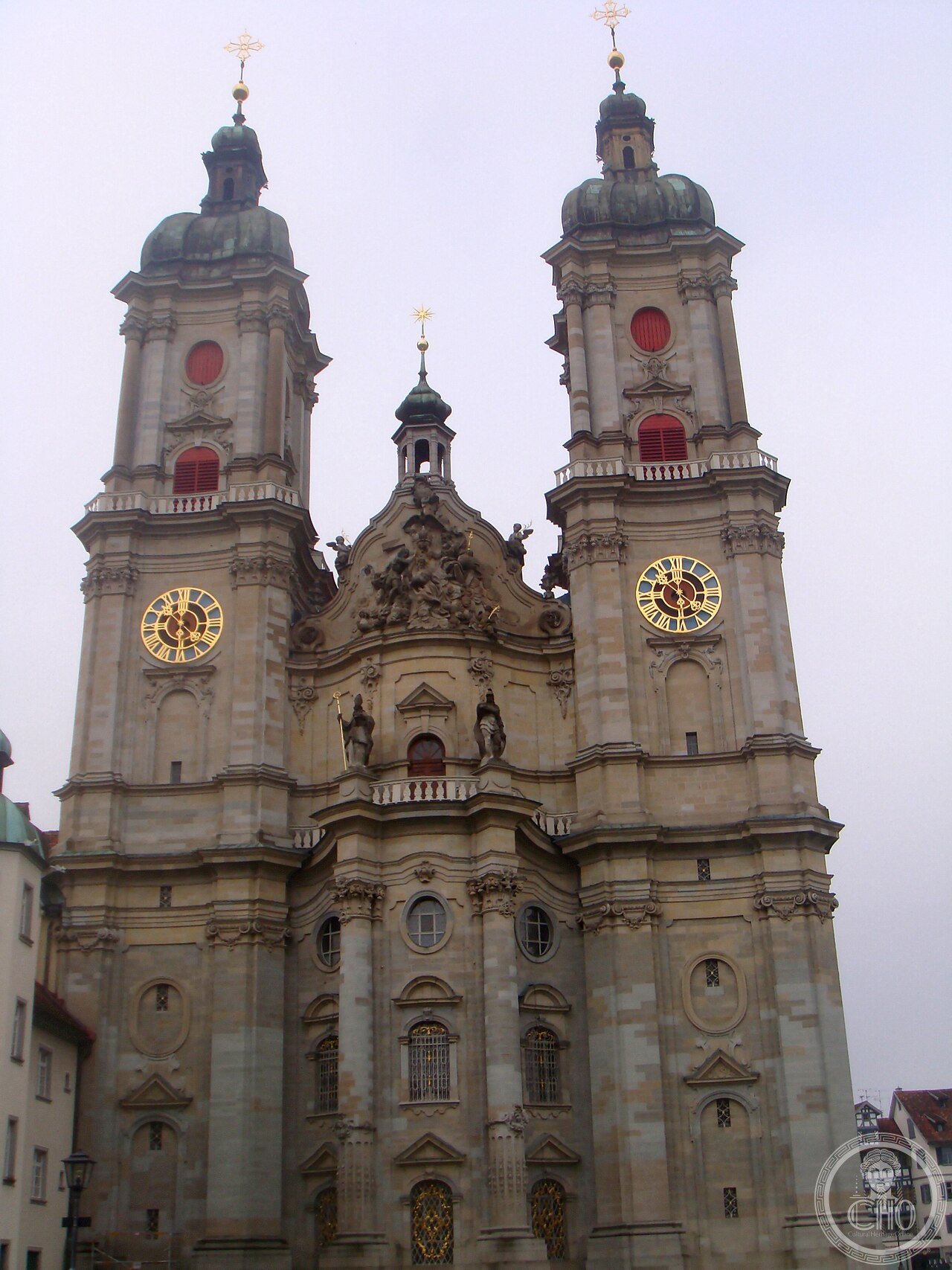
Around 612 Gall — by tradition an Irish monk, disciple and companion of Saint Columbanus — withdrew into a hermitage on this site. The Carolingian monastery that rose after his death became one of the principal Benedictine abbeys of Europe; in 1983 the whole complex was recognised by UNESCO as a “perfect example of a great Carolingian monastery”.
About St. Gallen Cathedral
St. Gallen Cathedral traces its origins to around 612, when Gallus — according to tradition an Irish monk, disciple and companion of Saint Columbanus — established a hermitage on the site. The Carolingian-era monastery proper dates from 719, founded by Saint Othmar on the spot where Gallus had built his hermitage. Over the following centuries, the Abbey of St. Gall became an independent principality between the 9th and 13th centuries, and for many centuries ranked among the chief Benedictine abbeys anywhere in Europe. The abbey was secularised around 1800, and in 1848 its former abbey church became St. Gallen Cathedral, seat of the newly created Diocese of St. Gallen. The present late Baroque cathedral structure, designed by architect Peter Thumb, was built between 1755 and 1768, its twin towers — each 68 metres tall — completed in 1761 under the direction of Johann Michael Beer, adorned with pilasters shifting from Ionic at the base through Corinthian in the middle to Composite at the top. The abbey’s library, one of the oldest monastic libraries in the world, holds precious manuscripts including the earliest known architectural plan drawn on parchment, and today comprises around 170,000 books within what is considered Switzerland’s most beautiful non-ecclesiastical Baroque hall. Since 1983, the entire abbey precinct has been a UNESCO World Heritage Site, inscribed as “a perfect example of a great Carolingian monastery.”
Key facts
- Hermitage: c. 612, by Gallus, an Irish monk and companion of Saint Columbanus
- Carolingian monastery: founded 719, by Saint Othmar, on the site of Gallus’s hermitage
- Historical status: independent principality 9th-13th centuries; one of Europe’s chief Benedictine abbeys for centuries
- Secularisation: c. 1800; former abbey church became St. Gallen Cathedral in 1848, seat of the new Diocese of St. Gallen
- Present Baroque structure: designed by Peter Thumb, built 1755-1768; twin 68-metre towers completed 1761 by Johann Michael Beer
- Abbey Library: one of the oldest monastic libraries in the world, c. 170,000 books, including the earliest known architectural plan on parchment
- UNESCO status: World Heritage Site since 1983, “a perfect example of a great Carolingian monastery”
History
Gallus’s Irish origins and his documented connection to Saint Columbanus situate St. Gallen’s founding hermitage within the broader wave of Irish monastic missionary activity across early medieval Continental Europe, a movement that also produced comparable Irish-founded institutions like Vienna’s own Schottenstift, though separated from it by several centuries and a considerably more direct, unbroken institutional lineage traceable back to Gallus’s own 7th-century presence. The abbey’s subsequent development into an independent princely territory between the 9th and 13th centuries reflects the substantial temporal power major Central European monastic institutions could accumulate during the high medieval period, functioning as genuine autonomous political entities rather than purely religious communities subordinate to secular rulers.
The abbey library’s status as one of the world’s oldest and richest monastic libraries, including its uniquely significant earliest surviving architectural plan on parchment — the so-called Plan of Saint Gall, a theoretical blueprint for an ideal Carolingian monastery — gives the institution genuinely foundational significance for the study of medieval architecture and monastic planning, independent of the library’s already substantial manuscript holdings more broadly. The 1983 UNESCO inscription’s specific framing of the complex as “a perfect example of a great Carolingian monastery” reflects international recognition of St. Gallen’s unusually well-preserved combination of surviving Carolingian-era planning principles with its later Baroque architectural transformation, the two layers together telling a remarkably complete story of European monastic development across more than a millennium.
What you see
The Abbey Library, with its Baroque hall considered Switzerland’s most beautiful non-ecclesiastical Baroque interior, is the complex’s essential single destination, its 170,000 volumes including the celebrated Plan of Saint Gall rewarding dedicated attention. The cathedral’s twin 68-metre towers, their pilaster orders shifting from Ionic through Corinthian to Composite, anchor the late Baroque east facade designed by Peter Thumb. The wider abbey precinct, recognised by UNESCO as an exemplary Carolingian monastic complex, extends the site’s significance across the entire historic district surrounding the cathedral and library.
Practical information
- Opening hours: generally open daily, check current hours before visiting; separate admission fee for the Abbey Library
- Address: Klosterhof 6D, 9000 St. Gallen, Switzerland
Getting there
St. Gallen has direct rail connections from Zurich (approximately 1 hour) and Bregenz, Austria (approximately 30 minutes). By car, St. Gallen sits on the A1 motorway network in eastern Switzerland. The cathedral and abbey precinct stand at the heart of the old town. GPS: 47.4231° N, 9.3767° E.
Nearby
- St. Gallen old town — surrounding the abbey precinct, with distinctive oriel windows on its historic buildings
- Lake Constance (Bodensee) — a short distance away, shared by Switzerland, Germany, and Austria
- Appenzell — a traditional rural canton within easy reach, known for its distinctive culture
Sources
- Wikipedia — “Abbey of Saint Gall” and “St. Gallen Cathedral” (en.wikipedia.org)
- UNESCO World Heritage Centre — “Abbey of St Gall” (whc.unesco.org)
- Stiftsbezirk St. Gallen — official portal (stiftsbezirk.ch)
Find it on the map
See this place and what’s around it →📷 Become a Cultural Heritage Online photographer
Share your photos of places: they stay published under your name as the author. The more they're seen, the more you get noticed — and soon a contest will reward the most appreciated photos.
Log in or sign up free to add a photo