

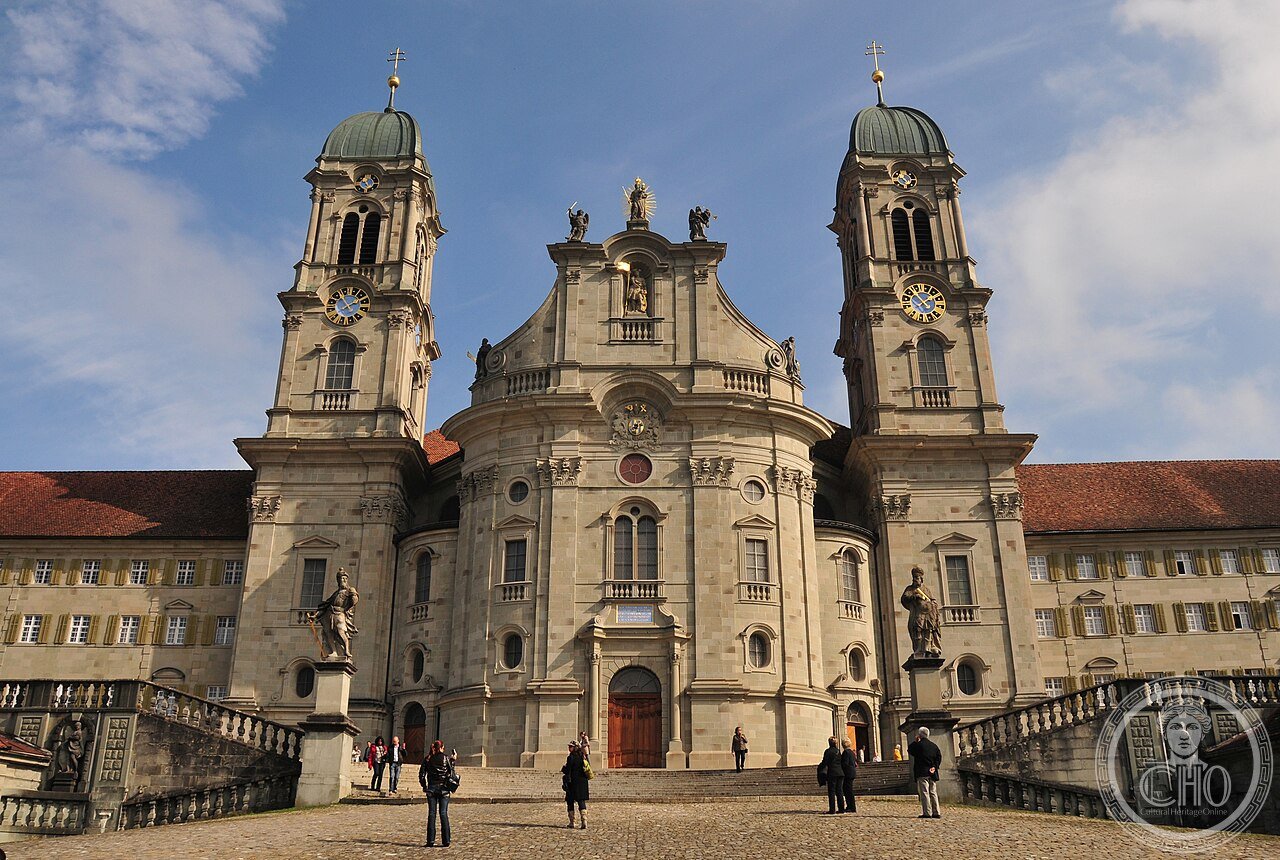
The hermit Meinrad withdrew into the forest of Einsiedeln around 835, taking with him a black statue of the Virgin received from Abbess Hildegard of Zurich. Killed by two brigands in January 861, his hermitage became an abbey in 934; by legend it was Jesus Christ himself, in person, who consecrated the new church in 948, in honour of his mother.
About Einsiedeln Abbey
Einsiedeln Abbey traces its origins to Saint Meinrad, who had studied at the abbey school on the island of Reichenau before becoming a monk and priest, and who established a hermitage in the Einsiedeln forest around 835 after reportedly performing miracles that drew public attention. According to tradition, Meinrad carried with him a black statue of the Virgin Mary, given to him by Abbess Hildegard of Fraumünster Abbey in Zurich, said to be capable of miraculous phenomena. Meinrad was murdered by two robbers in January 861. In 934, Eberhard, formerly Provost of Strasbourg, built the abbey and church on the hermitage site and became its first abbot. Tradition holds that the church was consecrated in 948 in person by Jesus Christ himself, in honour of his mother Mary — the legendary “Angelic Consecration” still commemorated at the abbey today. The Black Madonna now venerated in the Chapel of Grace is a late Gothic image from the mid-15th century, which replaced the original Romanesque miraculous statue destroyed in a fire in 1465. The shrine draws around 800,000 pilgrims and visitors annually, historically attracting devotees from southern Germany, Alsace, Switzerland, and northern Italy, making Einsiedeln the largest pilgrimage site in Switzerland.
Key facts
- Hermitage: established c. 835, by Saint Meinrad, in the Einsiedeln forest
- Meinrad’s death: murdered by two robbers, January 861
- Abbey foundation: 934, by Eberhard, former Provost of Strasbourg, as first abbot
- Legendary consecration: 948, according to tradition performed in person by Christ himself (“Angelic Consecration”)
- Black Madonna: present statue, late Gothic, mid-15th century, replacing a Romanesque original destroyed by fire in 1465
- Pilgrimage scale: around 800,000 pilgrims and visitors annually; the largest pilgrimage site in Switzerland
History
Meinrad’s specific connection to Reichenau Abbey’s monastic school situates Einsiedeln’s founding hermit within one of early medieval Europe’s most significant centres of monastic learning, giving his subsequent hermitage a documented institutional pedigree rather than an entirely isolated spiritual retreat. The Black Madonna’s origin story — a gift from Abbess Hildegard of Zurich’s Fraumünster, carried by Meinrad into the forest — connects Einsiedeln’s founding devotional object to another significant contemporary religious institution, situating the shrine’s earliest history within a network of documented 9th-century Central European monastic relationships rather than purely local legend.
The legendary “Angelic Consecration” of 948, in which tradition holds Christ himself personally consecrated the church, represents one of medieval Christendom’s more theologically striking foundation legends, and its continued liturgical commemoration at Einsiedeln today gives the abbey a devotional tradition considerably more elaborate than a standard saint’s-relic pilgrimage narrative. The 1465 fire that destroyed the original Romanesque miraculous statue, followed by its replacement with the mid-15th-century Gothic Black Madonna now venerated, illustrates how even a shrine’s most central devotional object could be lost and replaced across the centuries without diminishing the underlying pilgrimage tradition — the replacement statue itself now carrying centuries of its own accumulated veneration.
What you see
The Chapel of Grace, housing the Black Madonna at the heart of the abbey church, is Einsiedeln’s essential single destination, drawing the vast majority of the shrine’s 800,000 annual visitors specifically to venerate the statue. The abbey’s Baroque architecture, considerably later than the original 934 foundation, gives the complex its present monumental appearance. The abbey’s continuing active Benedictine community and its associated school extend Einsiedeln’s institutional life well beyond its pilgrimage function alone.
Practical information
- Opening hours: generally open daily, check current hours before visiting; free admission to the church and Chapel of Grace
- Address: Klosterplatz 1, 8840 Einsiedeln, Switzerland
Getting there
Einsiedeln has direct rail connections from Zurich (approximately 1 hour). By car, Einsiedeln sits on the road network in the canton of Schwyz, central Switzerland. GPS: 47.1268° N, 8.7523° E.
Nearby
- Lake Zurich (Zürichsee) — within reach of Einsiedeln, a major recreational lake
- Sattel and the Mythen mountains — hiking terrain in the surrounding canton of Schwyz
- Zurich — approximately 1 hour by train; Switzerland’s largest city
Sources
- Wikipedia — “Einsiedeln Abbey” (en.wikipedia.org)
- Sacred Sites — “Einsiedeln” (sacredsites.com)
- The Catholic Travel Guide — “Einsiedeln, Switzerland: Shrine of Our Lady of Einsiedeln” (thecatholictravelguide.com)
Find it on the map
See this place and what’s around it →📷 Become a Cultural Heritage Online photographer
Share your photos of places: they stay published under your name as the author. The more they're seen, the more you get noticed — and soon a contest will reward the most appreciated photos.
Log in or sign up free to add a photo