
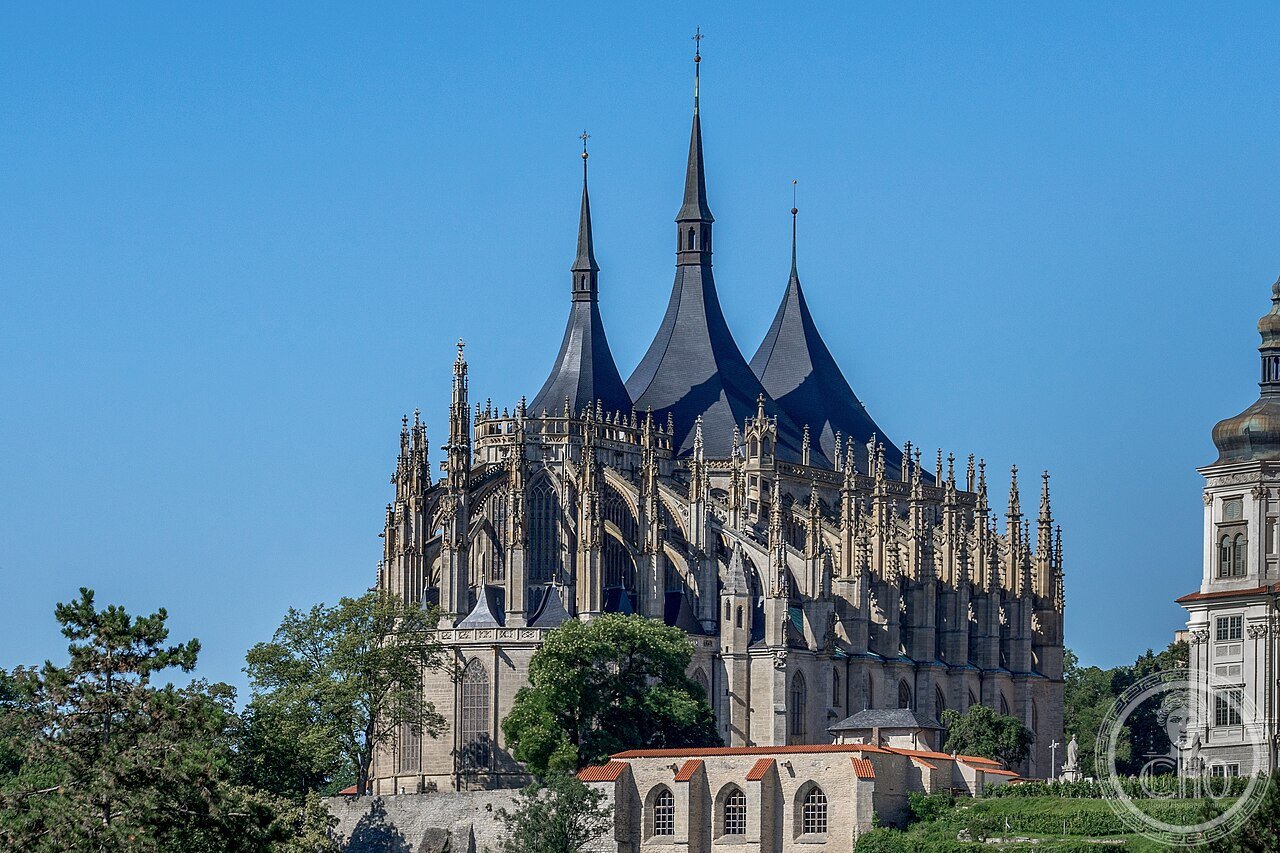
In 1388 the miners and citizens of Kutná Hora, enriched by the local silver mines and eager to free themselves from the nearby monastery of Sedlec, began building a church dedicated to Saint Barbara, patroness of miners, outside the town walls. The work, interrupted for more than sixty years by the Hussite wars and slowed by the decline of the mines, was finished only in 1905: more than five centuries after the first stone was laid.
About St Barbara’s Church
Construction of St Barbara’s Church began in 1388, commissioned by the miners and townspeople of Kutná Hora, whose wealth derived entirely from the town’s silver mines and who sought both a fitting expression of their prosperity and a deliberate assertion of independence from the nearby Sedlec Monastery, on whose land Kutná Hora had originally been built — for this reason, they chose a site outside the city walls, on land belonging instead to the Prague Chapter. The church was dedicated to Saint Barbara, patron saint of miners, a fitting choice for a town whose entire economy rested on mining. The first architect was likely Johann Parler, son of the celebrated Peter Parler, architect of Prague’s own St Vitus Cathedral. Construction was interrupted for more than sixty years during the Hussite Wars, and work resumed only in 1481 under the architects Matěj Rejsek and Benedikt Rejt. The original design had envisioned a building potentially twice the size of what survives today, but declining productivity from the silver mines forced a scaling-back of ambitions; by 1588, the church’s distinctive three-peaked, tent-like roof had been completed, along with a provisional closing wall, leaving the building in an unfinished but usable state for centuries. Work resumed once more only in the late 19th century, and the church was finally and fully completed in 1905, under the architects Josef Mocker and Ludvík Labler — a construction history spanning 517 years from its first stone to its last. Inside, medieval frescoes, remarkably, depict not only religious themes but scenes from the secular life of the medieval mining town itself, a rare instance of a Gothic church directly illustrating the working lives of the community that built it. The church has been a UNESCO World Heritage Site since 1995.
Key facts
- 1388: construction begins, commissioned by Kutná Hora’s silver-mining community
- First architect: likely Johann Parler, son of Peter Parler of Prague’s St Vitus Cathedral
- Hussite Wars: construction halted for over 60 years
- 1481: work resumes under architects Matěj Rejsek and Benedikt Rejt
- 1588: distinctive three-peaked tent-like roof completed; building left provisionally closed
- 1905: church finally completed under architects Josef Mocker and Ludvík Labler
- Frescoes: uniquely depict secular scenes of medieval mining life alongside religious themes
- 1995: inscribed as a UNESCO World Heritage Site
History
The 517-year span between St Barbara’s 1388 groundbreaking and its 1905 completion makes it one of the longest individual church construction projects documented anywhere in Europe, its progress repeatedly shaped by forces entirely external to the building itself — the Hussite Wars’ six-decade interruption, the later decline of the very silver mines whose wealth had funded the original ambitious design, and finally a 19th-century revival of interest in completing medieval Gothic monuments to their original conception. The miners’ deliberate choice to build outside Kutná Hora’s walls, on land independent of the Sedlec Monastery that had founded the town, reflects a genuinely assertive act of civic and economic self-definition by a mining community whose silver wealth had made it, for a time, nearly as significant as Prague itself.
The frescoes’ unusual inclusion of secular mining scenes alongside conventional religious imagery gives St Barbara’s a rare documentary function within Gothic ecclesiastical art, effectively embedding a visual record of the town’s actual working economy into the same sacred space dedicated to the miners’ own patron saint — a direct, self-referential connection between a community’s labour and its devotional life rarely made so explicit in medieval church decoration.
What you see
The church’s distinctive three-peaked, tent-like roof, completed in 1588, remains its most recognisable exterior feature, supported by flying buttresses around the choir and surrounded by eight radial chapels with trapezoidal interiors. Inside, the surviving medieval frescoes depict both religious subjects and scenes of secular mining life, offering visitors a rare glimpse of the town’s working history within its most significant religious building. The interior also preserves a Gothic spiral staircase among its architectural features.
Practical information
- Opening hours: generally open daily with seasonal variation; check current hours before visiting; admission fee applies
- Address: Pod Barborou, Žižkov, 284 01 Kutná Hora, Czech Republic
Getting there
St Barbara’s Church is reachable by train or car from Prague (approximately 1 hour) in the Central Bohemian Region. GPS: 49.9449° N, 15.2636° E.
Nearby
- Sedlec Ossuary — the bone church, within the same town
- Historic Centre of Kutná Hora — the surrounding UNESCO World Heritage medieval town
- Italian Court — the former royal mint, nearby in the town centre
Sources
- Wikipedia — “St. Barbara’s Church, Kutná Hora” (en.wikipedia.org)
- Kutná Hora official tourism — “St. Barbara’s Church” (kutnahora.net)
- The World Is A Book — “St. Barbara Cathedral Kutna Hora: A Miner’s Church” (theworldisabook.com)
Find it on the map
See this place and what’s around it →📷 Become a Cultural Heritage Online photographer
Share your photos of places: they stay published under your name as the author. The more they're seen, the more you get noticed — and soon a contest will reward the most appreciated photos.
Log in or sign up free to add a photo